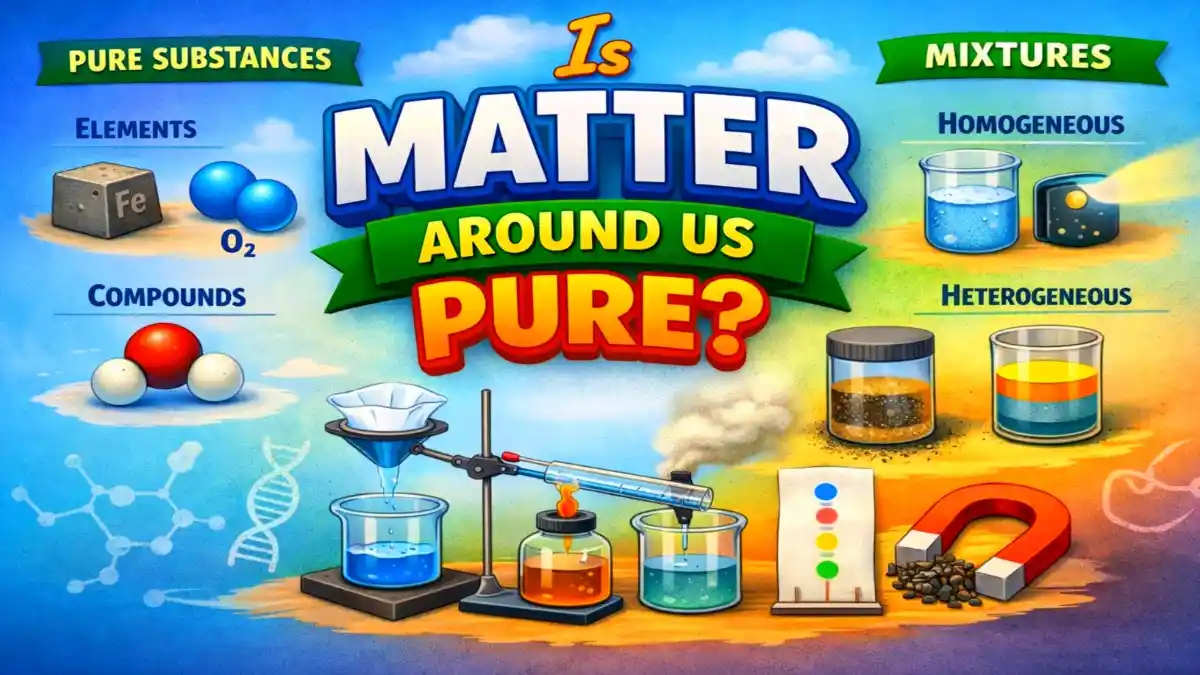
Is Matter Around Us Pure? – Class 9 Notes: In our daily life, we use many substances like water, milk, air, salt, and sugar. But are all these substances pure? To know the answer of this question you must read this article till the last. we have tried our best to understand.
In science, purity does not mean “clean” — it means whether a substance is made of only one kind of particle or not.
For example:
- Distilled water = Pure substance
- Milk = Mixture (not pure)
What is a Pure Substance?
A pure substance is made up of only one type of particles and has a fixed composition in their composition.
Types of Pure Substances:
There are mainly two types of pure substances. They are followings.
- Elements
- Compounds
Elements
An element is a substance that cannot be broken down into simpler substances by chemical methods. We can also defined as an element is made of only one types of atoms.
Examples:
- Iron (Fe)
- Oxygen (O₂)
- Gold (Au)
Types of Elements:
There are three types of elements and they are followings:
- Metals → Iron, Copper (conduct electricity)
- Non-metals → Oxygen, Nitrogen (non-conductors)
- Metalloids → Silicon (properties of both)
Compounds
A compound is formed when two or more elements combine chemically in a fixed ratio. They have different properties from the elements they are made of.
Examples:
- Water (H₂O)
- Carbon dioxide (CO₂)
Properties:
- Always have a fixed composition
- Properties are different from the elements forming them
Example:
Hydrogen + Oxygen → Water
(But water properties are different from both gases)
What is a Mixture?
A mixture is a combination of two or more substances that are not chemically combined.
Examples:
- Air
- Salt + Water
- Sand + Iron filings
Properties:
- No fixed composition
- Components can be separated by physical methods
Types of Mixtures
1. Homogeneous Mixture
- Uniform composition
- Cannot see different components
Examples:
- Salt solution
- Air
2. Heterogeneous Mixture
- Non-uniform composition
- Components can be seen separately
Examples:
- Oil and water
- Sand in water
What is a Solution?
A solution is a homogeneous mixture of two or more substances.
Components:
- Solute → Substance dissolved (e.g., salt)
- Solvent → Substance that dissolves (e.g., water)
Example: Salt + Water = Solution
Properties of a Solution:
- Homogeneous in nature
- Particles are very small (cannot be seen)
- Do not scatter light
- Cannot be separated by filtration
Types of Solutions
- True Solution
- Completely dissolved
- Example: Sugar in water
- Suspension
- Particles are visible and settle down
- Example: Muddy water
- Colloid
- Intermediate between solution and suspension
- Example: Milk
Tyndall Effect
The scattering of light by particles in a colloid is called the Tyndall Effect.
Example:
- Sunlight passing through fog
Separation of Mixtures
Different mixtures can be separated using different methods:
Common Methods:
- Filtration → Separate solids from liquids
- Evaporation → Obtain solute from solution
- Distillation → Separate liquids with different boiling points
- Magnetic Separation → Separate magnetic materials
- Chromatography → Separate colors/pigments
Example:
- Separating salt from water → Evaporation
Physical and Chemical Changes
1. Physical Change
- No new substance formed
- Reversible
Example: Ice melting
2. Chemical Change
- New substance formed
- Irreversible
Example: Burning of paper
Difference Between Mixture and Compound
| Mixture | Compound |
|---|---|
| No fixed ratio | Fixed ratio |
| Physical combination | Chemical combination |
| Properties retained | New properties formed |
| Can be separated physically | Need chemical methods |
Key Points to Remember
✔ Pure substances = Elements + Compounds
✔ Mixtures can be homogeneous or heterogeneous
✔ Solutions are homogeneous mixtures
✔ Colloids show Tyndall effect
✔ Separation methods depend on properties of substances
Is Matter Around Us Pure? – Class 9 Notes: Conclusion
The chapter “Is Matter Around Us Pure?” helps us understand the difference between pure substances and mixtures. It also explains how substances can be classified and separated. This knowledge is very useful in daily life as well as in scientific experiments. You all are requested to continue read this website for more chapters.
FAQ:
What is a pure substance? / शुद्ध पदार्थ क्या होता है?
A pure substance is made of only one type of particles and has a fixed composition.
एक शुद्ध पदार्थ केवल एक प्रकार के कणों से बना होता है और इसकी संरचना निश्चित होती है।
What is the difference between mixture and compound? / मिश्रण और यौगिक में क्या अंतर है?
A mixture is a physical combination with no fixed ratio, while a compound is a chemical combination in a fixed ratio.
मिश्रण एक भौतिक संयोजन होता है जिसका अनुपात निश्चित नहीं होता, जबकि यौगिक रासायनिक संयोजन होता है जिसका अनुपात निश्चित होता है।
What are homogeneous and heterogeneous mixtures? / समांगी और विषमांगी मिश्रण क्या होते हैं?
Homogeneous mixtures have uniform composition, while heterogeneous mixtures have non-uniform composition.
समांगी मिश्रण में संरचना समान होती है, जबकि विषमांगी मिश्रण में असमान होती है।
What is a solution? / विलयन क्या होता है?
A solution is a homogeneous mixture of solute and solvent.
विलयन एक समांगी मिश्रण होता है जिसमें विलेय और विलायक होते हैं।
What is the Tyndall effect? / टिंडल प्रभाव क्या है?
The scattering of light by colloidal particles is called the Tyndall effect.
कोलॉइडल कणों द्वारा प्रकाश का प्रकीर्णन टिंडल प्रभाव कहलाता है।
How can mixtures be separated? / मिश्रण को कैसे अलग किया जा सकता है?
Mixtures can be separated using methods like filtration, evaporation, and distillation.
मिश्रण को निस्पंदन, वाष्पीकरण और आसवन जैसी विधियों से अलग किया जा सकता है।
What are the types of solutions? / विलयन के प्रकार क्या हैं?
There are three types: true solution, suspension, and colloid.
तीन प्रकार होते हैं: वास्तविक विलयन, निलंबन और कोलॉइड।
2 thoughts on “Is Matter Around Us Pure? – Class 9 Notes”