
If you are looking for easy-to-understand Class 12 Chemistry notes on Concentration of Solution, this guide is the perfect resource for you. Concentration of Solution is one of the most important topics in the Solutions chapter and is frequently asked in CBSE board exams, competitive exams, and numerical-based questions. Understanding the different methods of expressing concentration is essential for solving chemistry problems accurately.
In this article, you will learn all the major types of concentration, including Mass Percentage, Volume Percentage, Mass by Volume Percentage, Parts Per Million (PPM), Mole Fraction, Molarity, Molality, and Normality. Each concept is explained with simple formulas, easy examples, and step-by-step calculations to help you build a strong foundation. Whether you are preparing for your board exams or revising before a test, these notes will make learning quicker, easier, and more effective.

Download NCERT BOOK PDF.
What is the Concentration of a Solution?
The concentration of a solution refers to the amount of solute present in a given quantity of solvent or solution. It helps measure how “strong” or “diluted” a solution is.
For example:
- A highly concentrated solution contains more solute and less solvent.
- A dilute solution has more solvent and less solute.
Understanding concentration is crucial in:
- Laboratory experiments
- Industrial chemical processes
- Daily activities like preparing a sugar solution
Types of Concentration of Solution
Let’s understand the common types of solution concentrations with formulas and examples.
Mass Percentage (w/w)
The percentage of the mass of solute in the total mass of the solution.
Formula:

Example:
If 10 g of salt is dissolved in 90 g of water, the mass percentage is:

Read More: Notes of solution for chemistry 12th chapter two
Volume Percentage (v/v)
Definition: The volume of solute per 100 mL of solution.
Formula:

Example:
Mixing 25 mL of alcohol with 75 mL of water gives:

Mass by Volume Percentage (w/v)
Definition: The mass of solute in grams per 100 mL of solution.
Formula:

Example:
Dissolving 5 g of sugar in 100 mL of water gives:

Read Also: Ncert Solutions Chemistry12 Chapter 1: Free Pdf Download
Molarity (M)
Definition: The number of moles of solute dissolved in one liter of solution.
Formula:

Example:
If 0.5 moles of NaCl are dissolved in 2 L of water:
M=0.52=0.25 M
Molality (m)
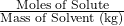
Definition: The number of moles of solute per kilogram of solvent.
Formula:

Example:
If 1 mole of glucose is dissolved in 0.5 kg of water:
m=10.5=2 m
Normality (N)
Definition: The number of gram equivalents of solute per liter of solution.
Formula:

Mole Fraction (X)
Definition: The ratio of the moles of one component to the total moles in the solution.
Formula:

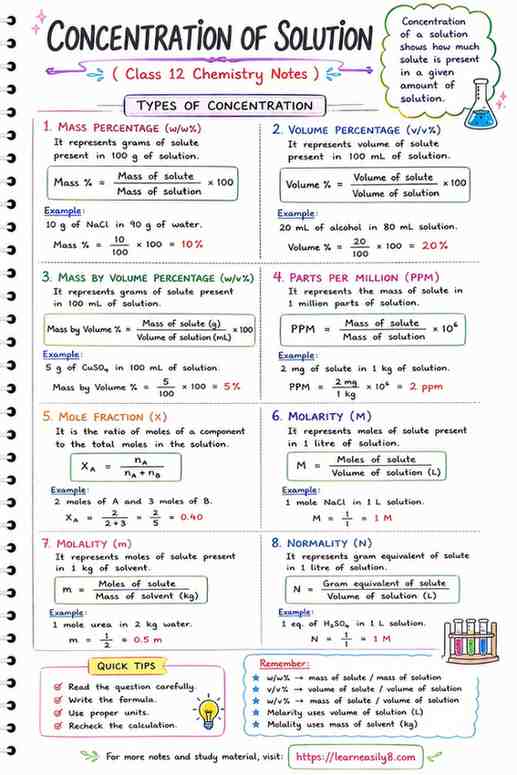
Key Formulas for Concentration of Solution
Below is a table summarizing the key formulas:





Concentration of Solution: 10 Long Numerical Questions with Solution
Numerical 1: Mass Percentage (w/w %)
Question:
A solution is prepared by dissolving 25 g of NaCl in 175 g of water. Calculate the mass percentage (w/w) of NaCl.
Given:
- Mass of solute = 25 g
- Mass of solvent = 175 g
Mass of solution
= 25 + 175
= 200 g
Formula:
Mass % = (Mass of solute / Mass of solution) × 100
Solution:
Mass %
= (25/200) × 100
= 12.5%
Answer:
Mass percentage of NaCl = 12.5%
Numerical 2: Volume Percentage (v/v %)
Question:
40 mL ethanol is mixed with water to prepare 250 mL solution. Calculate volume percentage.
Given:
- Volume of solute = 40 mL
- Volume of solution = 250 mL
Formula:
Volume % = (Volume of solute / Volume of solution) × 100
Solution:
= (40/250) ×100
= 16%
Answer:
Volume percentage = 16%
Numerical 3: Mass by Volume Percentage (w/v %)
Question:
15 g glucose is dissolved in water to prepare 300 mL solution. Calculate mass by volume percentage.
Formula:
Mass by Volume % = (Mass of solute / Volume of solution) ×100
Solution:
= (15/300) ×100
= 5%
Answer:
Mass by Volume Percentage = 5%
Numerical 4: Parts Per Million (PPM)
Question:
A water sample contains 8 mg of fluoride in 2 kg water. Calculate concentration in ppm.
Given:
Mass of solution
= 2 kg
= 2,000,000 mg
Formula:
PPM = (Mass of solute / Mass of solution) ×10⁶
Solution:
PPM
= (8 / 2,000,000) ×10⁶
= 4 ppm
Answer:
Concentration = 4 ppm
Numerical 5: Mole Fraction
Question:
A solution contains 3 moles of ethanol and 12 moles of water. Calculate the mole fraction of ethanol.
Formula:
Mole Fraction = Moles of component / Total moles
Solution:
Total moles
= 3 +12
=15
Mole fraction
=3/15
= 0.20
Answer:
Mole Fraction of ethanol = 0.20
Numerical 6: Molarity
Question:
5 moles of NaOH are dissolved to prepare 2.5 L solution. Calculate molarity.
Formula:
Molarity = Moles of solute / Volume of solution (L)
Solution:
M
=5/2.5
= 2 M
Answer:
Molarity = 2 M
Numerical 7: Molality
Question:
2 moles of urea are dissolved in 1.25 kg water. Calculate molality.
Formula:
Molality = Moles of solute / Mass of solvent (kg)
Solution:
m
=2/1.25
= 1.6 m
Answer:
Molality = 1.6 mol kg⁻¹
Numerical 8: Normality
Question:
10 gram equivalent of HCl is dissolved to prepare 2 L solution. Calculate normality.
Formula:
Normality = Gram equivalent / Volume of solution (L)
Solution:
N
=10/2
= 5 N
Answer:
Normality = 5 N
Numerical 9: Molarity from Mass
Question:
9.8 g of H₂SO₄ is dissolved to prepare 500 mL solution. Calculate molarity.
(Molar mass of H₂SO₄ = 98 g mol⁻¹)
Step 1: Calculate moles
Moles
=9.8/98
=0.1 mol
Step 2: Convert volume
500 mL
=0.5 L
Formula:
Molarity = Moles / Volume
Solution:
M
=0.1/0.5
= 0.20 M
Answer:
Molarity = 0.20 M
Numerical 10: Mole Fraction from Mass
Question:
18 g glucose (Molar mass = 180 g mol⁻¹) is dissolved in 180 g water (Molar mass = 18 g mol⁻¹). Calculate the mole fraction of glucose.
Step 1: Calculate moles
Glucose
=18/180
=0.1 mol
Water
=180/18
=10 mol
Step 2: Total moles
=10 +0.1
=10.1 mol
Step 3: Formula
Mole Fraction = Moles of glucose / Total moles
Solution
=0.1/10.1
= 0.0099
≈ 0.01
Answer:
Mole Fraction of glucose = 0.01
Exam Tip
For Class 12 Board exams, always remember these important formulas:
- Mass % = (Mass of Solute ÷ Mass of Solution) × 100
- Volume % = (Volume of Solute ÷ Volume of Solution) × 100
- Mass by Volume % = (Mass of Solute ÷ Volume of Solution) × 100
- PPM = (Mass of Solute ÷ Mass of Solution) × 10⁶
- Mole Fraction = Moles of Component ÷ Total Moles
- Molarity (M) = Moles of Solute ÷ Volume of Solution (L)
- Molality (m) = Moles of Solute ÷ Mass of Solvent (kg)
- Normality (N) = Gram Equivalent of Solute ÷ Volume of Solution (L)
These numericals cover the most important question types commonly asked in CBSE Class 12 Board Exams and are excellent for practice and revision.