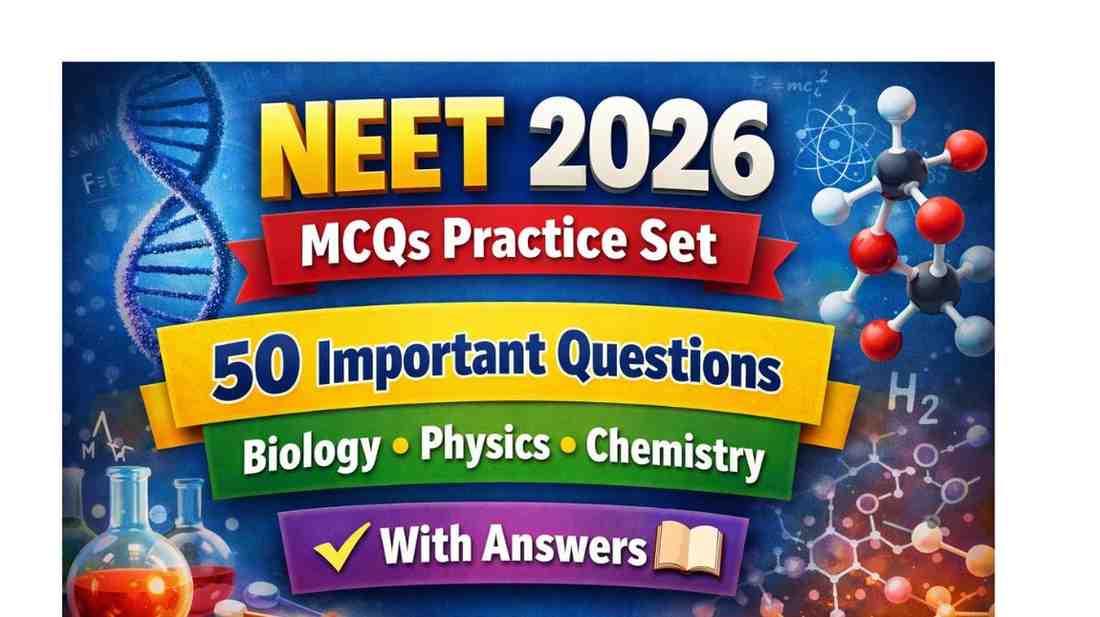
NEET 2026 MCQs: Preparing for NEET 2026 requires consistent practice and a clear understanding of concepts. One of the best ways to boost your preparation is by solving high-quality multiple-choice questions based on the latest exam pattern.
In this post, you will find 50 important MCQs covering Biology, Physics, and Chemistry, designed especially for NEET aspirants. Each question comes with four options and the correct answer to help you test your knowledge, improve accuracy, and build confidence for the exam.
Whether you are revising key concepts or practicing before the exam, this MCQ set will help you strengthen your preparation effectively.
NEET 2026 MCQs: 50 Important Questions with Answer
1. Which biomolecule is known as the “building block of proteins”?
A. Fatty acids
B. Amino acids
C. Nucleotides
D. Monosaccharides
Answer: B. Amino acids
2. Which part of the cell is responsible for energy production?
A. Nucleus
B. Mitochondria
C. Ribosome
D. Golgi apparatus
Answer: B. Mitochondria
3. The functional unit of kidney is:
A. Neuron
B. Nephron
C. Alveoli
D. Glomerulus
Answer: B. Nephron
4. DNA replication occurs during which phase of cell cycle?
A. G1 phase
B. S phase
C. G2 phase
D. M phase
Answer: B. S phase
5. Which hormone regulates blood sugar level?
A. Thyroxine
B. Insulin
C. Adrenaline
D. Estrogen
Answer: B. Insulin
6. Which vitamin is synthesized in human skin?
A. Vitamin A
B. Vitamin B
C. Vitamin C
D. Vitamin D
Answer: D. Vitamin D
7. The pH of human blood is approximately:
A. 6.5
B. 7.4
C. 8.0
D. 5.5
Answer: B. 7.4
8. Which gas is most abundant in Earth’s atmosphere?
A. Oxygen
B. Nitrogen
C. Carbon dioxide
D. Hydrogen
Answer: B. Nitrogen
9. The SI unit of force is:
A. Joule
B. Watt
C. Newton
D. Pascal
Answer: C. Newton
10. Which law explains the relationship between pressure and volume?
A. Charles’ Law
B. Boyle’s Law
C. Avogadro’s Law
D. Gay-Lussac’s Law
Answer: B. Boyle’s Law
11. The atomic number represents:
A. Neutrons
B. Electrons + Neutrons
C. Protons
D. Mass
Answer: C. Protons
12. Which organelle is called “suicide bag”?
A. Lysosome
B. Ribosome
C. Vacuole
D. Plastid
Answer: A. Lysosome
13. Which enzyme breaks down starch?
A. Pepsin
B. Amylase
C. Lipase
D. Trypsin
Answer: B. Amylase
14. Which blood group is universal donor?
A. A
B. B
C. AB
D. O
Answer: D. O
15. Which blood group is universal recipient?
A. A
B. B
C. AB
D. O
Answer: C. AB
16. Which part of brain controls balance?
A. Cerebrum
B. Cerebellum
C. Medulla
D. Hypothalamus
Answer: B. Cerebellum
17. Which structure carries genetic information?
A. Protein
B. DNA
C. Lipid
D. Carbohydrate
Answer: B. DNA
18. Which type of bond holds DNA strands together?
A. Ionic bond
B. Hydrogen bond
C. Covalent bond
D. Metallic bond
Answer: B. Hydrogen bond
19. The powerhouse of the cell is:
A. Nucleus
B. Golgi body
C. Mitochondria
D. ER
Answer: C. Mitochondria
20. Which vitamin helps in blood clotting?
A. Vitamin A
B. Vitamin B
C. Vitamin K
D. Vitamin D
Answer: C. Vitamin K
21. Which element is present in all organic compounds?
A. Oxygen
B. Carbon
C. Hydrogen
D. Nitrogen
Answer: B. Carbon
22. Which gas is used in photosynthesis?
A. Oxygen
B. Nitrogen
C. Carbon dioxide
D. Hydrogen
Answer: C. Carbon dioxide
23. Which organ filters blood in human body?
A. Liver
B. Kidney
C. Heart
D. Lung
Answer: B. Kidney
24. Which hormone is known as emergency hormone?
A. Insulin
B. Thyroxine
C. Adrenaline
D. Progesterone
Answer: C. Adrenaline
25. The unit of electric current is:
A. Volt
B. Ampere
C. Ohm
D. Watt
Answer: B. Ampere
26. Which particle has negative charge?
A. Proton
B. Neutron
C. Electron
D. Alpha particle
Answer: C. Electron
27. Which organ is involved in respiration?
A. Heart
B. Lung
C. Liver
D. Kidney
Answer: B. Lung
28. Which type of reproduction involves two parents?
A. Asexual
B. Sexual
C. Binary fission
D. Budding
Answer: B. Sexual
29. Which is the largest organ in human body?
A. Liver
B. Brain
C. Skin
D. Heart
Answer: C. Skin
30. Which part of plant conducts water?
A. Phloem
B. Xylem
C. Cortex
D. Epidermis
Answer: B. Xylem
31. Which law states F = ma?
A. First law
B. Second law
C. Third law
D. Law of gravitation
Answer: B. Second law
32. Which acid is present in stomach?
A. Sulfuric acid
B. Nitric acid
C. Hydrochloric acid
D. Acetic acid
Answer: C. Hydrochloric acid
33. Which organ produces bile?
A. Pancreas
B. Liver
C. Kidney
D. Stomach
Answer: B. Liver
34. Which metal is liquid at room temperature?
A. Iron
B. Mercury
C. Copper
D. Zinc
Answer: B. Mercury
35. Which type of cells lack nucleus?
A. WBC
B. RBC
C. Neuron
D. Muscle cell
Answer: B. RBC
36. Which part of eye controls light entry?
A. Retina
B. Cornea
C. Iris
D. Lens
Answer: C. Iris
37. Which process converts glucose into energy?
A. Photosynthesis
B. Respiration
C. Digestion
D. Transpiration
Answer: B. Respiration
38. Which enzyme digests proteins?
A. Amylase
B. Lipase
C. Pepsin
D. Maltase
Answer: C. Pepsin
39. Which is the smallest unit of life?
A. Tissue
B. Cell
C. Organ
D. Organ system
Answer: B. Cell
40. Which blood cells fight infection?
A. RBC
B. WBC
C. Platelets
D. Plasma
Answer: B. WBC
41. Which hormone controls growth?
A. Insulin
B. Growth hormone
C. Thyroxine
D. Cortisol
Answer: B. Growth hormone
42. Which structure connects muscle to bone?
A. Ligament
B. Tendon
C. Cartilage
D. Joint
Answer: B. Tendon
43. Which vitamin prevents scurvy?
A. Vitamin A
B. Vitamin B
C. Vitamin C
D. Vitamin D
Answer: C. Vitamin C
44. Which is the basic unit of heredity?
A. Cell
B. Gene
C. Chromosome
D. DNA
Answer: B. Gene
45. Which gas is released during respiration?
A. Oxygen
B. Nitrogen
C. Carbon dioxide
D. Hydrogen
Answer: C. Carbon dioxide
46. Which is the hardest natural substance?
A. Gold
B. Iron
C. Diamond
D. Quartz
Answer: C. Diamond
47. Which part of plant makes food?
A. Root
B. Stem
C. Leaf
D. Flower
Answer: C. Leaf
48. Which organ pumps blood?
A. Brain
B. Lung
C. Heart
D. Kidney
Answer: C. Heart
49. Which law states action = reaction?
A. First law
B. Second law
C. Third law
D. Boyle’s law
Answer: C. Third law
50. Which system controls body activities?
A. Digestive system
B. Respiratory system
C. Nervous system
D. Circulatory system
Answer: C. Nervous system