
Class 12 Physics में Wave Optics (तरंग प्रकाशिकी) एक महत्वपूर्ण chapter है, जिसमें प्रकाश के wave nature को समझाया गया है। इस chapter से Interference, Young’s Double Slit Experiment (YDSE), Diffraction, Polarisation, Huygens’ Principle, Fringe Width, Malus’ Law और Brewster’s Law जैसे महत्वपूर्ण topics questions और numericals में पूछे जाते हैं। इस post में आपको NCERT-based Wave Optics Class 12 Notes in Hindi सरल और आसान भाषा में मिलेंगे, ताकि difficult concepts को आसानी से समझकर exam में अच्छे marks प्राप्त किए जा सकें।
इस Notes में important derivations, formulas, step-by-step numericals, conceptual questions और 30 important MCQs with Assertion-Reason दिए गए हैं। खासतौर पर YDSE Fringe Width, Constructive और Destructive Interference, Single-Slit Diffraction तथा Polarisation को exam-oriented तरीके से समझाया गया है। यह notes CBSE और अन्य Class 12 Board Exams के students के लिए quick learning, revision और numerical practice में काफी उपयोगी होंगे। Download Physics NCERT BOOK PDF.
Wave Optics Class 12 Notes in Hindi | NCERT Physics
Wave Optics को Physical Optics भी कहा जाता है। इसमें प्रकाश (Light) के उन गुणों का अध्ययन किया जाता है जिन्हें केवल ray theory से explain नहीं किया जा सकता। जब प्रकाश की wavelength (λ) और optical system का size comparable हो, तब wave nature महत्वपूर्ण हो जाता है।
Wave Optics मुख्य रूप से प्रकाश की interference, diffraction और polarization जैसी phenomena को समझाता है। इन phenomena से यह सिद्ध होता है कि light में wave nature मौजूद है।
Wave Optics के मुख्य topics
- Wave nature of light
- Huygens’ Principle
- Wavefront
- Reflection और Refraction using wavefront
- Interference of light
- Young’s Double Slit Experiment (YDSE)
- Coherent sources
- Constructive और destructive interference
- Diffraction of light
- Single-slit diffraction
- Polarisation of light
- Malus’ Law
- Brewster’s Law
- Important numerical formulas
Wave Nature of Light
प्रकाश का wave nature सबसे स्पष्ट रूप से interference, diffraction और polarization में दिखाई देता है। यदि दो light waves एक-दूसरे से superpose करती हैं, तो कुछ स्थानों पर intensity बढ़ जाती है और कुछ स्थानों पर घट जाती है। इसे interference कहते हैं।
Diffraction में light किसी narrow slit या obstacle के किनारे से मुड़कर फैलती है। Polarization से पता चलता है कि light एक transverse wave है।
Important points
- Light electromagnetic wave है।
- Vacuum में light की speed: c = 3 × 10⁸ m/s
- Relation: c = νλ
जहाँ,
- c = speed of light
- ν = frequency
- λ = wavelength
Huygens’ Principle
Christiaan Huygens ने प्रकाश के wave propagation को explain करने के लिए Huygens’ Principle दिया।
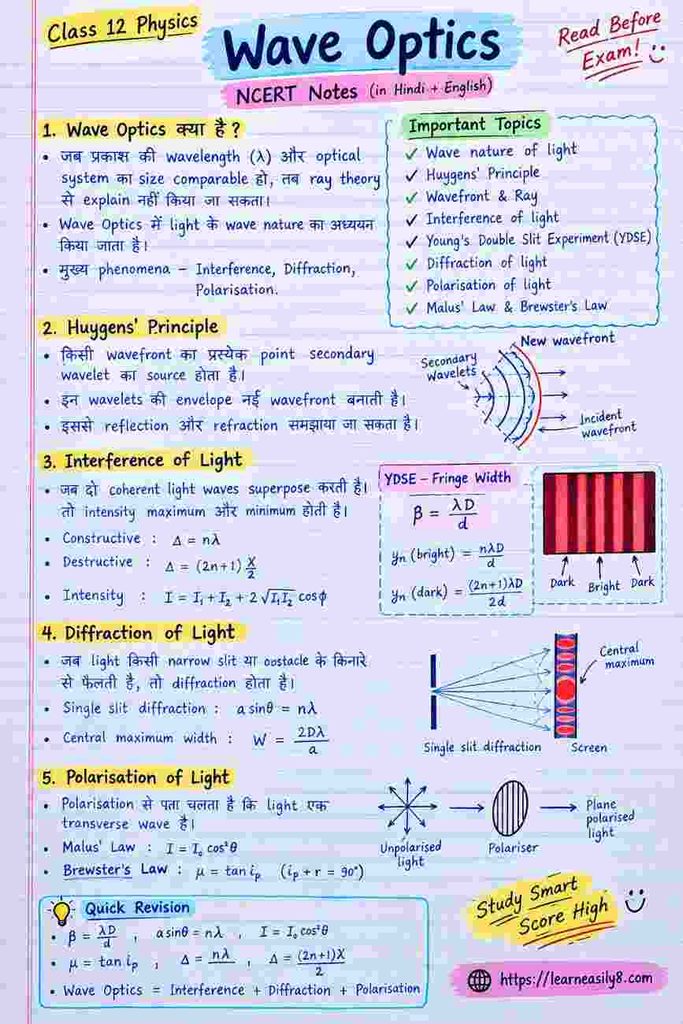
इस principle के अनुसार किसी wavefront का प्रत्येक point secondary wavelets का source होता है। ये wavelets आगे की दिशा में फैलती हैं और कुछ समय बाद इन wavelets की common tangent नई wavefront बनाती है।
Huygens’ Principle के मुख्य points
- Wavefront का प्रत्येक point secondary wavelet का source होता है।
- Secondary wavelets सभी directions में फैल सकती हैं।
- Forward direction में इन wavelets की envelope नई wavefront बनाती है।
- इससे reflection और refraction को explain किया जा सकता है।
- यह principle light के wave nature को समझने में बहुत उपयोगी है।
Wavefront क्या है?
Wavefront वह imaginary surface है जिसके सभी points पर medium के particles same phase में vibrate करते हैं।
सरल शब्दों में, एक wavefront पर उपस्थित सभी points तक wave समान अवस्था (same phase) में पहुँची होती है।
Wavefront के प्रकार
1 Spherical Wavefront
जब light किसी point source से सभी दिशाओं में फैलती है, तब spherical wavefront बनता है।
- Point source के लिए spherical wavefront बनता है।
- Wavefront की shape spherical होती है।
- Source से दूरी बढ़ने पर spherical wavefront का radius बढ़ता जाता है।
2 Cylindrical Wavefront
जब light किसी linear source से निकलती है, तो cylindrical wavefront प्राप्त हो सकता है।
- Linear source के कारण बनता है।
- Wavefront cylindrical shape का होता है।
- इसका उपयोग cylindrical waves को describe करने में किया जाता है।
3 Plane Wavefront
जब spherical wavefront का radius बहुत अधिक हो जाए, तो उसका छोटा portion लगभग plane दिखाई देता है।
- बहुत दूर स्थित source से आने वाली light लगभग plane wavefront बना सकती है।
- Plane wavefront के सभी points लगभग समान direction में propagate करते हैं।
- सूर्य से आने वाली rays को कई situations में approximately plane wavefront माना जा सकता है।
Ray और Wavefront का संबंध
Wavefront के प्रत्येक point पर खींची गई perpendicular line को ray कहते हैं। इसलिए ray हमेशा wavefront के perpendicular होती है।
Important relation
Ray ⟂ Wavefront
- Spherical wavefront में rays radial direction में होती हैं।
- Plane wavefront में rays parallel होती हैं।
- Ray light के propagation की direction बताती है।
- Wavefront light के समान phase वाले points को represent करता है।
Huygens’ Principle से Reflection
मान लें कि एक plane wavefront reflecting surface पर incident होता है। Wavefront का पहला point surface को touch करता है और secondary wavelet produce करता है। बाकी points भी क्रमशः surface तक पहुँचते हैं।
Secondary wavelets की envelope reflected wavefront बनाती है। Geometry से प्राप्त होता है:
Angle of incidence = Angle of reflection
अर्थात्,
i = r
Reflection के मुख्य points
- Incident ray, reflected ray और normal एक ही plane में होते हैं।
- Angle of incidence और reflection बराबर होते हैं।
- Huygens’ Principle wave nature से reflection को explain करता है।
- Reflection में frequency unchanged रहती है।
Huygens’ Principle से Refraction
जब light एक medium से दूसरे medium में जाती है, तो उसकी speed बदल जाती है। Frequency unchanged रहती है लेकिन wavelength बदल जाती है।
यदि पहले medium में velocity v₁ और दूसरे medium में velocity v₂ है, तो:
n₂₁ = v₁/v₂
जहाँ n₂₁ दूसरे medium का पहले medium के respect में refractive index है।
Important points
- Refraction में frequency नहीं बदलती।
- Speed बदलती है।
- Wavelength बदलती है।
- Medium में light की speed:
v = c/n
जहाँ n = refractive index।
Principle of Superposition
जब दो या अधिक waves एक ही region में simultaneously propagate करती हैं, तो resultant displacement individual displacements का algebraic sum होता है।
यदि दो waves के displacement हैं:
y₁ = a₁ sin ωt
और
y₂ = a₂ sin(ωt + φ)
तो दोनों waves के superposition से resultant wave प्राप्त होती है।
Superposition Principle के उपयोग
- Interference समझने में
- Standing waves समझने में
- Resultant amplitude निकालने में
- Light और sound waves के behaviour को समझने में
Interference of Light
जब दो coherent light waves एक-दूसरे पर superpose करती हैं, तो resultant intensity कभी maximum और कभी minimum होती है। इस phenomenon को interference of light कहते हैं।
यह phenomenon light की wave nature का महत्वपूर्ण evidence है।
Interference के मुख्य points
- Interference superposition principle पर आधारित है।
- कुछ points पर intensity maximum होती है।
- कुछ points पर intensity minimum होती है।
- Bright और dark fringes बन सकती हैं।
- Stable interference के लिए coherent sources आवश्यक हैं।
Coherent Sources
दो light sources को coherent sources कहते हैं यदि उनकी frequencies समान हों और उनके बीच phase difference constant रहे।
Coherent sources की conditions
- दोनों sources की frequency same होनी चाहिए।
- Phase difference constant होना चाहिए।
- Sources ideally same wavelength की waves produce करें।
- Stable interference pattern के लिए coherence जरूरी है।
Coherent और Incoherent Sources
Coherent sources:
- Constant phase difference
- Stable interference pattern
Incoherent sources:
- Random phase difference
- Stable interference pattern नहीं बनता
Constructive Interference
जब दो waves एक-दूसरे से इस प्रकार superpose करती हैं कि resultant amplitude maximum हो जाती है, तो इसे constructive interference कहते हैं।
इस स्थिति में bright fringe प्राप्त होती है।
Condition for constructive interference
Path difference:
Δ = nλ
जहाँ:
n = 0, 1, 2, 3, …
Phase difference:
φ = 2nπ
Maximum intensity:
Imax = (a₁ + a₂)²
यदि दोनों waves की amplitudes equal हों:
Imax = 4I₀
Read More: Electrostatics Class 12 Short Notes for JEE in Hindi | Formula, Concepts & Revision
Destructive Interference
जब दो waves इस प्रकार superpose करती हैं कि resultant amplitude minimum हो जाती है, तो इसे destructive interference कहते हैं।
इस स्थिति में dark fringe प्राप्त होती है।
Condition for destructive interference
Path difference:
Δ = (2n + 1)λ/2
Phase difference:
φ = (2n + 1)π
Minimum intensity:
Imin = (a₁ – a₂)²
यदि दोनों waves की amplitudes equal हों:
Imin = 0
Intensity in Interference
यदि दो waves की intensities I₁ और I₂ हैं और उनके बीच phase difference φ है, तो resultant intensity:
I = I₁ + I₂ + 2√(I₁I₂) cosφ
यह interference का सबसे important formula है।
यदि:
I₁ = I₂ = I₀
तो:
I = 2I₀(1 + cosφ)
या,
I = 4I₀ cos²(φ/2)
Important results
For constructive interference:
Imax = (√I₁ + √I₂)²
For destructive interference:
Imin = (√I₁ – √I₂)²
Equal intensities के लिए:
Imax/Imin = ∞
क्योंकि ideal case में Imin = 0।
Young’s Double Slit Experiment (YDSE)
Young’s Double Slit Experiment को Thomas Young ने light के interference को demonstrate करने के लिए किया था।
इस experiment में एक monochromatic light source से प्रकाश को दो narrow slits S₁ और S₂ से pass कराया जाता है। ये दोनों slits coherent sources की तरह कार्य करते हैं। Screen पर alternate bright और dark fringes दिखाई देती हैं।
YDSE arrangement
- S = monochromatic source
- S₁, S₂ = two narrow slits
- d = distance between two slits
- D = distance between slits and screen
- P = observation point
- y = central fringe से P की दूरी
Path Difference in YDSE
यदि screen पर किसी point P की central axis से दूरी y है, तो दोनों slits से आने वाली waves का path difference approximately:
Δ = d sinθ
Small angle के लिए:
sinθ ≈ tanθ ≈ y/D
इसलिए:
Δ = dy/D
यह YDSE का बहुत महत्वपूर्ण relation है।
Constructive condition
dy/D = nλ
इससे bright fringe की position:
yₙ = nλD/d
Destructive condition
dy/D = (2n + 1)λ/2
इससे dark fringe की position:
yₙ = (2n + 1)λD/2d
Fringe Width
दो consecutive bright fringes या दो consecutive dark fringes के बीच की distance को fringe width कहते हैं।
इसे β (beta) से denote करते हैं।
Formula
β = λD/d
जहाँ:
- β = fringe width
- λ = wavelength
- D = slit-screen distance
- d = slit separation
Fringe width किन factors पर depend करती है?
β ∝ λ
अर्थात wavelength बढ़ने पर fringe width बढ़ती है।
β ∝ D
Screen की distance बढ़ाने पर fringe width बढ़ती है।
β ∝ 1/d
Slit separation बढ़ाने पर fringe width घटती है।
Position of Bright Fringes
Central bright fringe को n = 0 माना जाता है।
Bright fringe के लिए:
yₙ = nλD/d
इसलिए:
- n = 0 → Central bright fringe
- n = 1 → First bright fringe
- n = 2 → Second bright fringe
- n = 3 → Third bright fringe
Important point
Bright fringes की positions:
0, ±β, ±2β, ±3β, …
होती हैं।
Position of Dark Fringes
Dark fringe के लिए:
yₙ = (2n + 1)λD/2d
जहाँ n = 0, 1, 2, …
इसलिए first dark fringe की position:
y = λD/2d
और second dark fringe:
y = 3λD/2d
Important point
Central bright fringe के दोनों ओर dark और bright fringes alternate रूप से दिखाई देती हैं।
Angular Width of Fringes
यदि fringe width को angle के रूप में express करें, तो angular fringe width:
θ = λ/d
Small angle approximation में:
β = Dθ
इसलिए:
β = Dλ/d
याद रखने योग्य बात
- Linear fringe width: β = λD/d
- Angular fringe width: θ = λ/d
Angular fringe width screen distance D पर depend नहीं करती।
Effect of Changing Wavelength
यदि wavelength बढ़ाई जाती है, तो fringe width भी बढ़ती है।
क्योंकि:
β = λD/d
इसलिए:
β ∝ λ
Example
यदि red light और blue light का interference pattern बनाया जाए, तो red light की wavelength अधिक होने के कारण red fringes अधिक widely spaced होंगे।
Red λ > Blue λ
इसलिए:
βred > βblue
Effect of Changing Slit Separation
Fringe width:
β = λD/d
से स्पष्ट है कि fringe width slit separation के inversely proportional है।
यदि d बढ़े, तो:
β घटेगा
यदि d घटे, तो:
β बढ़ेगा
Exam point
Slits को पास लाने पर fringes अधिक दूर-दूर दिखाई देंगी।
Slits को दूर करने पर fringes अधिक पास-पास दिखाई देंगी।
Effect of Medium on Interference
यदि YDSE apparatus को किसी medium में रखा जाए जिसका refractive index μ है, तो wavelength:
λ’ = λ/μ
हो जाती है।
इसलिए नई fringe width:
β’ = λ’D/d
अर्थात्:
β’ = β/μ
Important conclusion
Medium में fringe width कम हो जाती है।
यदि medium का refractive index 1 से अधिक है:
β’ < β
Intensity Distribution in YDSE
YDSE में intensity uniformly distributed नहीं होती। Bright fringes पर intensity maximum और dark fringes पर minimum होती है।
यदि दोनों slits समान intensity की waves produce करें:
I = 4I₀ cos²(φ/2)
इससे intensity का periodic variation प्राप्त होता है।
Important points
- Bright fringe → Maximum intensity
- Dark fringe → Minimum intensity
- Equal intensity sources के लिए ideal dark fringe पर intensity zero होती है।
- Fringes समान width की होती हैं।
Interference और Diffraction में अंतर
Interference और diffraction दोनों wave nature of light के परिणाम हैं, लेकिन दोनों की physical conditions अलग हैं।
Interference
- दो या अधिक coherent sources से होता है।
- Fringes generally equally spaced होती हैं।
- Ideal equal sources में bright fringes की intensity लगभग समान हो सकती है।
- Dark fringes ideal case में zero intensity दे सकती हैं।
Diffraction
- Wavefront के अलग-अलग parts के superposition से होता है।
- Single slit भी diffraction produce कर सकता है।
- Central maximum सबसे अधिक broad और intense होता है।
- Secondary maxima की intensity कम होती जाती है।
Diffraction of Light
जब light किसी narrow aperture या obstacle के किनारे से गुजरते समय geometrical shadow में फैलती और मुड़ती है, तो इस phenomenon को diffraction कहते हैं।
Diffraction तब अधिक स्पष्ट होता है जब aperture का size wavelength के comparable हो।
Important points
- Diffraction light की wave nature को demonstrate करता है।
- Narrow slit से diffraction अधिक स्पष्ट होता है।
- Slit width बढ़ाने पर diffraction कम होता है।
- Slit width wavelength के comparable होने पर effect prominent होता है।
Single Slit Diffraction
Single-slit diffraction में monochromatic light को एक narrow slit से pass कराया जाता है। Screen पर एक broad central maximum और उसके दोनों sides पर weaker secondary maxima तथा minima दिखाई देते हैं।
यदि slit width a है, तो minima की condition:
a sinθ = nλ
जहाँ:
n = ±1, ±2, ±3, …
First minimum
a sinθ = λ
Small angle के लिए:
θ ≈ λ/a
Width of Central Maximum
Single-slit diffraction pattern में central maximum सबसे important होता है।
First minima दोनों sides पर:
a sinθ = λ
Small angle approximation:
θ ≈ λ/a
इसलिए angular width of central maximum:
2θ = 2λ/a
यदि screen distance D है, तो linear width:
W = 2Dλ/a
Important conclusion
Central maximum की width:
W ∝ λ
और
W ∝ 1/a
अर्थात wavelength बढ़ाने पर central maximum broad होता है और slit width बढ़ाने पर narrow होता है।
Polarisation of Light
Polarisation वह phenomenon है जिसमें unpolarised light के vibrations को एक particular direction या plane में restrict किया जाता है।
यह सिद्ध करता है कि light एक transverse wave है।
क्यों?
Longitudinal waves को इस प्रकार polarise नहीं किया जा सकता, क्योंकि उनके vibrations propagation direction के parallel होते हैं।
Light में electric field और magnetic field propagation direction के perpendicular होते हैं। इसलिए electromagnetic light transverse nature की होती है।
Unpolarised Light
Unpolarised light में electric field vibrations propagation direction के perpendicular सभी possible directions में होते हैं।
Examples
- Sunlight
- Candle light
- Ordinary bulb light
इन sources से निकलने वाली ordinary light सामान्यतः unpolarised होती है।
Plane Polarised Light
जब light wave के electric field vibrations केवल एक निश्चित direction में होते हैं, तो उसे plane polarised light कहते हैं।
Important terms
Plane of vibration: वह plane जिसमें vibrations होते हैं।
Plane of polarisation: वह plane जो vibration direction के perpendicular होता है।
याद रखें
Plane of vibration और plane of polarisation एक-दूसरे के perpendicular होते हैं।
Polaroid
Polaroid एक ऐसा optical device/material है जो unpolarised light को plane-polarised light में convert कर सकता है।
इसमें केवल एक particular direction के electric field vibrations effectively transmit होते हैं।
Polaroid के uses
- Sunglasses
- Camera filters
- LCD screens
- Glare reduction
- Photography
- Optical instruments
- Stress analysis
Polariser और Analyzer
Polariser वह device है जो unpolarised light को plane-polarised light में बदलता है।
Analyzer यह determine करने के लिए उपयोग किया जाता है कि light polarised है या नहीं और उसके vibration direction की information प्राप्त करने में मदद करता है।
Arrangement
Unpolarised light → Polariser → Plane polarised light → Analyzer → Detector
यदि analyzer को rotate किया जाए तो transmitted intensity बदलती है।
Malus’ Law
जब plane-polarised light किसी analyzer से pass करती है और transmission axis तथा incident light के vibration direction के बीच angle θ हो, तो transmitted intensity:
I = I₀ cos²θ
इसे Malus’ Law कहते हैं।
जहाँ:
- I₀ = intensity of incident plane-polarised light
- I = transmitted intensity
- θ = angle between polariser and analyzer axes
Special cases
जब:
θ = 0°
तो:
I = I₀
जब:
θ = 90°
तो:
I = 0
इसलिए crossed polaroids ideally light को block कर देते हैं।
Brewster’s Law
जब unpolarised light किसी transparent surface पर एक particular angle पर incident होती है और reflected light completely plane polarised हो जाती है, तो उस angle को Brewster angle या polarising angle कहते हैं।
इसे iₚ से denote करते हैं।
Brewster’s Law:
μ = tan iₚ
जहाँ μ = refractive index of medium।
Important result
Brewster angle पर reflected ray और refracted ray के बीच angle:
90°
होता है।
अर्थात्:
iₚ + r = 90°
Reflection द्वारा Polarisation
जब unpolarised light किसी transparent surface पर Brewster angle से incident होती है, तो reflected light plane-polarised हो सकती है।
यह polarization का महत्वपूर्ण method है।
Important points
- Brewster angle को iₚ कहते हैं।
- Relation:
μ = tan iₚ
- Brewster angle पर:
iₚ + r = 90°
- Reflected और refracted rays mutually perpendicular होती हैं।
Polarisation का महत्व
Polarisation केवल light के transverse nature को prove नहीं करता बल्कि इसका practical importance भी बहुत अधिक है।
Applications
- Anti-glare sunglasses में
- Photography में unwanted reflections कम करने में
- 3D movies में
- LCD displays में
- Communication systems में
- Stress analysis में
- Optical instruments में
Important Formula List — Wave Optics
Basic wave relation
v = νλ
Vacuum में:
c = νλ
Refractive index
μ = c/v
Interference intensity
I = I₁ + I₂ + 2√(I₁I₂)cosφ
Maximum intensity
Imax = (√I₁ + √I₂)²
Minimum intensity
Imin = (√I₁ – √I₂)²
Constructive interference
Δ = nλ
Destructive interference
Δ = (2n + 1)λ/2
YDSE path difference
Δ = dy/D
Fringe width
β = λD/d
Bright fringe
yₙ = nλD/d
Dark fringe
yₙ = (2n + 1)λD/2d
Angular fringe width
θ = λ/d
Medium में wavelength
λ’ = λ/μ
Medium में fringe width
β’ = β/μ
Single-slit diffraction minima
a sinθ = nλ
Central maximum angular width
2λ/a
Central maximum linear width
2Dλ/a
Malus’ Law
I = I₀ cos²θ
Brewster’s Law
μ = tan iₚ
Important Definitions for Board Exam
Interference
दो coherent light waves के superposition के कारण intensity का redistribution interference कहलाता है।
Coherent Sources
ऐसे sources जिनकी frequency समान और phase difference constant हो, coherent sources कहलाते हैं।
Wavefront
समान phase में vibrating points का geometrical locus wavefront कहलाता है।
Diffraction
Light का narrow aperture या obstacle के आसपास फैलना diffraction कहलाता है।
Polarisation
Light vibrations को एक particular direction में restrict करने की process polarisation कहलाती है।
Fringe Width
दो consecutive bright या dark fringes के बीच की दूरी fringe width कहलाती है।
Brewster Angle
वह angle of incidence जिस पर reflected light completely plane polarised हो जाती है, Brewster angle कहलाता है।
Very Important Differences
Interference vs Diffraction
| Interference | Diffraction |
|---|---|
| दो या अधिक coherent sources की waves के superposition से | Same wavefront के different parts के superposition से |
| Multiple coherent sources की आवश्यकता होती है | Single slit भी पर्याप्त है |
| Fringes लगभग equally spaced होती हैं | Central maximum सबसे broad होता है |
| Equal source intensities में bright fringes समान intensity की हो सकती हैं | Secondary maxima की intensity कम होती जाती है |
| Dark fringes ideal case में zero intensity दे सकती हैं | Minima और maxima की intensity pattern अलग होती है |
Polarisation vs Interference
| Polarisation | Interference |
|---|---|
| Light के transverse nature को establish करता है | Light के wave nature को establish करता है |
| Vibrations की direction से संबंधित है | Superposition से संबंधित है |
| Polaroid का उपयोग हो सकता है | Coherent sources आवश्यक हैं |
| Malus’ Law important है | Fringe width important है |
Important Conceptual Questions
Q1. Light की wave nature को कौन-कौन से phenomena prove करते हैं?
Answer: Interference, diffraction और polarization light के wave nature को establish करने में महत्वपूर्ण हैं। Interference और diffraction wave behaviour को demonstrate करते हैं, जबकि polarization विशेष रूप से यह बताता है कि light transverse nature की है।
Q2. Interference के लिए coherent sources क्यों आवश्यक हैं?
Answer: Stable interference pattern के लिए phase difference constant होना चाहिए। यदि phase difference continuously बदलता रहे, तो bright और dark regions की positions भी बदलती रहेंगी और स्थायी fringes दिखाई नहीं देंगी।
Q3. Fringe width का formula क्या है?
Answer:
β = λD/d
यह wavelength और screen distance के directly proportional तथा slit separation के inversely proportional होती है।
Q4. YDSE में central fringe bright क्यों होती है?
Answer: Central point पर दोनों slits से आने वाली waves का path difference zero होता है। इसलिए दोनों waves same phase में पहुँचती हैं और constructive interference produce करती हैं। अतः central fringe bright होती है।
Q5. Polarisation क्या prove करता है?
Answer: Polarisation यह prove करता है कि light transverse wave है, क्योंकि केवल transverse waves के vibrations को propagation direction के perpendicular किसी particular direction में restrict किया जा सकता है।
Important Numerical Tips
Wave Optics के numericals में सबसे पहले दिए गए quantities को SI units में convert करें।
याद रखने की strategy
- Wavelength → metre
- Distance → metre
- Slit separation → metre
- Frequency → Hz
- Angle → degree या radian, जैसा question में आवश्यक हो
YDSE में
यदि पूछा गया हो:
Fringe width → β = λD/d
यदि wavelength पूछी हो:
λ = βd/D
यदि slit separation पूछी हो:
d = λD/β
यदि screen distance पूछी हो:
D = βd/λ
Formula को rearrange करके answer आसानी से निकाला जा सकता है।
One-Minute Revision — Wave Optics
Exam से पहले इन points को जरूर revise करें:
- Wavefront = Same phase points का locus
- Ray ⟂ Wavefront
- Huygens’ Principle → Every point acts as secondary wavelet source
- Interference → Superposition of coherent waves
- Constructive → Δ = nλ
- Destructive → Δ = (2n+1)λ/2
- YDSE → β = λD/d
- Bright fringe → yₙ = nλD/d
- Dark fringe → yₙ = (2n+1)λD/2d
- Medium में → λ’ = λ/μ
- Diffraction minima → a sinθ = nλ
- Central maximum width → 2Dλ/a
- Malus’ Law → I = I₀ cos²θ
- Brewster’s Law → μ = tan iₚ
- Polarisation proves transverse nature of light.
Board Exam के लिए Most Important Topics
Wave Optics chapter में निम्न topics को विशेष रूप से अच्छी तरह तैयार करें:
- Huygens’ Principle
- Wavefront और उसके types
- Huygens’ explanation of reflection
- Huygens’ explanation of refraction
- Principle of superposition
- Interference of light
- Coherent sources
- Constructive और destructive interference
- Young’s Double Slit Experiment
- Derivation of fringe width
- Effect of wavelength और slit separation
- Interference intensity formula
- Single-slit diffraction
- Width of central maximum
- Polarisation
- Malus’ Law
- Brewster’s Law
- Important numerical problems
Final Quick Revision Table
| Concept | Important Formula/Fact |
|---|---|
| Speed of light | c = νλ |
| Refractive index | μ = c/v |
| Constructive interference | Δ = nλ |
| Destructive interference | Δ = (2n+1)λ/2 |
| Interference intensity | I = I₁ + I₂ + 2√I₁I₂ cosφ |
| Maximum intensity | (√I₁ + √I₂)² |
| Minimum intensity | (√I₁ – √I₂)² |
| YDSE fringe width | β = λD/d |
| Bright fringe | yₙ = nλD/d |
| Dark fringe | yₙ = (2n+1)λD/2d |
| Angular fringe width | λ/d |
| Medium wavelength | λ/μ |
| Diffraction minima | a sinθ = nλ |
| Central maximum width | 2Dλ/a |
| Malus’ Law | I = I₀ cos²θ |
| Brewster’s Law | μ = tan iₚ |
| Brewster condition | iₚ + r = 90° |
Conclusion
Wave Optics Class 12 Physics का एक महत्वपूर्ण chapter है क्योंकि यह light के wave behaviour को समझाता है। Board और competitive examinations दोनों के लिए YDSE, fringe width, interference conditions, diffraction और polarization विशेष रूप से महत्वपूर्ण हैं। Numerical problems में units और formula selection पर विशेष ध्यान दें। सबसे पहले basic concepts समझें, फिर formulas याद करें और अंत में numerical तथा derivation की practice करें। इससे chapter को कम समय में effectively revise किया जा सकता है।