
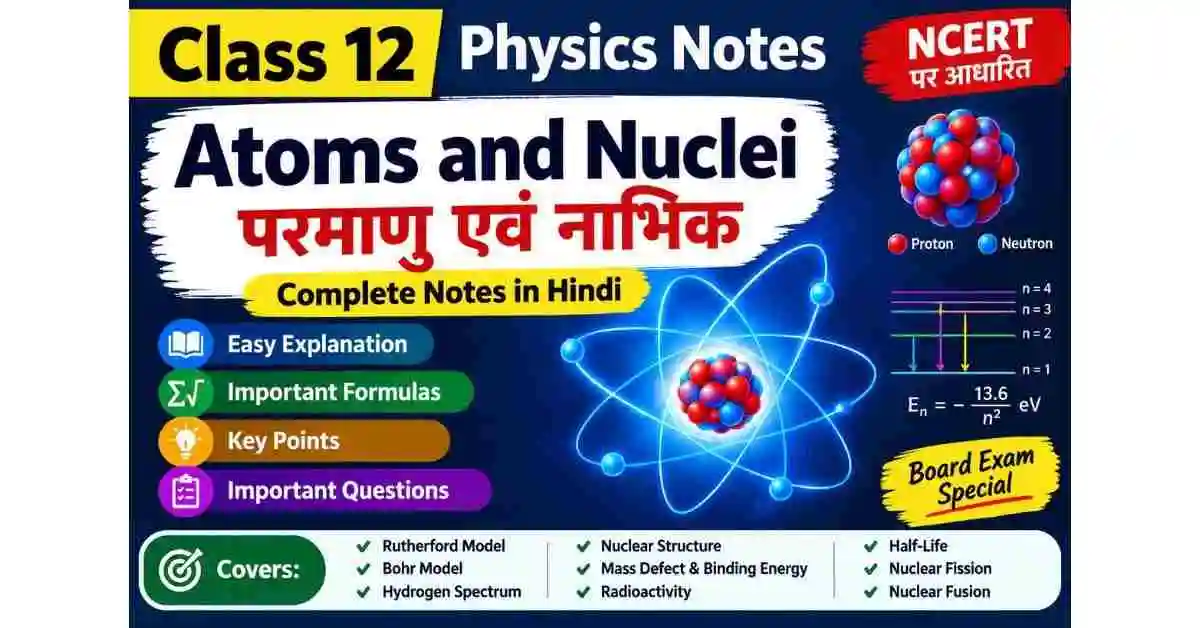
Class 12 Physics में Atoms and Nuclei (परमाणु एवं नाभिक) Modern Physics का एक महत्वपूर्ण chapter है। इस chapter में विद्यार्थियों को Rutherford Atomic Model, Bohr Model, Hydrogen Spectrum, Energy Levels, Nuclear Structure, Mass Defect, Binding Energy, Radioactivity, Nuclear Fission और Nuclear Fusion जैसे महत्वपूर्ण concepts पढ़ने को मिलते हैं। यहाँ Atoms and Nuclei Class 12 Notes in Hindi को NCERT के concepts के आधार पर सरल और आसान भाषा में समझाया गया है, ताकि students कठिन topics को आसानी से समझ और revise कर सकें।
इस Notes में important definitions, formulas, derivations, important points और exam-oriented concepts को व्यवस्थित तरीके से दिया गया है। साथ ही Bohr Model, Hydrogen Spectrum, Radioactive Decay, Half-Life, Binding Energy और Nuclear Reactions से संबंधित formulas भी शामिल किए गए हैं। यह notes CBSE और अन्य Class 12 Board Exams की तैयारी के साथ-साथ Physics के conceptual और numerical questions के revision में भी उपयोगी हो सकते हैं। Download NCERT BOOK PDF.
Atoms and Nuclei Class 12 Notes in Hindi | NCERT Physics
Subject: Physics | Class 12 | Modern Physics
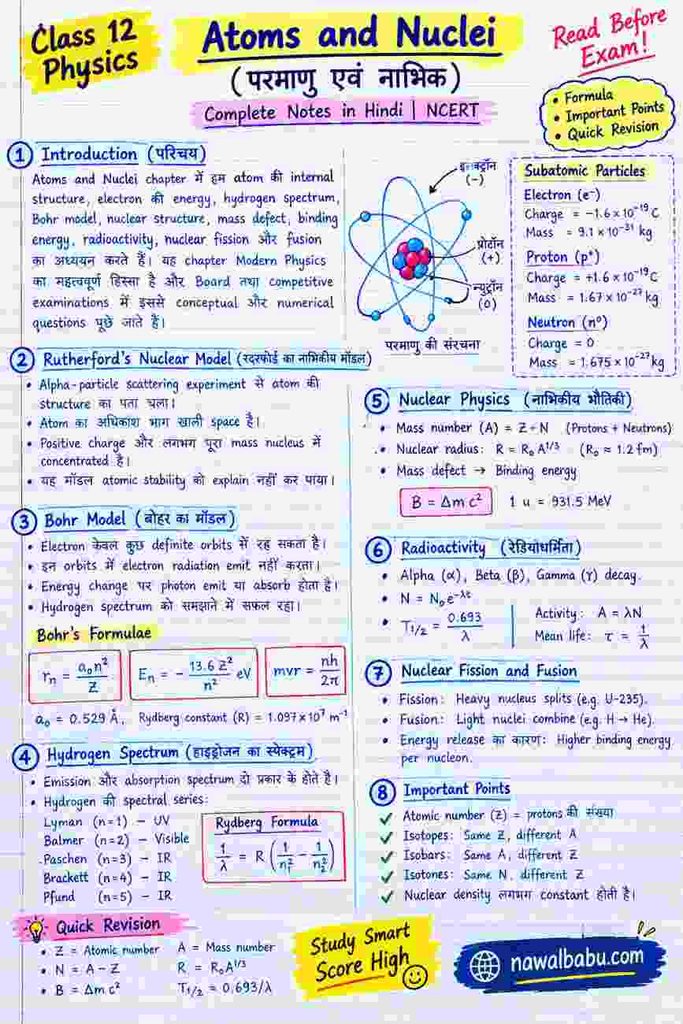
Atoms and Nuclei chapter में हम atom की internal structure, electron की energy, hydrogen spectrum, Bohr model, atomic energy levels, nucleus की composition, nuclear size, mass defect, binding energy, radioactivity, nuclear fission और fusion का अध्ययन करते हैं। यह chapter Modern Physics का महत्वपूर्ण हिस्सा है और Board तथा competitive examinations में इससे conceptual और numerical questions पूछे जाते हैं। इस chapter को समझने के लिए Energy, Momentum, Electromagnetic Radiation और Quantisation की basic concepts को ध्यान में रखना उपयोगी है।
Atomic Structure – परमाणु की संरचना
Atom किसी element की वह smallest electrically neutral unit है जो उस element के chemical properties को बनाए रखती है। Atom मुख्यतः तीन particles से बना होता है—electron, proton और neutron। Electron negatively charged होता है और nucleus के बाहर पाया जाता है, जबकि proton और neutron nucleus में स्थित होते हैं। Proton का charge positive तथा neutron electrically neutral होता है। Atom का लगभग पूरा mass nucleus में concentrated होता है, जबकि atom का अधिकांश volume खाली space होता है।
Electron – इलेक्ट्रॉन
Electron का charge −e और mass लगभग 9.1 × 10⁻³¹ kg होता है। यह atom के nucleus के बाहर उपस्थित होता है। Electron की discovery J. J. Thomson ने cathode ray experiment के द्वारा की थी। Atomic structure को समझने में electron की भूमिका बहुत महत्वपूर्ण है क्योंकि chemical reactions और atomic spectra मुख्यतः electrons की energy states से संबंधित होते हैं। Electron का charge magnitude लगभग 1.6 × 10⁻¹⁹ C होता है।
Proton – प्रोटॉन
Proton positively charged particle है जिसका charge magnitude electron के charge के बराबर होता है लेकिन sign opposite होता है। इसका charge +1.6 × 10⁻¹⁹ C तथा mass लगभग 1.67 × 10⁻²⁷ kg है। Proton nucleus के अंदर उपस्थित रहता है। किसी atom में protons की संख्या को atomic number (Z) कहते हैं। किसी element की chemical identity atomic number द्वारा निर्धारित होती है।
Neutron – न्यूट्रॉन
Neutron एक electrically neutral particle है। इसका electric charge zero होता है और इसका mass लगभग 1.675 × 10⁻²⁷ kg है। Neutron nucleus के अंदर proton के साथ उपस्थित होता है। किसी nucleus में proton और neutron की total संख्या को mass number (A) कहते हैं। इसलिए यदि nucleus में Z protons और N neutrons हैं, तो:
A = Z + N
जहाँ
Z = Number of protons
N = Number of neutrons
A = Mass number
Thomson’s Model of Atom – थॉमसन का परमाणु मॉडल
J. J. Thomson ने atom का एक model प्रस्तावित किया जिसे अक्सर plum-pudding model कहा जाता है। इसके अनुसार atom एक uniformly positively charged sphere की तरह था और electrons उसके अंदर embedded थे। इस model में positive charge और negative charge पूरे atom में distributed माने गए। Model atom की electrical neutrality को explain करता था, लेकिन बाद में Rutherford scattering experiment के results को explain नहीं कर सका। इसलिए Thomson model को atomic structure की complete explanation नहीं माना गया।
Rutherford’s Nuclear Model – रदरफोर्ड का नाभिकीय मॉडल
Rutherford ने alpha-particle scattering experiment द्वारा atom की structure के बारे में महत्वपूर्ण जानकारी प्राप्त की। उन्होंने thin gold foil पर alpha particles bombard किए। अधिकांश particles बिना deviation के निकल गए, कुछ particles थोड़े angle से deflect हुए और बहुत कम particles वापस लौटे। इससे निष्कर्ष निकला कि atom का अधिकांश भाग empty space है और positive charge तथा लगभग पूरा mass एक बहुत छोटे central region में concentrated है। इस central region को nucleus कहा गया।
1. Rutherford Alpha-Particle Scattering Experiment
Experiment में radioactive source से alpha particles की beam निकाली गई और उसे thin gold foil पर incident कराया गया। Scattered particles को fluorescent screen की सहायता से detect किया गया। अधिकांश alpha particles straight चले गए, जिससे atom के empty space होने का पता चला। कुछ particles के deflection से positive charge के concentrated होने का evidence मिला। बहुत कम particles के वापस लौटने से यह सिद्ध हुआ कि nucleus अत्यंत छोटा, dense और positively charged होता है।
2. Conclusions of Rutherford Model
Rutherford experiment से मुख्य conclusions ये थे:
- Atom का अधिकांश भाग empty space है।
- Atom के centre में छोटा और dense nucleus होता है।
- Nucleus positively charged होता है।
- लगभग पूरा atomic mass nucleus में concentrated होता है।
- Electrons nucleus के चारों ओर मौजूद होते हैं।
- Nucleus का size atom की तुलना में बहुत छोटा होता है।
यह model nuclear structure समझने में revolutionary था, लेकिन इसमें classical physics से जुड़ी एक गंभीर समस्या थी।
3. Limitation of Rutherford Model
Classical electromagnetic theory के अनुसार यदि कोई charged particle circular orbit में acceleration के साथ घूमता है, तो उसे electromagnetic radiation emit करनी चाहिए। इसलिए orbiting electron लगातार energy lose करेगा और उसकी orbit छोटी होती जाएगी। अंततः electron nucleus में गिर जाना चाहिए। लेकिन वास्तविक atoms stable होते हैं। Rutherford model atomic stability और line spectra को satisfactorily explain नहीं कर पाया।
Atomic Spectra – परमाणु स्पेक्ट्रम
जब atoms energy absorb या emit करते हैं, तो specific wavelengths की electromagnetic radiation प्राप्त हो सकती है। इन wavelengths को spectroscope द्वारा observe करने पर spectrum मिलता है। Atomic spectra दो मुख्य प्रकार के होते हैं—continuous spectrum और line spectrum। Hydrogen atom का spectrum विशेष रूप से important है क्योंकि इसमें अलग-अलग discrete lines दिखाई देती हैं। इन spectral lines ने यह संकेत दिया कि electron की energy arbitrary नहीं बल्कि कुछ definite values में quantised होती है।
1. Emission Spectrum – उत्सर्जन स्पेक्ट्रम
जब excited atoms अपनी higher energy state से lower energy state में आते हैं, तो electromagnetic radiation emit करते हैं। यदि emitted radiation को spectroscope से देखा जाए तो कुछ specific wavelengths की bright lines दिखाई देती हैं। इसे emission line spectrum कहते हैं। Hydrogen का emission spectrum कई series में divided है, जैसे Lyman, Balmer, Paschen, Brackett और Pfund series। प्रत्येक series particular final energy level से associated होती है।
2. Absorption Spectrum – अवशोषण स्पेक्ट्रम
जब continuous radiation किसी cool gas या atom से गुजरती है, तो atoms कुछ specific wavelengths की radiation absorb कर सकते हैं। Result में continuous spectrum के बीच dark lines दिखाई देती हैं। इसे absorption spectrum कहा जाता है। Absorption lines की wavelengths सामान्यतः उसी atom के emission spectrum की corresponding wavelengths के बराबर होती हैं। इससे पता चलता है कि atoms केवल specific energy differences से संबंधित photons को absorb या emit करते हैं।
Read More: Structure of Atom MCQ in Hindi: कक्षा 11 बिहार बोर्ड के लिए 50 महत्वपूर्ण प्रश्नोत्तरी (Chapter 2)
Hydrogen Spectrum – हाइड्रोजन का स्पेक्ट्रम
Hydrogen सबसे simple atom है क्योंकि इसमें केवल एक electron और एक proton होता है। Hydrogen spectrum में discrete spectral lines मिलती हैं। इन lines को विभिन्न spectral series में classify किया गया है। प्रत्येक series में electron किसी higher energy level से एक particular lower level पर आता है। Hydrogen spectrum का mathematical explanation Bohr model ने successfully दिया। Hydrogen spectrum atomic energy levels की quantisation का strong evidence है।
1. Rydberg Formula
Hydrogen spectral lines की wavelength को Rydberg formula से express किया जा सकता है:
1/λ = R [1/n₁² − 1/n₂²]
जहाँ:
- λ = wavelength
- R = Rydberg constant
- n₁ = lower energy level
- n₂ = higher energy level
- n₂ > n₁
Hydrogen के लिए R लगभग 1.097 × 10⁷ m⁻¹ होता है।
Hydrogen Spectral Series – हाइड्रोजन की स्पेक्ट्रल सीरीज
Hydrogen spectrum की spectral lines को final energy level के आधार पर अलग-अलग series में बाँटा जाता है। यदि electron n = 2 पर आता है तो Balmer series मिलती है। n = 1 पर आने से Lyman series और n = 3 पर आने से Paschen series प्राप्त होती है। इसी प्रकार higher levels से Brackett और Pfund series मिलती हैं। प्रत्येक series की wavelength range और energy transitions अलग होती हैं।
| Series | Final Level | Region |
|---|---|---|
| Lyman | n = 1 | Ultraviolet |
| Balmer | n = 2 | Visible/near UV |
| Paschen | n = 3 | Infrared |
| Brackett | n = 4 | Infrared |
| Pfund | n = 5 | Infrared |
Bohr’s Model of Hydrogen Atom – बोहर का मॉडल
Niels Bohr ने Rutherford model की limitations को दूर करने के लिए hydrogen atom का model प्रस्तावित किया। Bohr model में electrons केवल कुछ allowed circular orbits में रह सकते हैं जिन्हें stationary orbits कहते हैं। इन orbits में electron radiation emit नहीं करता। Electron केवल तब radiation absorb या emit करता है जब वह एक allowed energy state से दूसरी allowed energy state में transition करता है। Bohr model hydrogen spectrum को explain करने में बहुत successful रहा।
Bohr’s Postulates
Bohr model के प्रमुख postulates:
- Electron nucleus के चारों ओर कुछ definite stationary orbits में घूमता है।
- Stationary orbit में electron energy radiate नहीं करता।
- Allowed orbit में electron का angular momentum quantised होता है।
- Electron energy तभी emit या absorb करता है जब वह एक orbit से दूसरी orbit में transition करे।
- Emitted या absorbed photon की energy दो energy levels के difference के बराबर होती है।
Quantisation of Angular Momentum
Bohr के अनुसार electron के allowed orbit में angular momentum arbitrary नहीं होता। यह केवल certain discrete values ले सकता है:
mvr = nh/2π
जहाँ:
- m = electron mass
- v = electron velocity
- r = orbit radius
- h = Planck constant
- n = principal quantum number
यहाँ n = 1, 2, 3, … होता है। इस condition को angular momentum quantisation condition कहा जाता है। यही condition classical continuous orbits की जगह discrete allowed orbits को establish करती है।
Radius of Bohr Orbit
Hydrogen-like atom के लिए nth orbit की radius:
rₙ = a₀ n²/Z
जहाँ a₀ Bohr radius है और इसका approximate value:
a₀ = 0.529 Å = 5.29 × 10⁻¹¹ m
Hydrogen atom के लिए Z = 1 होता है, इसलिए:
rₙ = a₀n²
इससे स्पष्ट है कि orbit number बढ़ने पर electron की average distance from nucleus बढ़ती है। Hydrogen atom की first orbit के लिए radius लगभग 0.529 Å होती है।
Velocity of Electron in Bohr Orbit
Hydrogen-like atom में nth orbit में electron की speed approximately:
vₙ = (Z/n) αc
जहाँ α fine-structure constant है और c speed of light है। Hydrogen atom के लिए Z = 1 होने पर:
vₙ ∝ 1/n
इसका अर्थ है कि higher orbit में electron की speed कम होती जाती है। First orbit में electron की speed सबसे अधिक होती है। यह result Coulomb force और angular momentum quantisation को combine करके प्राप्त किया जाता है।
Energy of Electron in Hydrogen Atom
Hydrogen-like atom में nth energy level की energy:
Eₙ = −13.6 Z²/n² eV
Hydrogen के लिए Z = 1:
Eₙ = −13.6/n² eV
इसलिए ground state, अर्थात n = 1 के लिए:
E₁ = −13.6 eV
Negative sign यह बताता है कि electron nucleus से bound है। जैसे-जैसे n बढ़ता है, energy zero के करीब आती जाती है। n → ∞ पर electron free हो जाता है और उसकी energy zero मानी जाती है।
Ground State and Excited State – मूल अवस्था और उत्तेजित अवस्था
जब electron सबसे lower energy level अर्थात n = 1 में होता है, atom की अवस्था ground state कहलाती है। जब electron energy absorb करके higher level जैसे n = 2, 3 या उससे अधिक पर पहुँचता है, तो atom excited state में होता है। Excited state generally unstable होती है और electron lower energy state में वापस आ सकता है। इस transition के दौरान photon emit होता है जिसकी energy दो levels के difference के बराबर होती है।
Energy Level Diagram of Hydrogen
Hydrogen atom के energy levels discrete होते हैं:
Eₙ = −13.6/n² eV
कुछ important values:
- n = 1 → −13.6 eV
- n = 2 → −3.4 eV
- n = 3 → −1.51 eV
- n = 4 → −0.85 eV
- n = ∞ → 0 eV
Energy levels के बीच electron transition करने पर photon emit या absorb होता है। Higher levels के बीच energy difference comparatively कम होता जाता है।
Hydrogen Atom as a Bound System
Ground state में hydrogen electron की energy −13.6 eV होती है। Electron को atom से completely remove करने के लिए कम से कम 13.6 eV energy required होती है। इस energy को hydrogen की ionisation energy कहा जाता है। Ionisation के बाद electron free हो जाता है और n = ∞ state से associated energy zero मानी जाती है। इसलिए ground state से ionisation energy:
Eᵢ = 0 − (−13.6) = 13.6 eV
Excitation Energy – उत्तेजन ऊर्जा
Ground state से electron को किसी higher energy level तक पहुँचाने के लिए required energy को excitation energy कहते हैं। यदि electron n = 1 से n = 2 पर जाए:
ΔE = E₂ − E₁
= −3.4 − (−13.6)
= 10.2 eV
अर्थात hydrogen atom के electron को first excited state तक पहुँचाने के लिए 10.2 eV energy चाहिए। Different transitions के लिए excitation energy अलग होती है।
Photon Emission and Absorption
जब electron higher energy state से lower energy state में आता है, तो photon emit होता है:
hν = Eᵢ − E_f
जब electron lower energy state से higher energy state में जाता है, तो photon absorb होता है:
hν = E_f − Eᵢ
यहाँ h Planck constant और ν photon frequency है। चूँकि atomic energy levels discrete होते हैं, इसलिए emitted या absorbed photons की energies भी discrete होती हैं। यही line spectra का मुख्य कारण है।
de Broglie Explanation of Bohr’s Quantisation
de Broglie hypothesis के अनुसार moving particle की wavelength:
λ = h/mv
Bohr की angular momentum condition:
mvr = nh/2π
को rearrange करने पर:
2πr = nλ
इसका अर्थ है कि allowed orbit में electron की circumference पर electron की matter wave की integer number of wavelengths fit होती हैं। इसलिए केवल वही orbits stable होंगी जिनमें standing wave condition satisfy होती है। यह interpretation Bohr quantisation को wave nature of matter से जोड़ती है।
Limitations of Bohr Model
Bohr model hydrogen और hydrogen-like one-electron systems के लिए बहुत useful है, लेकिन इसकी कुछ limitations हैं:
- यह multi-electron atoms के spectra को completely explain नहीं करता।
- Spectral lines की fine structure को पूरी तरह explain नहीं करता।
- Zeeman effect की complete explanation नहीं देता।
- Stark effect को satisfactorily explain नहीं करता।
- Electron को definite circular orbit में मानना modern quantum mechanics से पूरी तरह compatible नहीं है।
- Electron की wave nature और uncertainty principle को classical orbit concept में properly include नहीं किया गया।
Read Also: Structure of Atoms: Important models of atomic Structure
Atomic Number and Mass Number
Nucleus में protons की संख्या को atomic number Z कहते हैं:
Z = Number of protons
Nucleus में protons और neutrons की total संख्या को mass number A कहते हैं:
A = Z + N
इसलिए:
N = A − Z
Atomic number element की identity निर्धारित करता है, जबकि mass number nucleus में total nucleons की संख्या बताता है। उदाहरण के लिए carbon-12 के लिए Z = 6 और A = 12 है, इसलिए neutrons की संख्या 6 होगी।
Isotopes – समस्थानिक
एक ही element के ऐसे atoms जिनका atomic number समान लेकिन mass number अलग होता है, isotopes कहलाते हैं। इनके protons की संख्या समान होती है लेकिन neutrons की संख्या अलग होती है। उदाहरण के लिए hydrogen के isotopes हैं:
- Protium: ¹H
- Deuterium: ²H
- Tritium: ³H
तीनों में proton की संख्या एक है लेकिन neutron की संख्या क्रमशः 0, 1 और 2 है।
Isobars and Isotones
Isobars: ऐसे nuclei जिनका mass number समान लेकिन atomic number अलग होता है।
Isotones: ऐसे nuclei जिनमें neutrons की संख्या समान होती है लेकिन atomic number अलग होता है।
उदाहरण:
Isobars: ⁴⁰Ar और ⁴⁰Ca
क्योंकि दोनों का A = 40 है लेकिन Z अलग है।
Isotones का identification करने के लिए:
N = A − Z
निकालकर compare किया जाता है।
Nuclear Size – नाभिक का आकार
Atomic nucleus बहुत छोटा लेकिन अत्यधिक dense region होता है। Nuclear radius approximately mass number के cube root के proportional होती है:
R = R₀ A¹ᐟ³
जहाँ:
R₀ ≈ 1.2 × 10⁻¹⁵ m
और A mass number है। इससे पता चलता है कि nucleus का volume लगभग A के proportional होता है। क्योंकि nucleus में nucleons की संख्या भी A के proportional है, इसलिए nuclear matter की density लगभग सभी nuclei के लिए comparable होती है।
Nuclear Density – नाभिकीय घनत्व
Nucleus का mass लगभग A mₙ और volume लगभग:
V = 4/3 πR³
होता है।
चूँकि:
R = R₀A¹ᐟ³
इसलिए:
V ∝ A
और mass भी ∝ A होता है। अतः:
ρ = mass/volume ≈ constant
इससे पता चलता है कि nuclear density लगभग mass number पर depend नहीं करती। Nuclear density ordinary matter की density की तुलना में बहुत अधिक होती है क्योंकि nuclear matter अत्यधिक compact होता है।
Nuclear Force – नाभिकीय बल
Nucleus में positively charged protons एक-दूसरे को electrostatic repulsion से repel करते हैं। फिर भी nucleus stable रह सकता है क्योंकि nucleons के बीच strong nuclear force कार्य करता है। Nuclear force बहुत strong attractive force है और short-range nature का होता है। यह proton-proton, neutron-neutron तथा proton-neutron nucleons के बीच कार्य कर सकता है। कुछ femtometres की दूरी के अंदर यह महत्वपूर्ण होता है। Nuclear stability को समझने में nuclear force की भूमिका fundamental है।
Properties of Nuclear Force
Nuclear force की मुख्य properties:
- यह बहुत strong force है।
- यह short-range force है।
- लगभग charge-independent होता है।
- Saturation property रखता है।
- Nuclear distances पर attractive होता है।
- बहुत छोटी दूरी पर repulsive nature भी दिखाई दे सकता है।
- यह electromagnetic force की तुलना में nuclear scale पर dominant होता है।
Mass-Energy Equivalence
Einstein के mass-energy relation के अनुसार mass और energy equivalent हैं:
E = mc²
इस relation में m mass और c speed of light है। Nuclear physics में यह equation बहुत important है क्योंकि बहुत छोटे mass difference से भी बहुत बड़ी energy release हो सकती है। Atomic mass unit के लिए useful conversion:
1 u ≈ 931.5 MeV/c²
इसलिए यदि mass defect atomic mass unit में दिया हो:
Energy equivalent = Δm × 931.5 MeV
Mass Defect – द्रव्यमान दोष
किसी nucleus के individual free nucleons के masses का total mass nucleus के actual mass से थोड़ा अधिक होता है। इन दोनों के difference को mass defect (Δm) कहते हैं।
यदि nucleus में Z protons और N neutrons हैं:
Δm = Zmₚ + Nmₙ − Mₙ
जहाँ Mₙ nucleus का actual mass है।
Mass defect nuclear binding energy से directly related है:
B = Δmc²
Mass defect जितना अधिक होगा, generally nucleus की binding energy उतनी अधिक होगी।
Binding Energy – बंधन ऊर्जा
Nucleus को उसके constituent protons और neutrons में completely separate करने के लिए जितनी minimum energy required होती है, उसे binding energy कहते हैं। यही energy nucleus बनने पर release भी हो सकती है। इसलिए binding energy nucleus की stability का important measure है। यदि किसी nucleus की binding energy per nucleon अधिक है, तो वह generally more tightly bound होता है। Binding energy nuclear reactions, fission और fusion को समझने में बहुत important concept है।
Binding Energy Formula
Mass defect से binding energy:
B = Δmc²
यदि Δm atomic mass unit में है:
B(MeV) = Δm(u) × 931.5
उदाहरण के लिए यदि mass defect 0.01 u है:
B ≈ 0.01 × 931.5 = 9.315 MeV
इस formula का उपयोग nuclear numerical problems में बहुत frequently किया जाता है।
Binding Energy per Nucleon
Binding energy per nucleon:
Binding Energy per nucleon = Total Binding Energy / A
जहाँ A mass number है।
यह quantity nuclear stability की तुलना के लिए useful है। Medium-mass nuclei में binding energy per nucleon generally high होती है। Iron region के nuclei बहुत tightly bound होते हैं। इसी concept को समझकर nuclear fission और nuclear fusion में energy release की explanation की जाती है।
Binding Energy Curve
Binding energy per nucleon को mass number A के against plot करने पर एक characteristic curve प्राप्त होती है। Light nuclei में binding energy per nucleon तेजी से बढ़ती है। यह iron/nickel region के आसपास maximum के करीब होती है और फिर heavy nuclei की ओर धीरे-धीरे decrease होती है। Curve का यह behaviour बताता है कि light nuclei fusion द्वारा और heavy nuclei fission द्वारा अधिक tightly bound nuclei की ओर जा सकते हैं और energy release कर सकते हैं।
Nuclear Stability – नाभिकीय स्थिरता
Nuclear stability कई factors पर depend करती है, जैसे neutron-proton ratio, nuclear force और binding energy per nucleon। Light stable nuclei में neutron और proton numbers लगभग comparable हो सकते हैं, जबकि heavy stable nuclei में neutrons की संख्या protons से अधिक होती है। बहुत अधिक neutron या proton वाले nuclei unstable हो सकते हैं और radioactive decay कर सकते हैं। Higher binding energy per nucleon generally stronger nuclear binding का indication देती है।
Radioactivity – रेडियोधर्मिता
कुछ unstable atomic nuclei spontaneously transform होकर more stable nuclei बनाते हैं और इस process में radiation emit करते हैं। इस spontaneous nuclear phenomenon को radioactivity कहते हैं। Radioactive decay external temperature, pressure और ordinary chemical conditions से लगभग independent होता है। मुख्य radioactive radiations हैं:
- Alpha (α)
- Beta (β)
- Gamma (γ)
Radioactivity nuclear origin की phenomenon है और chemical reactions से fundamentally different है।
Alpha Decay – अल्फा क्षय
Alpha decay में unstable nucleus एक alpha particle emit करता है। Alpha particle essentially helium nucleus होता है:
⁴₂He
यदि parent nucleus:
ᴬ_ZX
है, तो alpha decay के बाद:
ᴬ_ZX → ᴬ⁻⁴_Z⁻²Y + ⁴₂He
अर्थात mass number 4 से और atomic number 2 से कम हो जाता है। Alpha particles comparatively heavy और positively charged होते हैं तथा उनकी penetrating power कम लेकिन ionising power high होती है।
Beta Decay – बीटा क्षय
Beta decay में nucleus के अंदर neutron-proton transformation हो सकता है। β⁻ decay में neutron proton में बदलता है और electron तथा antineutrino emit होते हैं:
n → p + e⁻ + ν̄
इसलिए β⁻ decay में mass number unchanged रहता है लेकिन atomic number एक unit बढ़ जाता है:
ᴬ_ZX → ᴬ_Z+1Y + e⁻ + ν̄
Beta particles electrons होते हैं और उनकी penetrating power alpha particles से अधिक होती है।
Gamma Decay – गामा क्षय
Gamma decay में excited nucleus अपनी excess energy electromagnetic radiation के रूप में release करता है। Gamma radiation high-energy photon होती है। इसमें nucleus का mass number और atomic number change नहीं होता:
A → A
Z → Z
Gamma emission अक्सर alpha या beta decay के बाद excited daughter nucleus से हो सकता है। Gamma rays की penetrating power बहुत high होती है और इनके shielding के लिए dense materials जैसे lead या concrete का उपयोग किया जा सकता है।
Radioactive Decay Law
यदि किसी समय t पर radioactive nuclei की संख्या N है, तो decay rate:
−dN/dt ∝ N
या:
−dN/dt = λN
जहाँ λ को decay constant कहते हैं। Integration करने पर:
N = N₀e⁻λᵗ
जहाँ N₀ initial number of nuclei है।
इस equation से पता चलता है कि radioactive nuclei की संख्या time के साथ exponentially decrease होती है।
Decay Constant – क्षय नियतांक
Decay constant λ किसी radioactive substance की decay probability से related quantity है। Equation:
−dN/dt = λN
में λ proportionality constant है। इसका SI unit:
s⁻¹
होता है।
यदि λ अधिक है, तो radioactive nuclei comparatively faster decay करेंगे। Decay constant किसी particular radioactive nuclide की characteristic property है और ordinary physical conditions से significantly affected नहीं होती।
Activity of Radioactive Sample
Radioactive sample की activity उस sample में प्रति unit time होने वाले nuclear decays की संख्या बताती है:
A = −dN/dt
और:
A = λN
Activity का SI unit becquerel (Bq) है।
1 Bq = 1 decay per second
Activity time के साथ decrease होती है क्योंकि radioactive nuclei की संख्या घटती जाती है:
A = A₀e⁻λᵗ
Half-Life – अर्ध-आयु
किसी radioactive sample के आधे nuclei के decay होने में लगने वाले time को half-life (T₁/₂) कहते हैं।
Radioactive decay equation से:
T₁/₂ = ln2/λ
अर्थात:
T₁/₂ = 0.693/λ
Half-life radioactive substance की characteristic property है। यदि initial nuclei N₀ हैं, तो one half-life के बाद N₀/2, two half-lives के बाद N₀/4 और three half-lives के बाद N₀/8 nuclei remaining रहेंगे।
Mean Life – औसत आयु
Radioactive nuclei की average lifetime को mean life (τ) कहते हैं:
τ = 1/λ
Half-life और mean life का relation:
T₁/₂ = 0.693 τ
इसलिए:
τ = T₁/₂ / 0.693
Mean life और half-life दोनों radioactive decay की time characteristics बताती हैं। Numericals में यह distinction ध्यान रखना बहुत important है।
Relation Between N, Activity and Half-Life
Radioactive decay के लिए:
N = N₀e⁻λᵗ
और activity:
A = λN
Half-life:
T₁/₂ = 0.693/λ
इसलिए यदि half-life दी गई हो तो:
λ = 0.693/T₁/₂
और फिर activity या remaining nuclei calculate की जा सकती है। ऐसे numericals में time और half-life को same units में रखना आवश्यक है।
Know More: NCERT Solutions of Atomic Structure : Class 11 Free Pdf Download
Nuclear Reaction
जब एक nucleus दूसरे nucleus या particle के साथ interaction करके नए nuclei या particles produce करता है, तो इसे nuclear reaction कहते हैं। Nuclear reactions में mass-energy conservation, charge conservation और nucleon number conservation जैसे conservation laws important होते हैं। Nuclear reaction में energy release या absorption हो सकती है। Nuclear fission और fusion इसके महत्वपूर्ण examples हैं।
Nuclear Fission – नाभिकीय विखंडन
जब एक heavy nucleus दो comparatively lighter nuclei में टूटता है और साथ में neutrons तथा large amount of energy release होती है, तो इसे nuclear fission कहते हैं। Uranium-235 का fission इसका प्रसिद्ध example है। एक neutron uranium nucleus को induce करके उसे two fragments में split कर सकता है। Fission में mass defect के कारण energy release होती है। Nuclear reactors और atomic weapons के physics में fission fundamental process है।
Chain Reaction – श्रृंखला अभिक्रिया
Fission reaction में released neutrons दूसरे fissile nuclei को split कर सकते हैं। यदि प्रत्येक fission आगे additional fissions produce करता है, तो process chain reaction बन जाता है। Controlled chain reaction nuclear reactor में उपयोग की जाती है। Uncontrolled chain reaction बहुत तेजी से energy release कर सकती है। Chain reaction को समझने में neutron multiplication और criticality important concepts हैं।
Nuclear Reactor – नाभिकीय रिएक्टर
Nuclear reactor एक system है जिसमें nuclear fission की chain reaction को controlled तरीके से maintain किया जाता है। Reactor के मुख्य components में fuel, moderator, control rods, coolant और shielding शामिल हो सकते हैं।
- Fuel: fissile material
- Moderator: neutrons को slow करता है
- Control rods: neutron population control करते हैं
- Coolant: heat remove करता है
- Shielding: radiation protection देता है
Produced heat का उपयोग steam और फिर turbine के माध्यम से electrical energy generate करने में किया जा सकता है।
Nuclear Fusion – नाभिकीय संलयन
जब दो light nuclei combine होकर एक heavier nucleus बनाते हैं और बड़ी मात्रा में energy release होती है, तो इस process को nuclear fusion कहते हैं। Fusion के लिए nuclei को बहुत high temperature पर रखना पड़ता है ताकि electrostatic repulsion को overcome किया जा सके। Sun और stars में energy generation का मूल mechanism nuclear fusion है। Light nuclei से heavier, more tightly bound nuclei बनने के कारण mass defect और energy release होती है।
Fusion in the Sun
Sun में hydrogen nuclei के fusion reactions के माध्यम से enormous energy release होती है। High temperature और pressure की conditions nuclear fusion को possible बनाती हैं। Hydrogen nuclei ultimately helium nucleus बनाने की दिशा में reactions करते हैं। इस process में initial mass का कुछ हिस्सा energy में convert होता है:
E = Δmc²
यही energy sunlight और solar radiation के रूप में पृथ्वी तक पहुँचती है।
Fission vs Fusion
| Nuclear Fission | Nuclear Fusion |
|---|---|
| Heavy nucleus splits | Light nuclei combine |
| Example: Uranium fission | Hydrogen isotopes fusion |
| Chain reaction possible | Very high temperature required |
| Nuclear reactors में used | Stars में naturally occurs |
| Heavy nucleus टूटता है | Heavier nucleus बनता है |
| Large energy release | Very large energy release possible |
दोनों processes में energy release का basic कारण products की greater binding energy per nucleon की ओर movement है।
Q-Value of Nuclear Reaction
Nuclear reaction में released या absorbed energy को reaction का Q-value कहते हैं:
Q = (Mass of reactants − Mass of products)c²
यदि:
Q > 0
तो energy release होती है और reaction exoergic कहलाती है।
यदि:
Q < 0
तो energy absorb होती है और reaction endoergic होती है।
Masses को atomic mass unit में use करने पर:
Q(MeV) = Δm(u) × 931.5
यह nuclear reaction numericals में अत्यंत useful formula है।
Important Nuclear Physics Constants
कुछ frequently used constants:
| Quantity | Value |
|---|---|
| Speed of light, c | 3 × 10⁸ m/s |
| Planck constant, h | 6.626 × 10⁻³⁴ J s |
| Electron charge, e | 1.6 × 10⁻¹⁹ C |
| 1 eV | 1.6 × 10⁻¹⁹ J |
| 1 u | ≈ 931.5 MeV/c² |
| Nuclear radius constant R₀ | ≈ 1.2 fm |
| Rydberg constant R | ≈ 1.097 × 10⁷ m⁻¹ |
| Bohr radius a₀ | ≈ 5.29 × 10⁻¹¹ m |
इन values को numericals में carefully use करना चाहिए और units conversion पर विशेष ध्यान देना चाहिए।
Important Formula Sheet – Atoms
Bohr Model
mvr = nh/2π
rₙ = a₀n²/Z
vₙ ∝ Z/n
Eₙ = −13.6 Z²/n² eV
Photon Energy
E = hν = hc/λ
Hydrogen Spectrum
1/λ = R(1/n₁² − 1/n₂²)
Ionisation Energy
For hydrogen ground state:
Eᵢ = 13.6 eV
ये formulas Atoms section के अधिकांश numerical questions के लिए fundamental हैं। Formula लगाने से पहले यह देखना चाहिए कि atom hydrogen है या hydrogen-like ion है, क्योंकि hydrogen-like systems में Z² factor energy में important होता है।
Important Formula Sheet – Nuclei
Mass Number
A = Z + N
Neutron Number
N = A − Z
Nuclear Radius
R = R₀A¹ᐟ³
Mass Defect
Δm = Zmₚ + Nmₙ − Mₙ
Binding Energy
B = Δmc²
Binding Energy in MeV
B = Δm × 931.5 MeV
Radioactive Decay
N = N₀e⁻λᵗ
Activity
A = λN
Half-Life
T₁/₂ = 0.693/λ
Mean Life
τ = 1/λ
ये formulas Nuclear Physics के numerical questions के लिए सबसे important हैं। विशेष रूप से mass defect, binding energy, decay law और half-life से questions में calculation पूछी जा सकती है।
Important Conceptual Points for Board Exam
Board examination में इस chapter से केवल formulas ही नहीं बल्कि conceptual questions भी पूछे जा सकते हैं। Rutherford model की limitation, Bohr postulates, hydrogen spectrum, mass defect, binding energy, radioactivity और fission-fusion के principles अच्छी तरह समझना चाहिए। Numerical answer में formula, substitution, calculation और final unit clearly लिखें। Nuclear equations में mass number और atomic number की conservation जरूर check करें। इससे calculation-based और reasoning-based दोनों प्रकार के questions solve करने में सहायता मिलेगी।
Common Mistakes Students Should Avoid
Students अक्सर इस chapter में कुछ common mistakes करते हैं:
- Atomic number और mass number को confuse करना।
- Electron charge का sign भूल जाना।
- Bohr energy formula में negative sign ignore करना।
- Hydrogen-like atom में Z² factor भूल जाना।
- Half-life और mean life को interchange करना।
- Mass defect को binding energy समझ लेना।
- Atomic mass unit को kg या MeV में incorrectly convert करना।
- Alpha decay में A को 4 और Z को 2 से reduce करना भूलना।
- Beta-minus decay में Z के one-unit increase को भूलना।
इन mistakes से बचने के लिए हर numerical में units और conservation laws जरूर check करें।
Quick Revision – Atoms
Atoms section की सबसे important बातें:
- Rutherford ने nucleus की discovery के लिए alpha scattering experiment किया।
- Bohr ने quantised stationary orbits का concept दिया।
- Angular momentum: mvr = nh/2π
- Hydrogen energy: Eₙ = −13.6/n² eV
- Ionisation energy of H: 13.6 eV
- Photon energy: E = hν
- Hydrogen spectrum Rydberg equation follow करता है।
- de Broglie relation: λ = h/mv
- Higher orbit → higher energy, larger radius।
- n → ∞ पर electron free state में पहुँचता है।
Quick Revision – Nuclei
Nuclei section की सबसे important बातें:
- Nucleus में protons और neutrons होते हैं।
- A = Z + N
- Nuclear radius: R = R₀A¹ᐟ³
- Mass defect से binding energy प्राप्त होती है।
- B = Δmc²
- 1 u ≈ 931.5 MeV/c²
- Radioactive decay spontaneous होता है।
- N = N₀e⁻λᵗ
- T₁/₂ = 0.693/λ
- Fission में heavy nucleus split होता है।
- Fusion में light nuclei combine होते हैं।
- Sun में fusion energy का मुख्य source है।
Most Important Exam Questions
- Rutherford alpha-particle scattering experiment को explain कीजिए।
- Rutherford atomic model की limitations लिखिए।
- Bohr model के postulates लिखिए।
- Hydrogen atom की nth orbit की energy derive कीजिए।
- Hydrogen spectrum के लिए Rydberg equation लिखिए।
- Bohr radius का expression प्राप्त कीजिए।
- de Broglie hypothesis द्वारा Bohr quantisation explain कीजिए।
- Mass defect क्या है?
- Binding energy और binding energy per nucleon समझाइए।
- Radioactive decay law derive कीजिए।
- Half-life और decay constant के बीच relation प्राप्त कीजिए।
- Alpha, beta और gamma decay में अंतर लिखिए।
- Nuclear fission और fusion को समझाइए।
- Nuclear reactor का principle और main components लिखिए।
- Q-value of nuclear reaction क्या है?
Important Numerical Practice Areas
Numerical preparation के लिए निम्न topics पर विशेष practice करें:
Atoms Numericals
- Bohr orbit radius
- Electron velocity
- Energy of electron
- Excitation energy
- Ionisation energy
- Photon wavelength
- Photon frequency
- Hydrogen spectral lines
- Rydberg formula
Nuclei Numericals
- Nuclear radius
- Mass defect
- Binding energy
- Binding energy per nucleon
- Q-value
- Radioactive decay
- Half-life
- Mean life
- Remaining nuclei
- Activity
Numerical solve करते समय सबसे पहले given quantities और required quantity लिखें। उसके बाद suitable formula लिखकर values substitute करें। Final answer में proper SI unit या required unit जरूर दें।
One-Minute Revision Table
| Concept | Formula/Fact |
|---|---|
| Atomic number | Z = No. of protons |
| Mass number | A = Z + N |
| Nuclear radius | R = R₀A¹ᐟ³ |
| Bohr angular momentum | mvr = nh/2π |
| Hydrogen energy | Eₙ = −13.6/n² eV |
| Photon energy | E = hν = hc/λ |
| Mass defect | Δm = mass difference |
| Binding energy | B = Δmc² |
| Decay law | N = N₀e⁻λᵗ |
| Activity | A = λN |
| Half-life | T₁/₂ = 0.693/λ |
| Mean life | τ = 1/λ |
| Fission | Heavy nucleus splits |
| Fusion | Light nuclei combine |
Final Summary – निष्कर्ष
Atoms and Nuclei chapter Modern Physics की foundation को समझने में बहुत important है। Rutherford experiment ने nucleus की discovery और atomic structure की दिशा स्पष्ट की, जबकि Bohr model ने hydrogen spectrum तथा quantised energy levels को explain किया। Nuclear section में mass defect और binding energy से nuclear stability तथा fission-fusion की energy release समझी जाती है। Radioactivity में decay constant, half-life और mean life महत्वपूर्ण concepts हैं। Board examination के लिए concepts के साथ formulas और numerical applications की नियमित practice सबसे उपयोगी रहेगी।