

This chapter is very important for all kind of students. Chemical kinetics class 12 gives a lot of ideas about a reaction like Rate of reaction, Factors on which the rate of reaction depends and mechanism of reaction. It also help the study of the effects of concentration on the rate of reaction gives rise to a new term called ‘Order of reaction ‘. Further, to explain the mechanism of reactions at the molecular level, we shall discuss about a theory involving collisions of molecules, called ‘Collisions theory of reaction rates.
Important topics of Chemical Kinetics Class 12
- Rate of reaction and its types
- Factors affecting rates of reaction
- Order and molecularity of reaction
- Rate law and specific rate constant.
- Integrated rate equations and half life(only for Zero and first order of reaction)
- Concepts of collisions theory
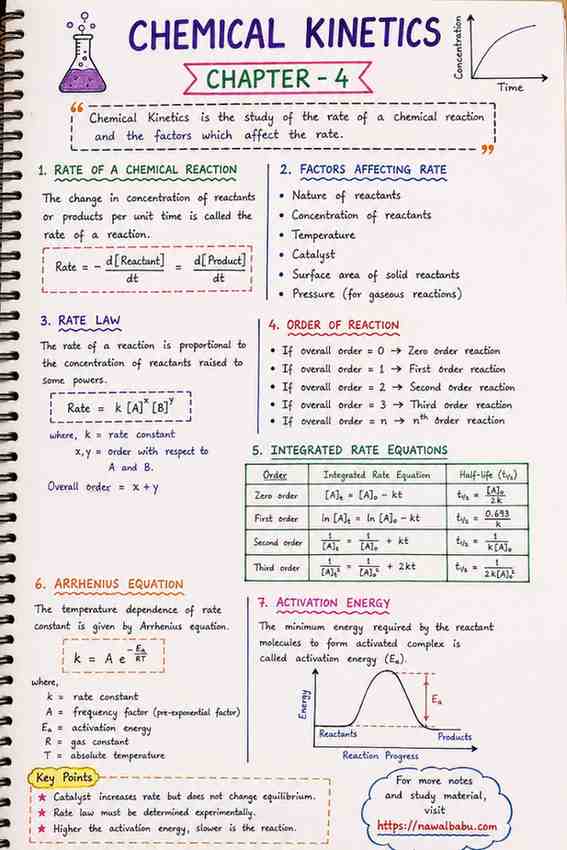
Chemical kinetics:-
The branch of chemistry which deals with the study of the speeds or the rate of chemical reactions, the factors influencing the rate of the reactions and the mechanism by which the reactions proceed is known as chemical kinetics.
Rate of reaction
It is the change in the concentration of any of the reactants or products per unit time.

The negative sign indicates that the concentration is decreasing with time in case of reactants.
Unit for the rate of reaction is mol L-1s-1.
• The rate of reaction is constant only for zero order of reactions. It decreases as the reaction proceeds in the forward direction in other order of reactions
Read More: Chemical Kinetics MCQs for Class 12 – 50 Important Questions for Board, NEET & JEE 2026
Types of the rate of reactions
There are two types of rate of reactions
- Average rate of reactions:- Rate of reaction at interval of time. It is denoted by rav.
Instantaneous rate of reactions:- Rate of reaction at any instant of time.


Instantaneous rate of reactions:- It is the change in concentration per unit or instant time. It is denoted by rinst.
Factors affecting the rate of reactions:
- Nature of the reactants
- Concentration of the reactants
- Temperature
- Presence of catalyst
- Surface area of the reactants
- Presence of light
Chemical Kinetics Class 12: Rate Law
Rate law is the expression which expresses the rate of the reaction in terms of molar concentration of the reactants with each term raised to some power, which may or may not be as the stoichiometric coefficient of that reactant in the balanced chemical equation.

Rate constant (k)- The rate of the reaction when the concentration of each reactant is taken as unity.
Order of reaction
It may be defined as the sum of the exponents to which the concentration terms are raised in the rate equation (or rate law) of the reaction. It can be fraction, zero or any whole number.
Molecularity of reaction:-
It is defined as the number of atoms or molecules or any other species in a reaction which collides simultaneously to bring about a chemical change.
* It is a theoretical concept. Its value is always a whole number. It is never more than three. It cannot be zero.
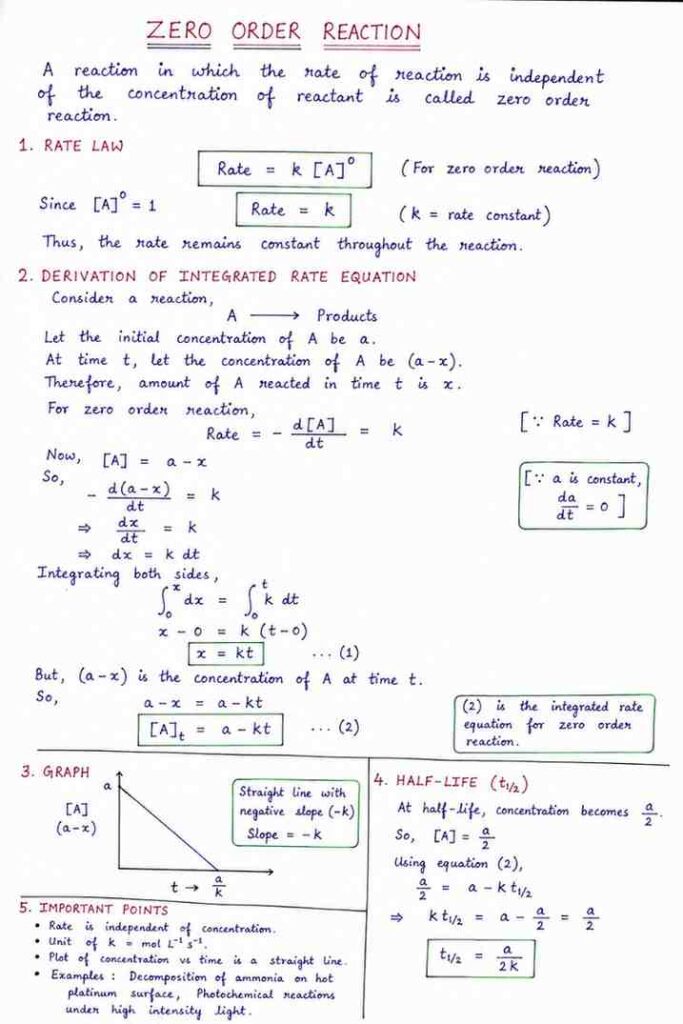
Zero order of reaction: Those reactions in which rate of reaction does not change with concentration of the reactants.
Rate law for such a reaction is expressed as. Rate = k [A]°[B]°
First order of reaction: A reaction is said to be first order if the sum of the powers raised over concentration terms in rate law equation for a reaction be one.
Second order of reaction: The reaction in which sum of powers of concentration terms in rate law equation is two.
The integrated rate equation for a first order reaction is given as
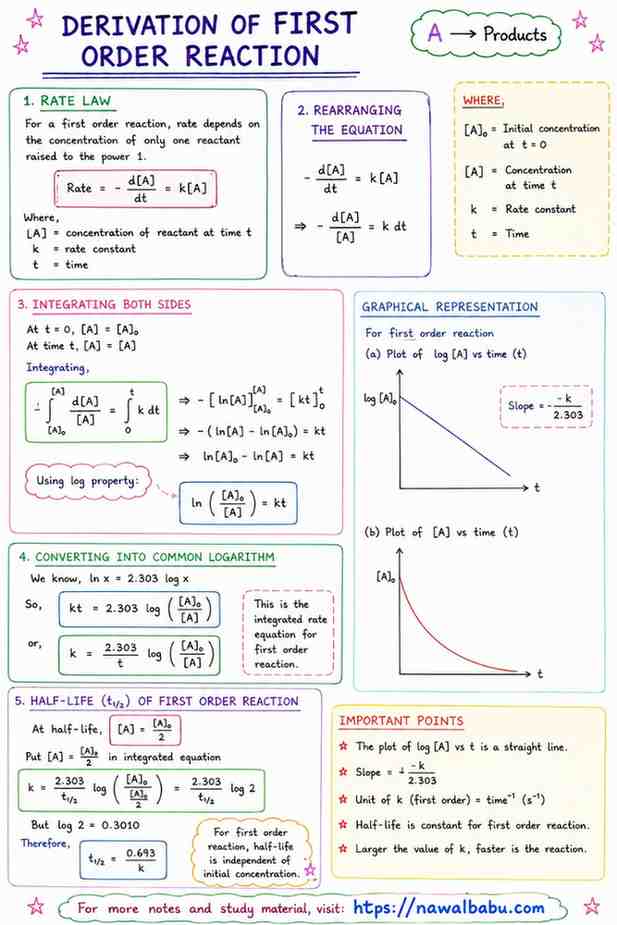

Half life period: It is the time required for the initial concentration of the reactant to be reduced to half its value.

Effect of Temperature on Rate Constant
It has been found that for a chemical reaction with rise in temperature by 10 °C, the rate constant gets nearly double or even more. The effects of temperature is usually expressed in terms of temperature coefficient it is the ratio of the rate constants of the reaction at two temperatures differing from one another by 10°C. The two temperatures usually taken are 35 °C and 25 °C.
The variation of rate constants with temperature can be represented by the Arrhenius equation in following way-
K=A e-Ea/Rt
where A is a constant known as frequency factor, Ea is the energy of activation, R is gas constant and T is the absolute temperature.
From the above equation, the rate constants at two different temperatures are related as

There are two important theories of reaction rates:
(i) Collision theory : It was put forward by Max Trautz and William Lewis. This theory is based upon kinetic theory of gases. As it is assumed that reactant molecules are hard spheres and reaction between them occurs only when they collide with each other.
(ii) Transition state theory: For the formation of a product in a chemical reaction. collisions among particles must be effective, the colliding molecules must have energy greater than threshold energy and also must have proper orientation.
Download NCERT Chemistry 12th
Conclusion of Chemical Kinetics Class 12
Chemical kinetics helps us to know about the rate of the reactions. There are two types of rate of reactions. They are average rate of reaction and instantaneous rate of reactions. We also learn the mechanism of the reactions. some reactions are elementary and some are complex. Nature of the reactants, concentration, presence of catalyst, temperature, surface area and presence of sun light are the important factors which affect the rate reactions. Based on the order of reaction, the reactions can be zero order, first order, second order and even of fraction orders.
FAQ in Chemical Kinetics Class 12
Q.No 1. Why are reactions of higher order less in number?
A reaction takes place because molecules colloid. The chances for a large number of molecules or ions to colloid simultaneously are less. Hence, the reaction of higher order are less.
Q. NO 2 Why boiling of an egg or cooking of rice in an open vessel takes more time at a hill station?
At a hill station, due to higher altitude, atmospheric pressure is low, water boils at a lower temperature and at this condition, the rate of the reaction decreases hence it takes longer time.
Q.No 3 What is the difference between Rate law and Law of Mass Action?
Rate Law is an experimental law where as law of mass action is a theoretical law based on the balanced chemical equation.
Q.No 4 Why hydrolysis of ethyl acetate with NaOH is reaction of 2nd order while with HCl, it is of 1st order ?
Rate of hydrolysis of ethyl acetate by NaOH depends upon concentration of both while that by HCl depends only on the concentration of ethyl acetate.
Q.No 5 What is meant by an elementary reaction?
A reaction which takes place in one step is called an elementary reaction. For example, reaction between H2 and I2 to form 2HI is an elementary reaction.
1. The unit of rate constant for a first order reaction is:
(a) mol L⁻¹ s⁻¹
(b) s⁻¹
(c) L mol⁻¹ s⁻¹
(d) mol² L⁻² s⁻¹
Answer: (b) s⁻¹
2. For a zero order reaction, rate is:
(a) proportional to concentration
(b) inversely proportional to concentration
(c) independent of concentration
(d) proportional to square of concentration
Answer: (c) independent of concentration
3. Half-life of a first order reaction depends on:
(a) initial concentration
(b) temperature only
(c) rate constant
(d) pressure
Answer: (c) rate constant
4. Which factor does not affect reaction rate?
(a) Catalyst
(b) Temperature
(c) Concentration
(d) Color of vessel
Answer: (d) Color of vessel
5. Molecularity of a reaction can never be:
(a) 0
(b) 1
(c) 2
(d) 3
Answer: (a) 0
6. Order of reaction can be:
(a) negative
(b) fractional
(c) zero
(d) all of these
Answer: (d) all of these
7. Arrhenius equation is:
(a) PV = nRT
(b) k = Ae⁻ᴱᵃ/ᴿᵀ
(c) E = mc²
(d) V = IR
Answer: (b) k = Ae⁻ᴱᵃ/ᴿᵀ
8. Catalyst increases reaction rate by:
(a) increasing concentration
(b) increasing pressure
(c) lowering activation energy
(d) increasing molecularity
Answer: (c) lowering activation energy
9. Unit of rate of reaction is:
(a) mol L⁻¹ s⁻¹
(b) s⁻¹
(c) mol² L⁻²
(d) atm⁻¹
Answer: (a) mol L⁻¹ s⁻¹
10. A straight line graph between log[A] and time indicates:
(a) zero order reaction
(b) first order reaction
(c) second order reaction
(d) third order reaction
Answer: (b) first order reaction
11. In a first order reaction, concentration becomes half after:
(a) one half-life
(b) two half-lives
(c) three half-lives
(d) four half-lives
Answer: (a) one half-life
12. Activation energy is the energy required to:
(a) stop reaction
(b) start reaction
(c) form activated complex
(d) cool reactants
Answer: (c) form activated complex
13. Which reaction has constant half-life?
(a) Zero order
(b) First order
(c) Second order
(d) Third order
Answer: (b) First order
14. The sum of powers of concentration terms in rate law is called:
(a) molecularity
(b) order
(c) rate constant
(d) activation energy
Answer: (b) order
15. Rate constant depends upon:
(a) concentration
(b) temperature
(c) pressure
(d) volume
Answer: (b) temperature
16. Molecularity is defined only for:
(a) complex reaction
(b) elementary reaction
(c) reversible reaction
(d) chain reaction
Answer: (b) elementary reaction
17. The unit of zero order rate constant is:
(a) s⁻¹
(b) mol L⁻¹ s⁻¹
(c) L mol⁻¹ s⁻¹
(d) L² mol⁻² s⁻¹
Answer: (b) mol L⁻¹ s⁻¹
18. Which reaction rate increases with increase in temperature?
(a) all reactions
(b) only endothermic
(c) only exothermic
(d) none
Answer: (a) all reactions
19. In Arrhenius equation, A represents:
(a) activation energy
(b) frequency factor
(c) order
(d) concentration
Answer: (b) frequency factor
20. The graph of concentration vs time for zero order reaction is:
(a) straight line
(b) parabola
(c) hyperbola
(d) circle
Answer: (a) straight line
21. Rate law for first order reaction is:
(a) Rate = k
(b) Rate = k[A]
(c) Rate = k[A]²
(d) Rate = k[B]
Answer: (b) Rate = k[A]
22. Unit of second order rate constant is:
(a) s⁻¹
(b) mol L⁻¹ s⁻¹
(c) L mol⁻¹ s⁻¹
(d) L² mol⁻² s⁻¹
Answer: (c) L mol⁻¹ s⁻¹
23. Which one is not a factor affecting reaction rate?
(a) catalyst
(b) temperature
(c) concentration
(d) shape of container
Answer: (d) shape of container
24. Higher activation energy means:
(a) faster reaction
(b) slower reaction
(c) no reaction
(d) explosive reaction
Answer: (b) slower reaction
25. Rate of reaction at equilibrium is:
(a) zero
(b) maximum
(c) minimum
(d) constant
Answer: (d) constant
26. A catalyst changes:
(a) equilibrium constant
(b) activation energy
(c) enthalpy
(d) free energy
Answer: (b) activation energy
27. SI unit of activation energy is:
(a) joule mole⁻¹
(b) mole litre⁻¹
(c) second⁻¹
(d) kelvin
Answer: (a) joule mole⁻¹
28. Which order reaction cannot have finite half-life?
(a) zero order
(b) first order
(c) second order
(d) all have finite half-life
Answer: (a) zero order
29. Rate constant of a reaction becomes double when:
(a) concentration doubles
(b) pressure doubles
(c) temperature increases
(d) catalyst removed
Answer: (c) temperature increases
30. Collision theory was proposed to explain:
(a) equilibrium
(b) reaction rate
(c) electrolysis
(d) osmosis
Answer: (b) reaction rate
31. Effective collisions are those collisions which:
(a) have low energy
(b) form products
(c) are random
(d) have no orientation
Answer: (b) form products
32. Unit of molecularity is:
(a) mol L⁻¹
(b) no unit
(c) second
(d) atm
Answer: (b) no unit
33. The rate determining step is generally:
(a) fastest step
(b) slowest step
(c) reversible step
(d) final step
Answer: (b) slowest step
34. Which quantity decreases during reaction?
(a) product concentration
(b) reactant concentration
(c) activation energy
(d) temperature
Answer: (b) reactant concentration
35. A first order reaction is 75% complete in:
(a) 1 half-life
(b) 2 half-lives
(c) 3 half-lives
(d) 4 half-lives
Answer: (b) 2 half-lives
36. Which graph gives rate constant from slope?
(a) log[A] vs t
(b) [A] vs t
(c) rate vs concentration
(d) none
Answer: (a) log[A] vs t
37. Order and molecularity are equal for:
(a) complex reactions
(b) elementary reactions
(c) reversible reactions
(d) chain reactions
Answer: (b) elementary reactions
38. The activated complex is also called:
(a) intermediate
(b) transition state
(c) catalyst
(d) product
Answer: (b) transition state
39. Rate law is determined experimentally because:
(a) it cannot be predicted theoretically
(b) it changes with pressure
(c) it depends on catalyst
(d) it depends on temperature only
Answer: (a) it cannot be predicted theoretically
40. Integrated rate equation for first order reaction is:
(a) k = 2.303/t log[A]₀/[A]
(b) k = [A]/t
(c) k = t/[A]
(d) k = [A]²/t
Answer: (a) k = 2.303/t log[A]₀/[A]
41. Which reaction has rate independent of reactant concentration?
(a) first order
(b) second order
(c) zero order
(d) third order
Answer: (c) zero order
42. Increase in surface area increases reaction rate because:
(a) collisions decrease
(b) effective collisions increase
(c) activation energy increases
(d) pressure decreases
Answer: (b) effective collisions increase
43. Which one is true for first order reaction?
(a) t₁/₂ ∝ [A]₀
(b) t₁/₂ independent of [A]₀
(c) rate independent of concentration
(d) k has unit mol L⁻¹ s⁻¹
Answer: (b) t₁/₂ independent of [A]₀
44. The value of Arrhenius factor depends on:
(a) collision frequency
(b) orientation factor
(c) both a and b
(d) none
Answer: (c) both a and b
45. A catalyst does not change:
(a) activation energy
(b) rate of reaction
(c) equilibrium position
(d) reaction pathway
Answer: (c) equilibrium position
46. Which reaction order is most common?
(a) zero order
(b) first order
(c) third order
(d) fractional order
Answer: (b) first order
47. The rate of decomposition of H₂O₂ follows:
(a) zero order
(b) first order
(c) second order
(d) third order
Answer: (b) first order
48. Radioactive decay is an example of:
(a) zero order reaction
(b) first order reaction
(c) second order reaction
(d) reversible reaction
Answer: (b) first order reaction
49. The slope of log[A] vs t graph is:
(a) k
(b) –k/2.303
(c) 2.303/k
(d) –2.303/k
Answer: (b) –k/2.303
50. The energy barrier between reactants and products is called:
(a) enthalpy
(b) activation energy
(c) entropy
(d) free energy
Answer: (b) activation energy