
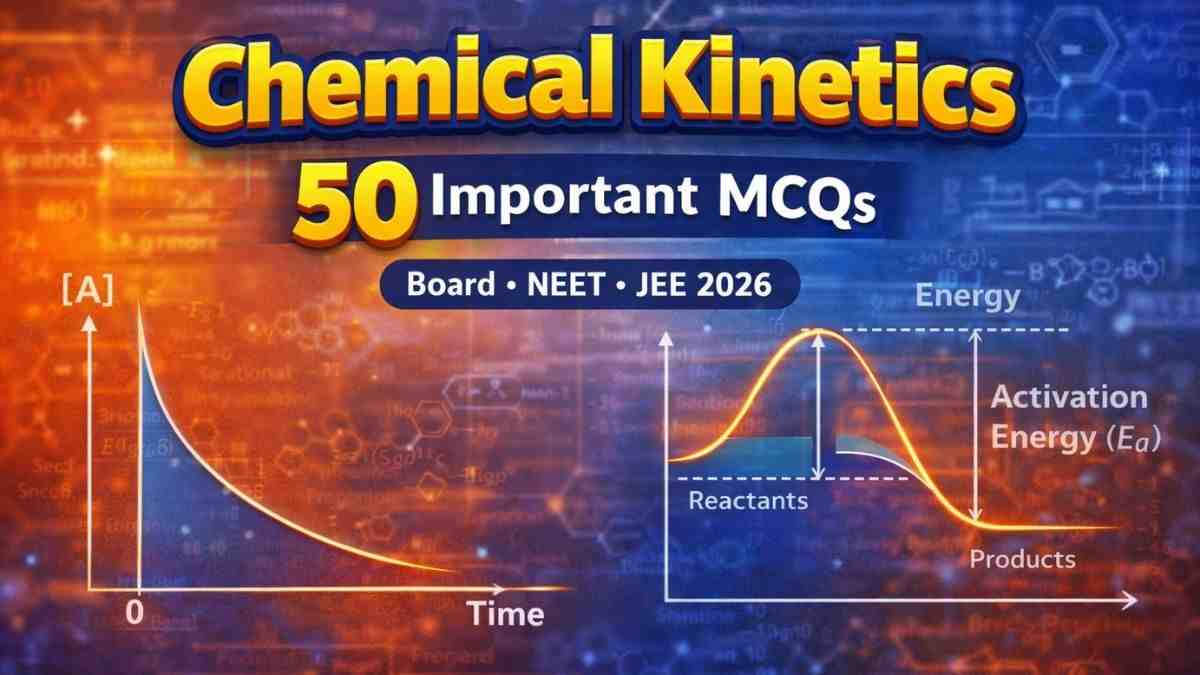
Practice 50 important Chemical Kinetics MCQs for Class 12 with answers. Perfect for CBSE Board, NEET & JEE 2026 exam preparation. Chemical Kinetics is one of the most interesting and scoring chapters in Class 12 Chemistry. While many chapters focus on what happens in a reaction, Chemical Kinetics explains how fast it happens and why it happens at that speed. From rusting of iron to digestion of food and even industrial production of ammonia, reaction rates play a crucial role in real life.
This chapter covers important concepts such as rate of reaction, order and molecularity, integrated rate equations, half-life, Arrhenius equation, activation energy, and the effect of temperature and catalysts. Questions from Chemical Kinetics are frequently asked in CBSE Board exams as well as competitive exams like NEET and JEE, making it a must-master topic.
To help you strengthen your preparation, we have compiled 50 carefully selected multiple-choice questions (MCQs) covering both conceptual understanding and formula-based problems. Practice these questions to improve speed, accuracy, and confidence — and boost your exam score with ease!
50 important Chemical Kinetics MCQs for Class 12
1. The rate of a chemical reaction generally increases with:
A) Decrease in temperature
B) Increase in temperature
C) Decrease in concentration
D) Addition of inert gas
Answer: B
2. The unit of rate constant for a first order reaction is:
A) mol L⁻¹ s⁻¹
B) s⁻¹
C) L mol⁻¹ s⁻¹
D) mol⁻¹ L s⁻¹
Answer: B
3. For a zero order reaction, the rate is:
A) Independent of concentration
B) Directly proportional to concentration
C) Inversely proportional to concentration
D) Proportional to square of concentration
Answer: A
4. Half-life of a first order reaction depends on:
A) Initial concentration
B) Temperature only
C) Rate constant
D) Pressure
Answer: C
5. The molecularity of a reaction can be:
A) Zero
B) Fractional
C) Whole number only
D) Negative
Answer: C
6. Order of reaction is determined experimentally by:
A) Stoichiometry
B) Balanced equation
C) Rate law
D) Molecular formula
Answer: C
7. The integrated rate equation for first order reaction is:
A) kt = [A]
B) kt = 2.303 log [A₀]/[A]
C) kt = [A]²
D) kt = 1/[A]
Answer: B
8. For a zero order reaction, concentration vs time graph is:
A) Straight line decreasing
B) Straight line increasing
C) Exponential
D) Hyperbola
Answer: A
9. The slope of ln[A] vs time graph for first order reaction gives:
A) k
B) –k
C) 1/k
D) –1/k
Answer: B
10. Arrhenius equation is:
A) k = Ae^(-Ea/RT)
B) k = A + Ea/RT
C) k = Ea/RT
D) k = A/RT
Answer: A
11. Activation energy is:
A) Minimum energy required for reaction
B) Heat of reaction
C) Rate of reaction
D) Collision frequency
Answer: A
12. Unit of rate for any reaction is:
A) mol L⁻¹ s⁻¹
B) s⁻¹
C) L mol⁻¹
D) mol s⁻¹
Answer: A
13. For second order reaction, unit of rate constant is:
A) s⁻¹
B) L mol⁻¹ s⁻¹
C) mol L⁻¹ s⁻¹
D) L s⁻¹
Answer: B
14. If half-life is independent of initial concentration, reaction is:
A) Zero order
B) First order
C) Second order
D) Third order
Answer: B
15. Catalyst increases rate by:
A) Increasing Ea
B) Decreasing Ea
C) Increasing temperature
D) Increasing concentration
Answer: B
16. Collision theory explains rate based on:
A) Energy
B) Collisions
C) Temperature
D) Pressure
Answer: B
17. For zero order reaction, half-life is:
A) Independent of concentration
B) Proportional to initial concentration
C) Inversely proportional to concentration
D) Constant
Answer: B
18. The sum of powers of concentration terms in rate law gives:
A) Molecularity
B) Order
C) Activation energy
D) Frequency factor
Answer: B
19. The temperature coefficient usually lies between:
A) 1–2
B) 2–3
C) 3–4
D) 4–5
Answer: B
20. A reaction with rate = k[A]² is:
A) First order
B) Zero order
C) Second order
D) Third order
Answer: C
21. Half-life of zero order reaction is:
A) 0.693/k
B) [A₀]/2k
C) 2.303/k
D) 1/k
Answer: B
22. Rate law for first order reaction is:
A) r = k
B) r = k[A]
C) r = k[A]²
D) r = k/[A]
Answer: B
23. Pseudo first order reaction occurs when:
A) One reactant is in excess
B) Both reactants equal
C) Catalyst present
D) No solvent
Answer: A
24. Graph of 1/[A] vs time for second order reaction is:
A) Straight line
B) Curve
C) Exponential
D) Horizontal
Answer: A
25. Increasing surface area increases rate in:
A) Homogeneous reaction
B) Heterogeneous reaction
C) First order reaction
D) Zero order reaction
Answer: B
26. Higher activation energy means:
A) Faster reaction
B) Slower reaction
C) No effect
D) Constant rate
Answer: B
27. Rate constant does not depend on:
A) Temperature
B) Catalyst
C) Concentration
D) Nature of reactant
Answer: C
28. The value of e in Arrhenius equation is:
A) 2.303
B) 1
C) 2.718
D) 3.14
Answer: C
29. If rate doubles when concentration doubles, order is:
A) Zero
B) One
C) Two
D) Three
Answer: B
30. The slowest step in mechanism is:
A) Fast step
B) Rate determining step
C) Reversible step
D) Final step
Answer: B
31. Unit of rate constant for zero order is:
A) s⁻¹
B) mol L⁻¹ s⁻¹
C) L mol⁻¹ s⁻¹
D) mol⁻¹ L s⁻¹
Answer: B
32. Arrhenius plot is:
A) k vs T
B) ln k vs 1/T
C) k vs 1/T
D) ln k vs T
Answer: B
33. Half-life of second order reaction:
A) 0.693/k
B) 1/k[A₀]
C) [A₀]/2k
D) k/2
Answer: B
34. A catalyst changes:
A) ΔH
B) ΔG
C) Activation energy
D) Equilibrium constant
Answer: C
35. Rate of reaction is:
A) Change in concentration per unit time
B) Total concentration
C) Heat evolved
D) Pressure change
Answer: A
36. Units of k depend on:
A) Temperature
B) Order of reaction
C) Pressure
D) Volume
Answer: B
37. For first order reaction, 75% completion time equals:
A) t½
B) 2t½
C) 3t½
D) 1.5t½
Answer: B
38. Activation energy is represented by:
A) Ea
B) ΔH
C) ΔG
D) k
Answer: A
39. If order is zero, molecularity is:
A) Always zero
B) Always one
C) Cannot be zero
D) Fractional
Answer: C
40. The collision must have sufficient:
A) Speed
B) Energy
C) Mass
D) Volume
Answer: B
41. Integrated rate law for zero order is:
A) [A] = [A₀] – kt
B) ln[A] = ln[A₀] – kt
C) 1/[A] = 1/[A₀] + kt
D) k = Ae^(-Ea/RT)
Answer: A
42. Rate constant increases with:
A) Decrease in temperature
B) Increase in activation energy
C) Increase in temperature
D) Decrease in pressure
Answer: C
43. For first order reaction, graph of log[A] vs time gives:
A) Straight line
B) Curve
C) Hyperbola
D) Horizontal line
Answer: A
44. A reaction with rate independent of reactant concentration is:
A) First order
B) Second order
C) Zero order
D) Third order
Answer: C
45. The factor A in Arrhenius equation is:
A) Activation energy
B) Frequency factor
C) Rate constant
D) Temperature
Answer: B
46. Molecularity of unimolecular reaction is:
A) 1
B) 2
C) 0
D) 3
Answer: A
47. For first order reaction, half-life is:
A) 0.693/k
B) 1/k[A₀]
C) [A₀]/2k
D) k/2
Answer: A
48. Order of reaction can be:
A) Fractional
B) Zero
C) Whole number
D) All of these
Answer: D
49. Increasing pressure increases rate of:
A) Liquid reactions
B) Solid reactions
C) Gaseous reactions
D) Zero order reactions
Answer: C
50. A straight line graph between [A] and time indicates:
A) First order
B) Zero order
C) Second order
D) Third order
Answer: B