
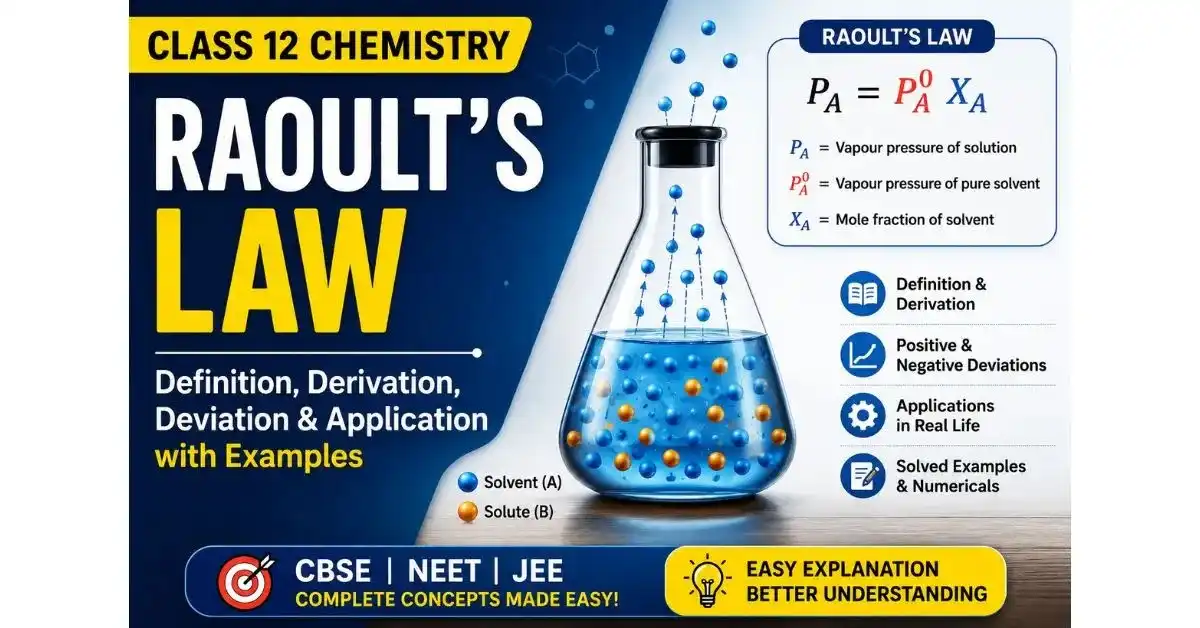
Understanding Raoult’s Law is essential for mastering the Solutions chapter in Class 12 Chemistry. This important law explains how the vapour pressure of a solution depends on the mole fraction of its components and forms the basis for understanding ideal and non-ideal solutions. In CBSE board exams and competitive exams like NEET, JEE Main, and other entrance tests, questions on the definition, derivation, formula, deviations, and applications of Raoult’s Law are frequently asked.
In this comprehensive guide, you will learn the definition of Raoult’s Law, its mathematical derivation, the conditions under which it is applicable, positive and negative deviations, practical applications, and solved numerical examples. The chapter is explained in simple language with clear formulas and diagrams, making it perfect for quick revision as well as detailed study. Whether you are preparing for board exams or competitive exams, these notes will strengthen your concepts and improve your problem-solving skills.
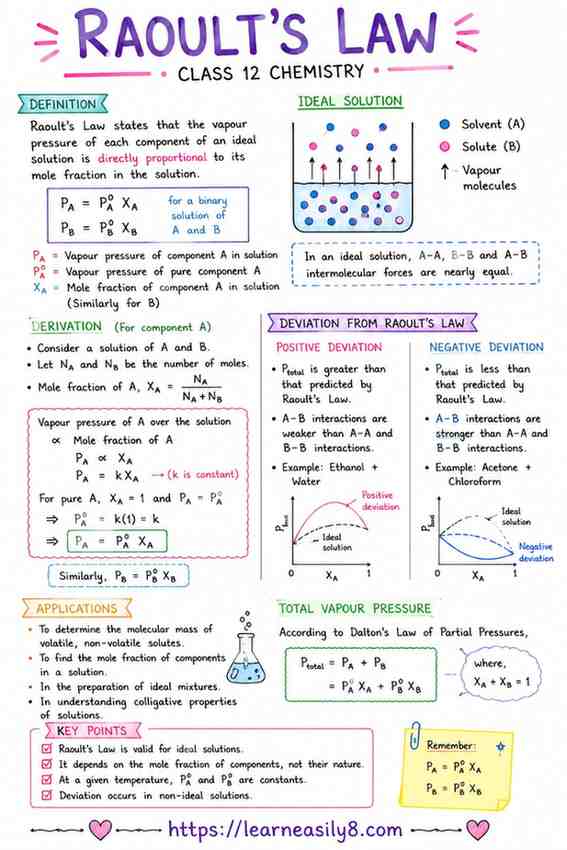
What is Raoult’s Law? (Definition)
This Law states that the partial vapor pressure of a component in a solution is directly proportional to its mole fraction in the solution.
For a solution containing a volatile solute A and solvent B, Raoult’s Law can be mathematically expressed as:
Where: pA = Partial vapor pressure of component A
p0A = Vapor pressure of pure component A
= Mole fraction of component A in the solution
Similarly, for component B:
The total vapor pressure of the solution is given by:
This law applies best to ideal solutions, where intermolecular forces remain unchanged upon mixing.

Derivation of Raoult’s Law
Step-by-Step Derivation
Consider a binary solution with two volatile liquids, A and B.
Each component exerts a partial vapor pressure, given by:
By Dalton’s Law of Partial Pressures, the total vapor pressure of the solution is:
Rearranging in terms of mole fractions:
Thus, Raoult’s Law explains how the total vapor pressure depends on the composition of the solution.

Deviation from Raoult’s Law
Not all solutions follow this Law perfectly. The deviations occur due to changes in intermolecular forces upon mixing.
Positive Deviation from Raoult’s Law
- Occurs when solute-solvent interactions are weaker than those in pure components.
- The solution has higher vapor pressure than predicted.
- Example: Ethanol and Acetone – Ethanol molecules break hydrogen bonds due to acetone, leading to increased vaporization.
Negative Deviation from Raoult’s Law
- Occurs when solute-solvent interactions are stronger than those in pure components.
- The solution has lower vapor pressure than predicted.
- Example: Chloroform and Acetone – Strong hydrogen bonding reduces the escape of molecules into the vapor phase.
| Types of Deviation | Cause | Example |
| Positive deviation | Weaker solute-solvent interactions | Ethanol + Acetone |
| Negative deviation | Stronger solute-solvent interactions | Chloroform + Acetone |
Applications of Raoult’s Law
Determination of Molar Mass
- Used to calculate molar masses of unknown substances by studying their impact on vapor pressure.
Explanation of Colligative Properties
- Helps understand relative lowering of vapor pressure, boiling point elevation, freezing point depression, and osmotic pressure.
Industrial Applications
- Used in distillation processes like fractional distillation in petroleum industries.
Medicine and Pharmacy
- Essential for designing drug solutions with controlled evaporation and concentration.
Weather and Environment
- Explains humidity and vapor pressure changes in the atmosphere.
Real-Life Examples of Raoult’s Law
- Perfume Evaporation
- When a bottle of perfume is opened, the volatile components evaporate according to this law, contributing to its scent.
- Alcohol-Water Mixtures
- In liquor distillation, ethanol and water exhibit deviation from Raoult’s Law, affecting their boiling points.
- Saline Water Boiling
- Adding salt to water lowers its vapor pressure, requiring a higher temperature for boiling.
Read More:
Ncert Solutions Chemistry12 Chapter 1: Free Pdf Download
Notes of solution for chemistry 12th chapter two
Conclusion
Raoult’s Law plays a crucial role in understanding solutions, vapor pressure, and deviations in real-world applications. It forms the basis for colligative properties and is widely used in chemistry, industry, and environmental science. Understanding Raoult’s Law Class 12 helps in scoring better in exams and applying chemistry concepts in daily life. For more chemistry notes and explanations, explore our blog and keep learning!
Frequently Asked Questions (FAQs)
1. What is Raoult’s Law in simple terms?
Raoult’s Law states that the vapor pressure of a component in a solution is proportional to its mole fraction.
2. What are the limitations of Raoult’s Law?
It applies only to ideal solutions where there is no change in intermolecular forces.
3. What is a real-life example of Raoult’s Law?
Perfume evaporation follows Raoult’s Law, as its volatile components exert vapor pressure based on concentration.
4. Why does adding salt to water increase boiling point?
Salt reduces water’s vapor pressure, requiring more heat to reach boiling.
5. How does Raoult’s Law help in distillation?
It explains how different components evaporate at different rates, making separation possible.
Raoult’s Law Class 12: 10 Long-Type Numericals with Solutions
Numerical 1: Vapour Pressure of an Ideal Solution
Question:
A solution is prepared by mixing 2 moles of benzene (vapour pressure = 100 mmHg) and 3 moles of toluene (vapour pressure = 40 mmHg) at the same temperature. Calculate:
- Mole fraction of each component
- Partial vapour pressure of each component
- Total vapour pressure of the solution
Solution
Given
- mmHg
- mmHg
Step 1: Mole Fractions
Total moles
Step 2: Partial Vapour Pressures
Step 3: Total Vapour Pressure
Answer
- Mole fraction of benzene = 0.4
- Mole fraction of toluene = 0.6
- Partial pressures = 40 mmHg and 24 mmHg
- Total vapour pressure = 64 mmHg
Numerical 2: Finding Vapour Pressure
Question
The vapour pressure of pure acetone is 300 mmHg. A solution contains 0.70 mole fraction of acetone.
Find its vapour pressure.
Solution
Answer
210 mmHg
Numerical 3: Finding Mole Fraction
Question
The vapour pressure of pure ethanol is 80 mmHg. The solution has vapour pressure 48 mmHg.
Find the mole fraction of ethanol.
Solution
Answer
Mole fraction = 0.60
Numerical 4: Vapour Pressure Lowering
Question
Pure water has vapour pressure 23.8 mmHg. A solution has vapour pressure 21.4 mmHg.
Calculate:
- Lowering in vapour pressure
- Relative lowering
Solution
Lowering
Relative lowering
Answer
Lowering = 2.4 mmHg
Relative lowering = 0.101
Numerical 5: Mole Fraction of Solute
Question
The relative lowering of vapour pressure is 0.08.
Find the mole fraction of the solute.
Solution
According to Raoult’s law,
Therefore,
Answer
0.08
Numerical 5: Mole Fraction of Solute
Question
The relative lowering of vapour pressure is 0.08.
Find the mole fraction of the solute.
Solution
According to Raoult’s law,
Therefore,
Answer
0.08
Numerical 7: Binary Solution
Question
A solution contains 4 moles of A and 6 moles of B.
The vapour pressures are
- A = 120 mmHg
- B = 60 mmHg
Find the total vapour pressure.
Solution
Partial pressure of A
Partial pressure of B
Total
Answer
84 mmHg
Numerical 8: Unknown Vapour Pressure
Question
The mole fraction of solvent is 0.85.
Its partial vapour pressure is 102 mmHg.
Calculate the vapour pressure of the pure solvent.
Solution
Answer
120 mmHg
Numerical 9: Vapour Pressure of Binary Solution
Question
A solution contains
- 1 mole chloroform
- 2 moles carbon tetrachloride
Pure vapour pressures
- Chloroform = 200 mmHg
- Carbon tetrachloride = 90 mmHg
Calculate total vapour pressure.
Solution
Total moles
Partial pressures
Total
Answer
126.7 mmHg
Numerical 10: Relative Lowering of Vapour Pressure
Question
2 g of a non-volatile solute is dissolved in 98 g water.
The relative lowering of vapour pressure is 0.01.
Calculate the molar mass of the solute.
Solution
Relative lowering
Moles of water
Moles of solute
Molar mass
Answer
Molar mass of the solute = 36.7 g/mol