
Current Electricity Class 12 Notes in Hindi कक्षा 12 Physics के विद्यार्थियों के लिए एक महत्वपूर्ण और उपयोगी अध्ययन सामग्री है। विद्युत धारा (Current Electricity) का अध्याय बोर्ड परीक्षा के साथ-साथ JEE, NEET और अन्य प्रतियोगी परीक्षाओं के लिए भी बेहद महत्वपूर्ण माना जाता है। इस chapter में Electric Current, Drift Velocity, Ohm’s Law, Resistance, Resistivity, Conductivity, Combination of Resistors, EMF, Internal Resistance, Kirchhoff’s Laws, Wheatstone Bridge, Meter Bridge और Potentiometer जैसे सभी महत्वपूर्ण topics को आसान Hindi + English भाषा में समझाया गया है।
इन नोट्स में NCERT आधारित concepts, महत्वपूर्ण formulas, step-by-step derivations और साफ circuit diagrams शामिल हैं, जिससे कठिन Physics concepts को समझना आसान हो जाता है। विद्यार्थी इन Current Electricity Class 12 Notes का उपयोग quick revision, बोर्ड परीक्षा की तैयारी और महत्वपूर्ण numericals की practice के लिए कर सकते हैं। सरल भाषा और व्यवस्थित notes आपको इस chapter में बेहतर understanding और अच्छे marks प्राप्त करने में मदद करेंगे। Download NCERT BOOK PDF.
Current Electricity Class 12 Notes: विद्युत धारा NCERT Notes
Current Electricity Class 12 Physics का एक बहुत महत्वपूर्ण chapter है। इस chapter में हम electric charge के flow, electric current, resistance, Ohm’s law, resistivity, cells, Kirchhoff’s laws तथा electrical circuits के बारे में पढ़ते हैं। जब किसी conductor में electric charges लगातार एक दिशा में प्रवाहित होते हैं, तो इसे electric current कहते हैं। यह chapter बोर्ड परीक्षा के साथ-साथ JEE और NEET की तैयारी के लिए भी अत्यंत महत्वपूर्ण है।
Electric charge का flow = Electric Current
मुख्य unit = Ampere
मुख्य सूत्र = I = Q/t
Circuit और resistance इस chapter के महत्वपूर्ण topics हैं।
Electric Current (विद्युत धारा)
Electric Current की परिभाषा
किसी conductor के किसी cross-section से प्रति unit समय गुजरने वाले कुल electric charge को Electric Current (विद्युत धारा) कहते हैं। यदि किसी तार में बहुत सारे electrons लगातार flow करते हैं, तो electric current उत्पन्न होती है। सामान्यतः metals में current electrons के movement के कारण होती है। हालांकि conventional current की दिशा electrons की दिशा के विपरीत मानी जाती है।
Formula:
I = Q/t
जहाँ,
I = Electric Current
Q = Electric Charge
t = Time
SI Unit of Current = Ampere (A)
SI Unit of Electric Current
Electric current की SI unit Ampere (A) है। यदि किसी conductor के cross-section से 1 second में 1 coulomb charge गुजरता है, तो current की value 1 ampere होती है। Electric current को measure करने के लिए circuit में Ammeter का उपयोग किया जाता है। Ammeter को हमेशा circuit में series combination में लगाया जाता है क्योंकि उसी current को measure करना होता है जो circuit के उस भाग से गुजर रही होती है।
Mathematical Relation:
1 Ampere = 1 Coulomb/second
अर्थात,
1 A = 1 C/s
याद रखें:
Current → Ammeter से मापते हैं।
Ammeter → Series में लगाया जाता है।
SI unit → Ampere।
छोटा current → milliampere या microampere में व्यक्त किया जा सकता है।
Direction of Electric Current
Metals में electric current वास्तव में free electrons के movement के कारण उत्पन्न होती है। Electrons negative charge रखते हैं और उनका flow negative terminal से positive terminal की ओर होता है। लेकिन वैज्ञानिकों द्वारा निर्धारित Conventional Current की दिशा positive charge के movement की दिशा मानी जाती है। इसलिए conventional current की दिशा positive terminal से negative terminal की ओर मानी जाती है।
याद रखने योग्य बातें:
- Electron flow → Negative to Positive
- Conventional Current → Positive to Negative
- दोनों दिशाएँ एक-दूसरे के opposite होती हैं।
- Circuit diagrams में सामान्यतः conventional current का उपयोग किया जाता है।
Current Density (धारा घनत्व)
Current Density की परिभाषा
किसी conductor के प्रति unit cross-sectional area से गुजरने वाली electric current को Current Density (J) कहते हैं। यह बताती है कि किसी conductor के अंदर current कितनी densely flow कर रही है। यदि conductor का area छोटा है और उसी में अधिक current flow कर रही है, तो current density अधिक होगी।
Formula:
J = I/A
जहाँ,
- J = Current Density
- I = Current
- A = Cross-sectional Area
SI Unit:
Ampere per square metre (A/m²)
Current density एक Vector Quantity है और इसकी दिशा conventional current की दिशा में होती है।
Drift Velocity (अपवाह वेग)
जब किसी conductor पर electric field apply की जाती है, तो उसके free electrons एक निश्चित average velocity से move करने लगते हैं। इस average velocity को Drift Velocity (vₙ या vd) कहते हैं। बिना electric field के electrons random motion करते हैं, लेकिन electric field लगाने पर उनमें एक निश्चित दिशा में धीमा movement उत्पन्न होता है।
महत्वपूर्ण बातें:
- Electrons का random motion हमेशा होता है।
- Electric field लगाने पर drift उत्पन्न होती है।
- Drift velocity बहुत कम होती है।
- Electron drift direction electric field की direction के opposite होती है।
- Conventional current की direction electric field की direction में होती है।
Read More: Electrostatics Class 12 Short Notes for JEE in Hindi | Formula, Concepts & Revision
Drift Velocity और Electric Current का संबंध
Electric current को drift velocity के माध्यम से भी व्यक्त किया जा सकता है। यदि किसी conductor में free electrons की संख्या अधिक होगी या उनका drift velocity अधिक होगा, तो current भी अधिक होगी।
Important Formula:
I = neAvd
जहाँ,
- I = Current
- n = Number of free electrons per unit volume
- e = Charge of electron
- A = Cross-sectional area
- vd = Drift velocity
इस formula से पता चलता है कि current सीधे proportional होती है:
- Number density के
- Area के
- Drift velocity के
यह formula numerical questions के लिए बहुत महत्वपूर्ण है।
Mobility of Charge Carriers (गतिशीलता)
Mobility की परिभाषा
किसी charge carrier की drift velocity और applied electric field के अनुपात को Mobility (μ) कहते हैं। यह बताती है कि किसी electric field में charge carrier कितनी आसानी से move कर सकता है। अधिक mobility का अर्थ है कि charge carrier electric field के प्रभाव में अधिक आसानी से गति करेगा।
Formula:
μ = vd/E
जहाँ,
- μ = Mobility
- vd = Drift Velocity
- E = Electric Field
Mobility की SI unit: m² V⁻¹ s⁻¹
Mobility material और charge carriers की properties पर निर्भर करती है।
Ohm’s Law (ओम का नियम)
Ohm’s Law की परिभाषा
Ohm’s Law के अनुसार, यदि किसी conductor का temperature और अन्य physical conditions constant रखी जाएँ, तो उसके सिरों के बीच potential difference, उसमें प्रवाहित electric current के directly proportional होता है।
Mathematical Form:
V ∝ I या V = IR
जहाँ,
- V = Potential Difference
- I = Current
- R = Resistance
यह Physics के सबसे महत्वपूर्ण electrical laws में से एक है। सभी materials Ohm’s law को perfectly follow नहीं करते।
Resistance (प्रतिरोध)
Resistance की परिभाषा
किसी conductor द्वारा electric current के flow का विरोध करने की क्षमता को Resistance (प्रतिरोध) कहते हैं। जब electrons conductor में atoms से टकराते हैं, तो उनके movement में बाधा उत्पन्न होती है। यही बाधा resistance कहलाती है।
Formula:
R = V/I
Resistance की SI unit: Ohm (Ω)
यदि V = 1 volt और I = 1 ampere तो R = 1 Ohm
Resistance अधिक होने पर current कम होती है और resistance कम होने पर current अधिक flow कर सकती है।
Factors Affecting Resistance (प्रतिरोध को प्रभावित करने वाले कारक)
किसी conductor का resistance कई factors पर निर्भर करता है। मुख्यतः इसकी length, cross-sectional area, material तथा temperature resistance को प्रभावित करते हैं।
Resistance depends on:
- Length (L) बढ़ने पर resistance बढ़ता है।
- Area (A) बढ़ने पर resistance कम होता है।
- Material बदलने पर resistance बदलता है।
- Temperature बदलने पर resistance भी बदल सकता है।
Formula:
R ∝ L और R ∝ 1/A
इसलिए R = ρL/A जहाँ ρ (rho) resistivity कहलाती है।
Resistivity (प्रतिरोधकता)
Resistivity की परिभाषा
किसी material की वह property जो electric current के flow का विरोध करती है, उसे Resistivity (प्रतिरोधकता) कहते हैं। यह conductor के shape या size पर नहीं बल्कि material की प्रकृति पर निर्भर करती है। अलग-अलग materials की resistivity अलग होती है।
Formula:
ρ = RA/L या R = ρL/A
SI Unit: Ohm metre (Ω m)
याद रखें:
- Resistance → Length और area पर निर्भर करता है।
- Resistivity → Material की property है।
- Copper की resistivity कम होती है।
- Insulators की resistivity बहुत अधिक होती है।
Conductivity (चालकता)
किसी material की electric current को conduct करने की क्षमता को Conductivity (चालकता) कहते हैं। Conductivity resistivity का reciprocal होती है। जिस material की resistivity कम होगी, उसकी conductivity अधिक होगी।
Formula:
σ = 1/ρ
जहाँ,
- σ = Conductivity
- ρ = Resistivity
SI Unit: Siemens per metre (S/m)
Conductors की conductivity अधिक होती है, जबकि insulators की conductivity बहुत कम होती है। Copper और silver अच्छे conductors हैं क्योंकि उनमें charge carriers आसानी से move कर सकते हैं।
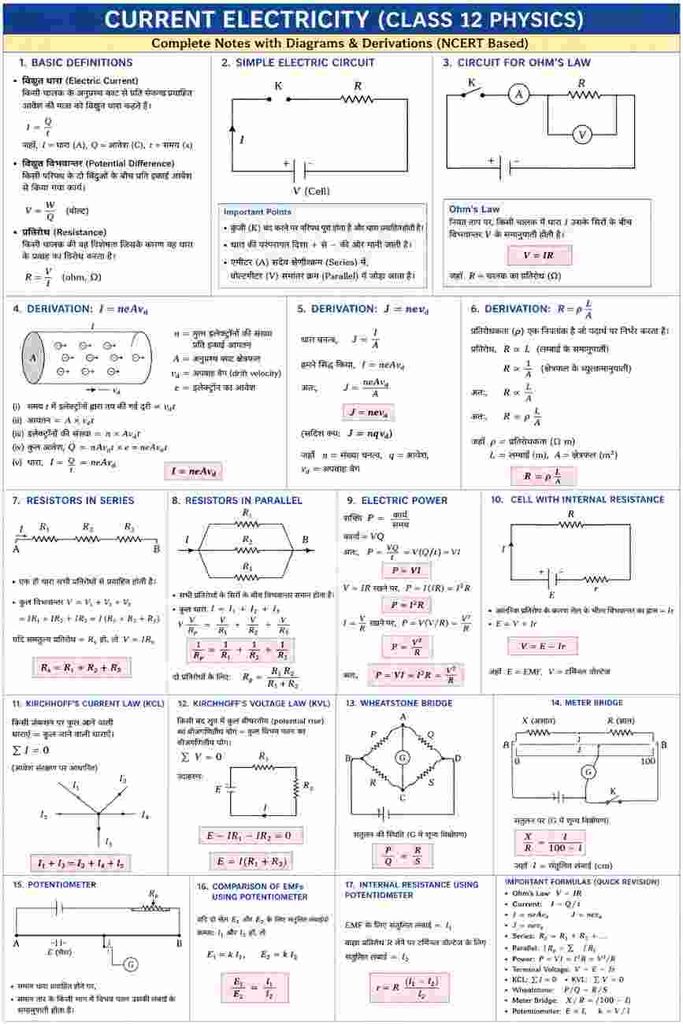
Temperature Dependence of Resistance
Metals का temperature बढ़ाने पर उनका resistance सामान्यतः बढ़ जाता है। ऐसा इसलिए होता है क्योंकि temperature बढ़ने पर atoms अधिक vibration करते हैं और electrons को अधिक collisions का सामना करना पड़ता है। इसलिए उनका movement कठिन हो जाता है।
Metals के लिए:
Rt = R₀(1 + αΔT)
जहाँ,
- R₀ = Initial Resistance
- Rt = Final Resistance
- α = Temperature Coefficient
- ΔT = Change in Temperature
Metals में temperature coefficient सामान्यतः positive होता है।
Temperature Coefficient of Resistance
Temperature coefficient of resistance यह बताता है कि temperature में परिवर्तन होने पर resistance कितनी तेजी से बदलता है। इसे सामान्यतः α (alpha) से represent किया जाता है। प्रत्येक material का temperature coefficient अलग हो सकता है।
Important Points:
- Metals → Positive temperature coefficient
- Semiconductors → Negative temperature coefficient
- Temperature बढ़ने पर metals का resistance बढ़ता है।
- Temperature बढ़ने पर semiconductors का resistance कम हो सकता है।
- यह property electrical devices और temperature sensors में उपयोगी होती है।
Formula:
α = Change in resistance / (Original resistance × Change in temperature)
Electrical Energy and Power
जब electric current किसी circuit में flow करती है, तो electrical energy अन्य forms of energy जैसे heat, light या mechanical energy में convert हो सकती है। किसी electrical device द्वारा energy consumption की rate को Electric Power कहते हैं।
Important Formula:
P = VI
Ohm’s law का उपयोग करके:
P = I²R और P = V²/R
SI Unit of Power: Watt (W)
Electrical power के numerical questions में voltage, current और resistance के बीच सही relation समझना बहुत आवश्यक है।
Combination of Resistors
Electrical circuits में resistors को मुख्यतः दो प्रकार से connect किया जाता है:
- Series Combination
- Parallel Combination
Resistors का combination circuit की total resistance को बदल देता है। Series connection में current सभी resistors में समान होती है, जबकि parallel connection में potential difference समान रहता है। यह topic board examination में numericals के लिए बहुत महत्वपूर्ण है।
सही circuit analysis के लिए हमें equivalent resistance निकालना आना चाहिए। प्रत्येक combination का अलग formula और electrical behavior होता है।
Resistors in Series (श्रृंखला संयोजन)
जब resistors को एक के बाद एक इस प्रकार connect किया जाता है कि सभी में समान current flow करे, तो इसे Series Combination कहते हैं।
Formula:
Rs = R₁ + R₂ + R₃ + …
Important Points:
- Current सभी resistors में same होती है।
- Potential difference अलग-अलग हो सकता है।
- Total resistance बढ़ जाती है।
- Equivalent resistance सबसे बड़े individual resistance से भी अधिक होती है।
- यदि एक resistor टूट जाए, तो पूरा circuit बंद हो सकता है।
Series combination का उपयोग कुछ electrical circuits में किया जाता है।
Resistors in Parallel (समानांतर संयोजन)
जब resistors के दोनों ends common points से जुड़े होते हैं, तो इसे Parallel Combination कहते हैं। इस combination में प्रत्येक resistor के across potential difference समान होता है।
Formula:
1/Rp = 1/R₁ + 1/R₂ + 1/R₃ + …
Important Points:
- Voltage सभी branches में same होता है।
- Current अलग-अलग branches में divide होती है।
- Equivalent resistance सबसे छोटे resistance से भी कम होती है।
- घरेलू wiring में parallel connection का उपयोग किया जाता है।
- एक appliance खराब होने पर दूसरे appliances काम करते रहते हैं।
Cells, EMF and Potential Difference
Electric Cell क्या है?
Electric cell एक ऐसा device है जो chemical energy को electrical energy में convert करता है। Cell के दो terminals होते हैं:
- Positive Terminal
- Negative Terminal
Cell द्वारा उत्पन्न maximum potential difference को EMF (Electromotive Force) कहते हैं। हालांकि नाम में force है, लेकिन EMF वास्तव में potential difference की तरह एक scalar quantity है।
EMF की SI unit: Volt (V)
Cell circuit में charge को energy प्रदान करता है जिससे current flow संभव होती है।
Electromotive Force (EMF)
EMF की परिभाषा
किसी source द्वारा प्रति unit charge को पूरे circuit में चलाने के लिए दी गई energy को Electromotive Force (EMF) कहते हैं। जब circuit open होता है और cell से current नहीं ली जा रही होती, तब terminal potential difference लगभग EMF के बराबर होता है।
Formula:
E = W/Q
जहाँ,
- E = EMF
- W = Work Done
- Q = Charge
EMF की SI unit Volt है। EMF cell की maximum energy देने की क्षमता को दर्शाती है।
Read Also: Bihar Board Class 12 Physics Chapter-wise Marks Distribution 2027
Internal Resistance of a Cell
Cell के अंदर भी electrolyte और अन्य components current के flow का विरोध करते हैं। इस opposition को Internal Resistance (r) कहते हैं। इसलिए cell द्वारा दिया गया terminal voltage हमेशा उसकी EMF के बराबर नहीं होता जब current flow कर रही हो।
Important Formula:
E = V + Ir या V = E – Ir
जहाँ,
- E = EMF
- V = Terminal Voltage
- I = Current
- r = Internal Resistance
Current बढ़ने पर internal resistance के कारण voltage drop बढ़ता है।
Terminal Voltage
Terminal Potential Difference
जब किसी cell को external circuit से connect किया जाता है और उसमें current flow करती है, तब cell के terminals के बीच मिलने वाले potential difference को Terminal Voltage कहते हैं।
Formula:
V = E – Ir
यहाँ:
- V = Terminal Voltage
- E = EMF
- I = Current
- r = Internal Resistance
यदि circuit open है:
I = 0 इसलिए V = E
Terminal voltage current और internal resistance पर निर्भर करती है। अधिक current लेने पर terminal voltage कम हो सकती है।
Cells in Series Combination
जब कई cells को इस प्रकार connect किया जाता है कि एक cell का positive terminal अगले cell के negative terminal से जुड़ा हो, तो यह Series Combination of Cells कहलाता है।
यदि n identical cells हों:
Total EMF:
Eeq = nE
Total Internal Resistance:
req = nr
Series combination तब उपयोगी होता है जब हमें अधिक potential difference की आवश्यकता होती है। इस arrangement में EMF बढ़ जाती है क्योंकि सभी cells की voltages add हो जाती हैं।
Cells in Parallel Combination
जब सभी cells के positive terminals एक साथ और सभी negative terminals एक साथ connect किए जाते हैं, तो इसे Parallel Combination of Cells कहते हैं।
Identical cells के लिए:
Equivalent EMF: Eeq = E
Equivalent Internal Resistance: req = r/n
Parallel combination में voltage समान रहती है, लेकिन internal resistance कम हो जाती है। इसलिए circuit लंबे समय तक अधिक current supply कर सकता है। यह arrangement तब उपयोगी होता है जब अधिक current capacity की आवश्यकता होती है लेकिन बहुत अधिक voltage नहीं चाहिए।
Kirchhoff’s Laws (किर्चॉफ के नियम)
Kirchhoff’s Laws complex electrical circuits को solve करने के लिए उपयोग किए जाते हैं। जब circuit में कई loops और junctions होते हैं, तब केवल Ohm’s law से solution कठिन हो सकता है। ऐसे circuits के लिए Kirchhoff के दो महत्वपूर्ण laws हैं:
- Kirchhoff’s Current Law (KCL)
- Kirchhoff’s Voltage Law (KVL)
ये laws conservation principles पर आधारित हैं। पहला law charge conservation पर और दूसरा energy conservation पर आधारित है।
Kirchhoff’s Current Law (KCL)
Junction Rule
Kirchhoff’s Current Law के अनुसार किसी junction पर आने वाली कुल current, junction से बाहर जाने वाली कुल current के बराबर होती है।
Formula:
ΣI = 0
या,
Total Current Entering = Total Current Leaving
यह law Conservation of Charge पर आधारित है। किसी junction पर charge अचानक create या destroy नहीं हो सकता।
Example:
यदि junction पर:
I₁ + I₂ = I₃ + I₄
तो entering current और leaving current बराबर होंगे।
यह law complex circuits में unknown currents निकालने के लिए उपयोगी है।
Kirchhoff’s Voltage Law (KVL)
Loop Rule
Kirchhoff’s Voltage Law के अनुसार किसी closed loop में सभी potential changes का algebraic sum zero होता है।
Formula:
ΣV = 0
यह law Conservation of Energy पर आधारित है। जब कोई charge एक complete closed loop घूमकर अपने initial point पर वापस आता है, तो उसकी total energy change zero होती है।
KVL apply करते समय:
- सही loop direction चुनें।
- Potential rise और drop का ध्यान रखें।
- Current की assumed direction स्पष्ट रखें।
- सभी voltage terms का algebraic sum zero रखें।
Wheatstone Bridge (व्हीटस्टोन ब्रिज)
Wheatstone Bridge एक electrical arrangement है जिसका उपयोग unknown resistance को accurately measure करने के लिए किया जाता है। इसमें चार resistances को bridge के रूप में arrange किया जाता है। जब galvanometer में current zero हो जाती है, तब bridge को balanced कहा जाता है।
Balance Condition:
P/Q = R/S या P/Q = R/X
जहाँ unknown resistance को calculate किया जा सकता है।
Important Points:
- Balanced bridge में galvanometer current = Zero
- Unknown resistance measure की जाती है।
- यह accurate electrical measurement के लिए उपयोगी है।
Meter Bridge (मीटर ब्रिज)
Meter Bridge Wheatstone Bridge के principle पर कार्य करता है। इसका उपयोग किसी unknown resistance को measure करने के लिए किया जाता है। इसमें एक uniform wire होती है जिसकी length सामान्यतः 1 metre होती है।
Formula:
X/R = l/(100 – l)
जहाँ,
- X = Unknown Resistance
- R = Known Resistance
- l = Balance Length
Meter bridge में null point प्राप्त होने पर galvanometer में deflection नहीं होता। यह practical Physics में resistance measurement का एक महत्वपूर्ण उपकरण है।
Potentiometer (पोटेंशियोमीटर)
Potentiometer एक ऐसा electrical instrument है जिसका उपयोग potential difference और EMF को accurately measure या compare करने के लिए किया जाता है। यह null deflection principle पर कार्य करता है। इसलिए potentiometer सामान्य voltmeter की तुलना में अधिक accurate measurement दे सकता है।
Potentiometer का मुख्य principle है:
Potential drop ∝ Length of wire
अर्थात, V ∝ l
यदि potential gradient constant है, तो wire की length बढ़ने के साथ potential drop भी बढ़ता है।
Principle of Potentiometer
Potentiometer का सिद्धांत
यदि एक uniform wire में constant current flow कर रही हो, तो wire की length के साथ potential drop directly proportional होता है।
Formula: V ∝ l या V = kl
जहाँ,
- V = Potential Difference
- l = Length
- k = Potential Gradient
Potential gradient: k = V/l
Potentiometer में balance point मिलने पर galvanometer में current zero हो जाती है। इसी कारण measurement बहुत accurate होती है क्योंकि source से practically current draw नहीं होती।
Comparison of EMFs Using Potentiometer
Potentiometer की सहायता से दो cells की EMF compare की जा सकती है। यदि दोनों cells के balance lengths क्रमशः l₁ और l₂ हों, तो:
Formula: E₁/E₂ = l₁/l₂
इस relation का उपयोग करके किसी unknown cell की EMF ज्ञात की जा सकती है। यह method accurate है क्योंकि balance condition पर galvanometer में current flow नहीं होती।
Important Points:
- EMF ∝ Balance Length
- Larger EMF → Larger Balance Length
- Null point मिलने पर accurate result मिलता है।
- यह potentiometer का महत्वपूर्ण practical application है।
Internal Resistance of a Cell Using Potentiometer
Potentiometer की सहायता से किसी cell की internal resistance भी ज्ञात की जा सकती है। इसके लिए पहले cell की EMF के लिए balance length ली जाती है और फिर external resistance जोड़कर terminal potential difference के लिए दूसरी balance length प्राप्त की जाती है।
Important Formula:
r = R(l₁ – l₂)/l₂
जहाँ,
- r = Internal Resistance
- R = External Resistance
- l₁ = Balance Length for EMF
- l₂ = Balance Length for Terminal Voltage
यह experiment Class 12 Physics practical और theory दोनों में महत्वपूर्ण है।
Important Differences: EMF and Potential Difference
EMF और Potential Difference में अंतर
EMF:
- Source द्वारा प्रति unit charge दी गई energy है।
- Cell की maximum voltage से संबंधित है।
- Circuit open होने पर measured की जा सकती है।
- Symbol = E
Potential Difference:
- दो points के बीच energy difference है।
- Circuit के components के across पाया जाता है।
- Current flow के दौरान terminal voltage बदल सकती है।
- Symbol = V
दोनों की SI unit Volt है, लेकिन उनका physical meaning अलग है।
Important Differences: Resistance and Resistivity
Resistance और Resistivity में अंतर
Resistance (R):
- Current के flow का opposition है।
- Length और area पर निर्भर करता है।
- Formula = R = ρL/A
- SI unit = Ohm
Resistivity (ρ):
- Material की intrinsic property है।
- Size और shape पर निर्भर नहीं करती।
- Formula = ρ = RA/L
- SI unit = Ohm metre
याद रखें: एक ही material के दो अलग आकार के तारों का resistance अलग हो सकता है, लेकिन resistivity समान रहती है।
Important Differences: Series and Parallel Combination
Series vs Parallel
Series Combination:
- Current same रहती है।
- Voltage divide होता है।
- Resistance add होती है।
- Formula: R = R₁ + R₂ + …
Parallel Combination:
- Voltage same रहता है।
- Current divide होती है।
- Equivalent resistance कम होती है।
- Formula: 1/R = 1/R₁ + 1/R₂ + …
घर की electrical wiring parallel होती है क्योंकि प्रत्येक appliance को समान supply voltage मिलती है और वे independently operate कर सकते हैं।
Important Formulas of Current Electricity
Electric Current
I = Q/t
Current and Drift Velocity
I = neAvd
Current Density
J = I/A
Mobility
μ = vd/E
Ohm’s Law
V = IR
Resistance
R = ρL/A
Resistivity
ρ = RA/L
Conductivity
σ = 1/ρ
Electric Power
P = VI = I²R = V²/R
More Important Formula Revision
Cell और Circuit के Important Formulas
Terminal Voltage
V = E – Ir
EMF
E = W/Q
Temperature Dependence
Rt = R₀(1 + αΔT)
Series Resistance
Rs = R₁ + R₂ + R₃
Parallel Resistance
1/Rp = 1/R₁ + 1/R₂ + 1/R₃
Potentiometer
V = kl
Comparison of EMFs
E₁/E₂ = l₁/l₂
इन formulas को नियमित रूप से लिखकर practice करने से numericals बहुत आसान हो जाते हैं।
Current Electricity – Most Important NCERT Points
परीक्षा के लिए महत्वपूर्ण बातें
- Electric current charge के flow की rate है।
- SI unit of current = Ampere।
- Metals में current free electrons के कारण होती है।
- Conventional current electron flow की opposite direction में होती है।
- Ohm’s law: V = IR
- Resistance की SI unit = Ohm।
- Resistivity की SI unit = Ohm metre।
- Current density एक vector quantity है।
- Metals का resistance temperature बढ़ने पर बढ़ता है।
- Kirchhoff’s laws complex circuits solve करने में उपयोगी हैं।
- Potentiometer null method पर आधारित है।
Current Electricity – Important Numerical Tips
Numerical questions solve करते समय सबसे पहले given quantities को ध्यान से लिखें और उनकी SI units check करें। फिर सही formula चुनें। कई बार question में milliampere, centimetre या kilo-ohm दिए होते हैं, जिन्हें SI units में convert करना आवश्यक होता है।
याद रखें:
- 1 mA = 10⁻³ A
- 1 μA = 10⁻⁶ A
- 1 kΩ = 10³ Ω
- 1 MΩ = 10⁶ Ω
- Area की unit m² रखें।
- Length को metre में convert करें।
Formula याद करने के बजाय concept समझकर numerical solve करें।
Common Mistakes Students Should Avoid
विद्यार्थी Current Electricity chapter में कुछ सामान्य गलतियाँ करते हैं। इन्हें avoid करने से numericals और theory answers दोनों बेहतर होंगे।
- Electron direction और conventional current को confuse न करें।
- Resistance और resistivity को समान न समझें।
- Series और parallel formulas गलत न लगाएँ।
- Internal resistance को ignore न करें।
- Kirchhoff’s law में signs का ध्यान रखें।
- Potentiometer में balance length correctly लें।
- Units convert करना न भूलें।
- Ohm’s law केवल suitable conditions में apply करें।
हर numerical में diagram बनाना helpful रहता है।
Quick Revision Notes
Current Electricity One Shot Revision
- Current: I = Q/t
- Unit: Ampere
- Ohm’s Law: V = IR
- Resistance: R = ρL/A
- Current Density: J = I/A
- Drift Current: I = neAvd
- Mobility: μ = vd/E
- Power: P = VI
- Terminal Voltage: V = E – Ir
- KCL: ΣI = 0
- KVL: ΣV = 0
- Potentiometer: V ∝ l
इन formulas और concepts का daily revision परीक्षा में अच्छे marks प्राप्त करने में मदद करेगा।
Important Questions for Board Exam
Very Important Questions
- Electric current की परिभाषा लिखिए।
- Drift velocity क्या है?
- Current density क्या होती है?
- Ohm’s law लिखिए और समझाइए।
- Resistance किन factors पर निर्भर करता है?
- Resistivity क्या है?
- Resistance और resistivity में अंतर लिखिए।
- Temperature का resistance पर क्या प्रभाव पड़ता है?
- EMF और terminal voltage में अंतर बताइए।
- Internal resistance क्या है?
- Kirchhoff’s laws लिखिए।
- Wheatstone bridge का principle लिखिए।
- Potentiometer का principle समझाइए।
Long Answer Questions
- Drift velocity की सहायता से electric current का expression derive कीजिए।
- Ohm’s law समझाइए तथा उसकी limitations लिखिए।
- Resistance और resistivity में अंतर उदाहरण सहित समझाइए।
- Resistors के series और parallel combination का derivation कीजिए।
- Kirchhoff’s current और voltage laws समझाइए।
- Wheatstone bridge की balance condition derive कीजिए।
- Potentiometer का principle और applications समझाइए।
- Potentiometer द्वारा दो cells की EMF की तुलना समझाइए।
- Cell की internal resistance ज्ञात करने की विधि लिखिए।
Final Chapter Summary
Current Electricity chapter में electric charges के flow और electrical circuits का अध्ययन किया जाता है। इस chapter की शुरुआत electric current, drift velocity और current density से होती है। इसके बाद Ohm’s law, resistance, resistivity तथा temperature effect पढ़ा जाता है। आगे cells, EMF, internal resistance और Kirchhoff’s laws complex circuits को समझने में मदद करते हैं। अंत में Wheatstone bridge, meter bridge और potentiometer electrical measurements के महत्वपूर्ण applications हैं।
सबसे महत्वपूर्ण Formula:
I = Q/t
V = IR
R = ρL/A
I = neAvd
V = E – Ir
P = VI
इन concepts और formulas की नियमित practice से Current Electricity Class 12 Physics chapter को आसानी से master किया जा सकता है।