

Magnetic Effects of Current and Magnetism Class 12 Notes in Hindi विद्यार्थियों के लिए Class 12 Physics का एक महत्वपूर्ण अध्ययन सामग्री है। इस chapter में electric current और magnetism के बीच संबंध को सरल भाषा में समझाया गया है। NCERT आधारित इन notes में Magnetic Field, Lorentz Force, Biot-Savart Law, Ampere’s Circuital Law, Current Carrying Conductor पर Force, Moving Coil Galvanometer, Cyclotron, Bar Magnet, Earth’s Magnetism तथा Diamagnetic, Paramagnetic और Ferromagnetic substances जैसे महत्वपूर्ण topics शामिल हैं।
यह chapter Board Exam और विभिन्न competitive examinations की तैयारी के लिए बहुत उपयोगी है। यहां दिए गए आसान Hindi + English explanations, महत्वपूर्ण formulas, concepts और exam-oriented points विद्यार्थियों को जल्दी समझने और revision करने में मदद करेंगे। अगर आप Magnetic Effects of Current and Magnetism Class 12 Notes को NCERT के अनुसार सरल तरीके से पढ़ना चाहते हैं, तो यह complete notes आपके लिए एक उपयोगी resource है। Download NCERT BOOK PDF.
Magnetic Effects of Current and Magnetism Class 12 Notes
Magnetic Effects of Current and Magnetism Class 12 Physics का एक महत्वपूर्ण विषय है। इसमें हम पढ़ते हैं कि electric current magnetic field कैसे उत्पन्न करता है, magnetic field में moving charge और current-carrying conductor पर force कैसे लगता है तथा विभिन्न प्रकार के magnetic पदार्थों का व्यवहार क्या होता है। यह chapter electricity और magnetism के बीच संबंध को समझने में मदद करता है। NCERT के अनुसार इसका आधार मुख्य रूप से Lorentz Force, Biot-Savart Law, Ampere’s Circuital Law और Magnetism हैं।
Magnetism (चुंबकत्व)
Magnetism क्या है?
Magnetism (चुंबकत्व) वह गुण है जिसके कारण कोई पदार्थ दूसरे magnetic पदार्थों पर आकर्षण या प्रतिकर्षण बल लगाता है। Magnet सामान्यतः iron, nickel और cobalt जैसे पदार्थों को आकर्षित करता है। प्रत्येक magnet के दो poles होते हैं—North Pole (उत्तर ध्रुव) और South Pole (दक्षिण ध्रुव)। समान poles एक-दूसरे को repel करते हैं जबकि विपरीत poles attract करते हैं। पृथ्वी भी लगभग एक विशाल magnet की तरह व्यवहार करती है।
मुख्य बिंदु:
- Like poles repel each other.
- Unlike poles attract each other.
- Magnetic poles हमेशा pair में पाए जाते हैं।
- अकेला magnetic monopole सामान्य magnets में नहीं मिलता।
- Magnet के poles पर magnetic effect अधिक होता है।
Magnetic Field (चुंबकीय क्षेत्र)
Magnetic Field क्या है?
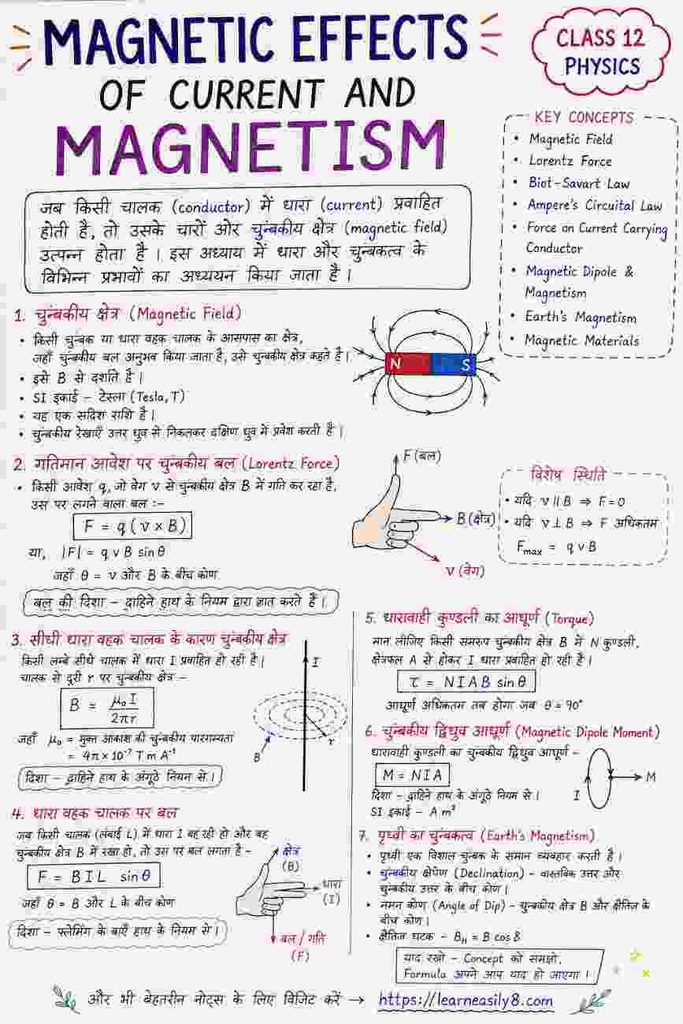
किसी magnet या current-carrying conductor के आसपास का वह क्षेत्र जहाँ magnetic force अनुभव किया जा सकता है, Magnetic Field (चुंबकीय क्षेत्र) कहलाता है। इसे सामान्यतः B से दर्शाते हैं। Magnetic field एक vector quantity है, इसलिए इसकी magnitude और direction दोनों होती हैं। Magnetic field lines की दिशा बाहर से North Pole से South Pole की ओर तथा magnet के अंदर South से North की ओर मानी जाती है।
याद रखने योग्य बातें:
- Symbol: B
- SI Unit: Tesla (T)
- Magnetic field vector quantity है।
- Field lines कभी एक-दूसरे को intersect नहीं करतीं।
- जहाँ field lines अधिक dense हों, वहाँ field अधिक strong होता है।
Magnetic Field Lines (चुंबकीय क्षेत्र रेखाएँ)
Magnetic field को समझाने के लिए imaginary lines का उपयोग किया जाता है जिन्हें Magnetic Field Lines कहते हैं। किसी बिंदु पर field line की tangent उस बिंदु पर magnetic field की दिशा बताती है। Bar magnet के बाहर field lines North Pole से निकलकर South Pole में प्रवेश करती हैं। Magnet के अंदर उनकी दिशा South से North होती है। इसलिए magnetic field lines हमेशा closed continuous curves बनाती हैं।
Important Points:
- Field lines बंद curves होती हैं।
- दो magnetic field lines intersect नहीं करतीं।
- अधिक पास-पास lines = stronger field।
- Tangent gives direction of magnetic field।
- Magnetic field lines का कोई starting या ending point नहीं होता।
Force on a Moving Charge: Lorentz Force
Lorentz Force क्या है?
जब कोई charged particle electric field और magnetic field दोनों में गति करता है, तब उस पर लगने वाले कुल बल को Lorentz Force कहते हैं। यदि केवल magnetic field मौजूद हो, तो moving charge पर magnetic force लगता है। यह force particle की velocity और magnetic field दोनों के perpendicular दिशा में कार्य करता है।
Formula:
F = q(v × B)
Magnitude:
F = qvB sin θ
जहाँ:
- q = charge
- v = velocity
- B = magnetic field
- θ = angle between v and B
यदि electric field भी हो:
F = q(E + v × B)
Direction of Magnetic Force
Magnetic force की दिशा Right-Hand Rule से ज्ञात की जा सकती है। यदि दाहिने हाथ की उंगलियाँ velocity की दिशा में और उन्हें magnetic field की दिशा की ओर मोड़ा जाए, तो अंगूठा positive charge पर लगने वाले force की दिशा बताता है। Negative charge के लिए force की दिशा opposite होगी।
विशेष स्थितियाँ:
- यदि v ∥ B, तो F = 0
- यदि v ⊥ B, तो force maximum होगा।
- Maximum force = qvB
- Magnetic force velocity की दिशा के perpendicular होता है।
- इसलिए magnetic field अकेले particle की speed नहीं बदलता।
Motion of Charged Particle in Magnetic Field
जब charged particle uniform magnetic field में प्रवेश करता है और उसकी velocity magnetic field के perpendicular होती है, तब उस पर लगने वाला magnetic force centripetal force का कार्य करता है। इसके कारण particle circular path में घूमता है। Magnetic force केवल velocity की direction बदलता है, speed नहीं।
महत्वपूर्ण Formula:
qvB = mv²/r
अतः r = mv/qB जहाँ r circular path की radius है।
Time Period:
T = 2πm/qB
Frequency:
f = qB/2πm
Helical Motion of Charged Particle
यदि charged particle की velocity magnetic field के साथ किसी angle पर हो, तो velocity को दो components में बाँटा जाता है:
- v⊥ = v sin θ
- v∥ = v cos θ
Perpendicular component circular motion कराता है जबकि parallel component particle को आगे बढ़ाता है। दोनों motions के combination से particle helical path (सर्पिल पथ) में चलता है।
Important:
- Circular motion due to v⊥
- Linear motion due to v∥
- दोनों मिलकर helix बनाते हैं।
- Magnetic field speed नहीं बदलता।
- यह motion charged particles के अध्ययन में महत्वपूर्ण है।
Cyclotron (साइक्लोट्रॉन)
Cyclotron क्या है?
Cyclotron एक ऐसा उपकरण है जिसका उपयोग charged particles जैसे proton और deuteron को बहुत अधिक ऊर्जा देने के लिए किया जाता है। इसमें electric field particle को accelerate करता है जबकि magnetic field उसे circular path में बनाए रखता है। Particle बार-बार electric field से गुजरता है और हर बार अधिक energy प्राप्त करता है।
Cyclotron Frequency: f = qB/2πm
Uses:
- Nuclear physics experiments
- Medical research
- Particle acceleration
Limitation:
बहुत high speed पर relativistic effects के कारण यह सामान्य रूप से प्रभावी नहीं रहता।
Biot-Savart Law (बायोट-सावर्ट नियम)
Biot-Savart Law किसी current-carrying conductor के छोटे current element द्वारा उत्पन्न magnetic field ज्ञात करने के लिए प्रयोग किया जाता है। Magnetic field current के proportional होता है तथा distance के बढ़ने पर कम होता है।
Formula:
dB = (μ₀/4π) × (I dl sin θ/r²)
जहाँ:
- I = current
- dl = current element
- r = distance
- θ = angle
- μ₀ = permeability of free space
याद रखें:
Magnetic field current के directly proportional है।
Magnetic Field Due to a Straight Current Carrying Wire
एक लंबे straight current-carrying conductor के आसपास circular magnetic field उत्पन्न होता है। इसकी दिशा Right-Hand Thumb Rule से ज्ञात की जाती है। यदि right hand का thumb current की दिशा में रखें, तो मुड़ी हुई fingers magnetic field की दिशा बताती हैं।
Formula:
B = μ₀I/2πr
जहाँ:
- I = current
- r = distance from wire
Important:
- Current बढ़ने पर B बढ़ता है।
- Distance बढ़ने पर B कम होता है।
- Field lines conductor के चारों ओर circles बनाती हैं।
Ampere’s Circuital Law
Ampere’s Circuital Law के अनुसार किसी closed path के along magnetic field का line integral उस path द्वारा enclosed total current के proportional होता है।
Mathematical Form:
∮ B · dl = μ₀I
यह नियम symmetrical current distributions के magnetic field को आसानी से ज्ञात करने में उपयोगी है।
Applications:
- Straight conductor
- Solenoid
- Toroid
यह Biot-Savart Law की तुलना में कुछ symmetric cases में calculation को आसान बनाता है।
Force on a Current Carrying Conductor
जब किसी current-carrying conductor को magnetic field में रखा जाता है, तो conductor पर magnetic force लगता है। इसका कारण conductor में मौजूद moving charges पर magnetic force लगना है।
Formula:
F = I(L × B)
Magnitude:
F = BIL sin θ
जहाँ:
- B = magnetic field
- I = current
- L = length of conductor
यदि conductor और magnetic field perpendicular हों, force maximum होता है।
Fleming’s Left-Hand Rule
Current-carrying conductor पर magnetic force की दिशा ज्ञात करने के लिए Fleming’s Left-Hand Rule प्रयोग किया जाता है।
Rule:
Left hand की:
- First finger → Magnetic Field
- Second finger → Current
- Thumb → Force/Motion
तीनों एक-दूसरे के perpendicular रखे जाते हैं। यह rule electric motors और current-carrying conductors पर force की direction समझने में बहुत उपयोगी है।
Force Between Two Parallel Current Carrying Conductors
दो parallel current-carrying wires एक-दूसरे पर magnetic force लगाते हैं। यदि दोनों wires में current same direction में हो, तो वे एक-दूसरे को attract करती हैं। यदि currents opposite direction में हों, तो wires repel करती हैं।
Force per Unit Length:
F/L = μ₀I₁I₂/2πd
जहाँ:
- I₁, I₂ = currents
- d = distance between wires
यह concept current की magnetic interaction को समझने के लिए महत्वपूर्ण है।
Torque on a Current Loop
जब किसी current-carrying loop को uniform magnetic field में रखा जाता है, तो loop पर torque लगता है। यह torque loop को rotate करने का प्रयास करता है। यही principle electric motor और moving coil instruments में उपयोग होता है।
Formula:
τ = NIAB sin θ
जहाँ:
- N = number of turns
- I = current
- A = area
- B = magnetic field
Maximum torque तब मिलता है जब θ = 90°।
Magnetic Dipole Moment of Current Loop
Current-carrying loop एक magnetic dipole की तरह व्यवहार करता है। इसका magnetic dipole moment loop की magnetic strength और orientation को दर्शाता है।
Formula:
M = NIA
Direction Right-Hand Thumb Rule से ज्ञात की जाती है। Fingers को current की दिशा में मोड़ने पर thumb magnetic dipole moment की दिशा बताता है।
SI Unit:
A m²
Magnetic dipole moment जितना अधिक होगा, magnetic effect उतना अधिक होगा।
Read Also: Electrostatics Class 12 Short Notes for JEE in Hindi | Formula, Concepts & Revision
Moving Coil Galvanometer
Moving Coil Galvanometer एक sensitive instrument है जिसका उपयोग बहुत छोटे electric current को detect और measure करने के लिए किया जाता है। इसमें एक coil को magnetic field में रखा जाता है। जब current flow करता है, coil पर torque लगता है और pointer deflect करता है।
Principle:
Torque on a current-carrying coil in magnetic field
Deflection:
θ ∝ I
इसलिए galvanometer current को measure करने में उपयोगी है।
Current Sensitivity of Galvanometer
Current sensitivity बताती है कि galvanometer प्रति unit current कितना angular deflection देता है।
Formula:
Current Sensitivity = θ/I
Moving coil galvanometer की sensitivity बढ़ाने के लिए:
- Number of turns बढ़ाएँ।
- Magnetic field बढ़ाएँ।
- Coil का area बढ़ाएँ।
- Torsional constant कम करें।
Sensitive galvanometer छोटे currents को detect करने में अधिक प्रभावी होता है।
Conversion of Galvanometer into Ammeter
Galvanometer केवल छोटे currents को measure कर सकता है। इसे ammeter बनाने के लिए इसके parallel में एक low resistance लगाया जाता है जिसे shunt resistance कहते हैं। अधिकांश current shunt से गुजरता है और केवल छोटा current galvanometer से गुजरता है।
Ammeter की विशेषता:
- Low resistance
- Circuit में series में लगाया जाता है।
- Current measure करता है।
इस प्रकार galvanometer को बड़ी current range के लिए उपयोग किया जा सकता है।
Conversion of Galvanometer into Voltmeter
Galvanometer को voltmeter में बदलने के लिए उसके series में high resistance लगाया जाता है। इसे high resistance या multiplier resistance कहा जाता है। इससे galvanometer में बहुत कम current flow करता है।
Voltmeter की विशेषता:
- High resistance
- Parallel में connect किया जाता है।
- Potential difference measure करता है।
Ideal voltmeter का resistance theoretically infinite माना जाता है।
Bar Magnet as a Magnetic Dipole
एक bar magnet को magnetic dipole माना जाता है क्योंकि इसके दो poles होते हैं—North और South। इसकी magnetic field electric dipole की field से कुछ हद तक समान होती है। Bar magnet का magnetic dipole moment उसकी magnetic strength और poles के बीच की दूरी पर निर्भर करता है।
Magnetic Dipole Moment:
M = m(2l)
जहाँ:
- m = pole strength
- 2l = magnetic length
Direction South Pole से North Pole की ओर होती है।
Magnetic Field Due to a Bar Magnet
Bar magnet के magnetic field को मुख्य रूप से दो positions पर पढ़ा जाता है:
- Axial Position
- Equatorial Position
Axial position में field magnetic axis के along होती है। Equatorial position में field magnet के perpendicular plane पर होती है। दोनों positions पर field की direction अलग होती है।
Far away from magnet:
B ∝ M/r³
अर्थात distance बढ़ने पर magnetic field तेजी से कम होता है।
Torque on a Magnetic Dipole
जब magnetic dipole को uniform magnetic field में रखा जाता है, तो उस पर torque लगता है। यह torque dipole को magnetic field की दिशा में align करने का प्रयास करता है।
Formula:
τ = MB sin θ
जहाँ:
- M = magnetic dipole moment
- B = magnetic field
- θ = angle
Torque maximum at 90° और zero at 0° तथा 180°।
Potential Energy of a Magnetic Dipole
Magnetic field में रखे magnetic dipole की potential energy उसकी orientation पर निर्भर करती है।
Formula:
U = -MB cos θ
जब magnetic dipole field के parallel होता है, potential energy minimum होती है। इसलिए यह स्थिति stable equilibrium कहलाती है। जब dipole field के opposite होता है, potential energy maximum होती है और स्थिति unstable होती है।
Important:
- Parallel → Stable equilibrium
- Antiparallel → Unstable equilibrium
Earth’s Magnetism (पृथ्वी का चुंबकत्व)
Earth लगभग एक विशाल magnet की तरह व्यवहार करती है और इसके आसपास magnetic field मौजूद है। पृथ्वी का geographical North और magnetic North बिल्कुल समान नहीं होते। इसी कारण compass needle पृथ्वी के geographical north की बजाय magnetic field की दिशा में align होती है।
Earth’s magnetic field के मुख्य elements हैं:
- Magnetic Declination
- Angle of Dip
- Horizontal Component
ये पृथ्वी के magnetic field को समझने के लिए महत्वपूर्ण हैं।
Magnetic Declination
Geographical meridian और magnetic meridian के बीच बनने वाले angle को Magnetic Declination कहते हैं। यह पृथ्वी पर अलग-अलग स्थानों पर अलग हो सकता है।
सरल भाषा में:
True geographical north और compass द्वारा दिखाई जाने वाली magnetic north direction के बीच का angular difference ही declination है।
Navigation और geographical measurements में इसका महत्व होता है क्योंकि compass needle हमेशा true north की दिशा नहीं दिखाती।
Angle of Dip (Magnetic Inclination)
Earth’s magnetic field और horizontal direction के बीच बनने वाला angle Angle of Dip या Magnetic Inclination कहलाता है।
Important Points:
- Magnetic equator पर dip = 0°
- Magnetic poles पर dip लगभग 90°
- Northern hemisphere में magnetic needle का north end नीचे की ओर झुकता है।
- Southern hemisphere में south end नीचे झुकता है।
Dip angle पृथ्वी के magnetic field की direction समझने में उपयोगी है।
Horizontal Component of Earth’s Magnetic Field
Earth’s magnetic field B को horizontal और vertical components में resolve किया जा सकता है। Horizontal component को BH कहते हैं।
Formula:
BH = B cos δ
जहाँ δ = angle of dip
यह component compass needle को horizontal plane में rotate करने के लिए responsible होता है।
याद रखें:
- Magnetic equator पर BH maximum होता है।
- Magnetic poles पर BH लगभग zero होता है।
Magnetism and Matter
कुछ पदार्थ magnetic field के प्रति अलग-अलग प्रकार से प्रतिक्रिया करते हैं। इसी आधार पर magnetic materials को मुख्यतः तीन categories में बाँटा जाता है:
- Diamagnetic
- Paramagnetic
- Ferromagnetic
इन पदार्थों का behavior उनकी atomic और molecular structure पर निर्भर करता है। Magnetic susceptibility और permeability इनके magnetic properties को समझने के महत्वपूर्ण physical quantities हैं।
Diamagnetic Substances
Diamagnetic substances weakly magnetic field से repel होते हैं। जब इन्हें external magnetic field में रखा जाता है, तो इनमें induced magnetic moment field की opposite direction में उत्पन्न होता है।
Examples:
- Bismuth
- Copper
- Silver
- Gold
- Water
Properties:
- Weakly repelled by magnetic field
- Magnetic susceptibility negative होती है।
- Relative permeability slightly less than 1 होती है।
- Permanent magnetism नहीं दिखाते।
Paramagnetic Substances
Paramagnetic substances external magnetic field की ओर weakly attract होते हैं। इनके atoms या molecules में permanent magnetic dipoles हो सकते हैं, लेकिन सामान्य अवस्था में वे random directions में रहते हैं।
Examples:
- Aluminium
- Platinum
- Oxygen
Properties:
- Weakly attracted by magnetic field
- Susceptibility positive होती है।
- Magnetization field की direction में होती है।
- Temperature बढ़ने पर paramagnetism कम हो सकता है।
Ferromagnetic Substances
Ferromagnetic substances magnetic field से बहुत strongly attract होते हैं। इनके अंदर magnetic domains होते हैं जो external field में एक दिशा में align हो सकते हैं। इसलिए ये strong magnetism प्रदर्शित करते हैं।
Examples:
- Iron
- Cobalt
- Nickel
Properties:
- Strongly attracted by magnetic field
- Large positive susceptibility
- Permanent magnet बनाया जा सकता है।
- Domains magnetism में महत्वपूर्ण भूमिका निभाते हैं।
Magnetic Domains
Ferromagnetic materials के अंदर छोटे-छोटे regions होते हैं जिन्हें Magnetic Domains कहा जाता है। प्रत्येक domain एक छोटे magnet की तरह कार्य करता है। Unmagnetised पदार्थ में domains अलग-अलग directions में होते हैं, इसलिए net magnetism लगभग zero होता है।
जब external magnetic field लगाया जाता है, domains एक दिशा में align होने लगते हैं और पदार्थ magnetised हो जाता है।
Know More: Nernst Equation Class 12: Definition, Formula, Derivation, Uses and Important Questions in Hindi
Curie’s Law
Paramagnetic substances की magnetic susceptibility temperature पर निर्भर करती है। Curie’s Law के अनुसार paramagnetic substance की susceptibility absolute temperature के inversely proportional होती है।
Formula:
χ ∝ 1/T या χ = C/T
जहाँ:
- χ = magnetic susceptibility
- C = Curie constant
- T = absolute temperature
Temperature बढ़ने पर paramagnetic behavior सामान्यतः कम होता है।
Curie Temperature
वह critical temperature जिसके ऊपर ferromagnetic substance अपना strong ferromagnetic property खोकर paramagnetic behavior दिखाने लगता है, Curie Temperature कहलाता है।
Curie temperature से नीचे magnetic domains अधिक व्यवस्थित हो सकते हैं। Temperature बढ़ने पर thermal motion domains के alignment को disturb करता है।
Examples of concept:
- Iron में एक निश्चित Curie temperature होता है।
- Curie temperature के ऊपर strong permanent magnetism समाप्त हो जाता है।
Magnetic Susceptibility
किसी पदार्थ में external magnetic field लगाने पर उत्पन्न magnetisation की क्षमता को magnetic susceptibility से समझा जाता है।
Formula:
χm = M/H
जहाँ:
- M = intensity of magnetisation
- H = magnetising field
Values:
- Diamagnetic → Negative
- Paramagnetic → Small positive
- Ferromagnetic → Very large positive
Susceptibility से पता चलता है कि कोई material magnetic field के प्रति कितना responsive है।
Magnetisation (Intensity of Magnetisation)
Magnetisation किसी material में प्रति unit volume उत्पन्न magnetic dipole moment है।
Formula:
M = Magnetic Moment/Volume
इसकी SI unit A/m है।
जब किसी magnetic substance को external magnetic field में रखा जाता है, उसके atomic dipoles partially या completely align हो सकते हैं। इस alignment के कारण material magnetised होता है। Magnetisation material के magnetic nature और applied field दोनों पर निर्भर करती है।
Magnetic Permeability
Magnetic permeability बताती है कि कोई medium magnetic field को अपने अंदर से गुजरने देने में कितना सक्षम है।
Formula:
μ = B/H
जहाँ:
- B = magnetic field
- H = magnetising field
Vacuum की permeability को μ₀ कहते हैं।
Relative Permeability:
μr = μ/μ₀
Diamagnetic materials में μr थोड़ा कम तथा paramagnetic और ferromagnetic materials में अधिक हो सकता है।
Permanent Magnets
Permanent magnets ऐसे materials से बनाए जाते हैं जो लंबे समय तक अपनी magnetism बनाए रख सकें। इनके लिए high retentivity और high coercivity वाले materials उपयुक्त होते हैं।
Characteristics:
- Strong magnetism लंबे समय तक बनाए रखते हैं।
- आसानी से demagnetise नहीं होते।
- Hard magnetic materials से बनाए जाते हैं।
- Loudspeakers, motors और measuring instruments में उपयोग होते हैं।
Steel और विशेष alloys permanent magnets बनाने में उपयोगी हो सकते हैं।
Electromagnets
Electromagnet वह magnet है जो electric current के कारण बनता है। जब solenoid या coil में current flow किया जाता है, तब magnetic field उत्पन्न होती है। Soft iron core लगाने पर magnetic field बहुत strong हो सकती है।
Advantages:
- Current बंद करने पर magnetism समाप्त किया जा सकता है।
- Magnetic strength को control किया जा सकता है।
- Cranes और electric devices में उपयोग होता है।
- Electric bells और relays में महत्वपूर्ण है।
Solenoid and Magnetic Field
Solenoid एक लंबी cylindrical coil होती है जिसमें बहुत सारे turns होते हैं। जब इसमें electric current flow करता है, तो इसके अंदर लगभग uniform magnetic field उत्पन्न होती है।
Formula:
B = μ₀nI
जहाँ:
- n = number of turns per unit length
- I = current
Solenoid का magnetic behavior एक bar magnet जैसा होता है। इसके एक end को North तथा दूसरे end को South Pole माना जा सकता है।
Important Difference: Electric Field and Magnetic Field
| Electric Field | Magnetic Field |
|---|---|
| Electric charges produce electric field | Moving charges/current produce magnetic field |
| Stationary charge पर force लगता है | Magnetic force moving charge पर लगता है |
| Force can change speed | Magnetic force generally direction बदलता है |
| Unit: N/C or V/m | Unit: Tesla |
दोनों fields electromagnetic phenomena का महत्वपूर्ण हिस्सा हैं और आधुनिक physics तथा electrical technology की foundation बनाते हैं।
Important Formula Revision
Moving Charge: F = qvB sin θ
Lorentz Force: F = q(E + v × B)
Circular Radius: r = mv/qB
Time Period: T = 2πm/qB
Straight Wire: B = μ₀I/2πr
Force on Conductor: F = BIL sin θ
Torque on Coil: τ = NIAB sin θ
Magnetic Dipole Torque: τ = MB sin θ
Potential Energy: U = -MB cos θ
Most Important NCERT Concepts for Exam
विद्यार्थियों को निम्न topics विशेष रूप से अच्छी तरह तैयार करने चाहिए:
- Lorentz Force
- Motion of charged particle
- Cyclotron
- Biot-Savart Law
- Ampere’s Circuital Law
- Force between parallel conductors
- Torque on current loop
- Moving Coil Galvanometer
- Bar Magnet
- Earth’s Magnetism
- Diamagnetic, Paramagnetic और Ferromagnetic substances
- Magnetic Domains
- Curie’s Law
इन topics से conceptual और numerical दोनों प्रकार के प्रश्न पूछे जा सकते हैं।
One-Line Important Questions and Answers
Q1. Magnetic field की SI unit क्या है?
Answer: Tesla (T)
Q2. Magnetic force maximum कब होता है?
जब velocity और magnetic field के बीच angle 90° हो।
Q3. समान दिशा में parallel currents क्या करते हैं?
एक-दूसरे को attract करते हैं।
Q4. Diamagnetic substances magnetic field के प्रति कैसे behave करते हैं?
Weakly repel होते हैं।
Q5. Galvanometer किसलिए उपयोग होता है?
Small electric current को detect करने के लिए।
Q6. Cyclotron किस principle पर काम करता है?
Electric field द्वारा acceleration और magnetic field द्वारा circular motion।
Conclusion
Magnetic Effects of Current and Magnetism Class 12 Physics का अत्यंत महत्वपूर्ण chapter है। इस chapter में electric current और magnetism के गहरे संबंध को समझाया जाता है। Moving charges, current-carrying conductors, magnetic fields और magnetic materials सभी इसी विषय का हिस्सा हैं। यदि विद्यार्थी formulas को केवल याद करने के बजाय उनके concepts और directions को समझकर पढ़ें, तो numericals और theoretical questions दोनों आसानी से हल किए जा सकते हैं। NCERT के diagrams, definitions और examples का revision अवश्य करें।
FAQs – Magnetic Effects of Current and Magnetism Class 12
1. What is the Magnetic Effect of Current?
जब किसी conductor में electric current प्रवाहित होता है, तो उसके आसपास magnetic field उत्पन्न होता है। इसी घटना को Magnetic Effect of Current कहते हैं।
2. What is a Magnetic Field?
किसी magnet या current-carrying conductor के आसपास का वह क्षेत्र जहाँ magnetic force महसूस किया जा सकता है, Magnetic Field कहलाता है।
3. What is the SI unit of Magnetic Field?
Magnetic Field की SI unit Tesla (T) है।
4. What is Lorentz Force?
Electric और magnetic field में moving charged particle पर लगने वाले कुल force को Lorentz Force कहते हैं।
Formula: F = q(E + v × B)
5. When is Magnetic Force Maximum?
जब charged particle की velocity और magnetic field के बीच angle 90° होता है, तब magnetic force maximum होता है।
F = qvB
6. Can a Magnetic Field Change the Speed of a Charged Particle?
नहीं। Magnetic field सामान्यतः charged particle की direction बदलता है, speed नहीं, क्योंकि magnetic force velocity के perpendicular होता है।
7. What is Biot-Savart Law?
यह law बताता है कि किसी current element द्वारा उत्पन्न magnetic field current, distance और angle पर निर्भर करता है।
8. What is Ampere’s Circuital Law?
Ampere’s Circuital Law के अनुसार closed path के along magnetic field का line integral enclosed current के proportional होता है।
∮B·dl = μ₀I
9. Which Rule is Used to Find the Direction of Magnetic Field?
Right-Hand Thumb Rule का उपयोग current-carrying conductor के आसपास magnetic field की direction ज्ञात करने के लिए किया जाता है।
10. What is Fleming’s Left-Hand Rule?
यह rule magnetic field में रखे current-carrying conductor पर लगने वाले force की direction ज्ञात करने के लिए प्रयोग किया जाता है।
11. What Happens Between Two Parallel Current-Carrying Wires?
यदि दोनों wires में current same direction में हो, तो वे attract करती हैं। यदि current opposite directions में हो, तो वे repel करती हैं।
12. What is the Formula for Force on a Current-Carrying Conductor?
Current-carrying conductor पर magnetic force:
F = BIL sin θ
13. What is Magnetic Dipole Moment?
किसी magnet या current loop की magnetic strength और orientation को दर्शाने वाली quantity को Magnetic Dipole Moment कहते हैं।
Current loop के लिए:
M = NIA
14. What is Torque on a Current Loop?
Magnetic field में current-carrying loop को rotate करने वाला turning effect Torque कहलाता है।
τ = NIAB sin θ
15. What is a Moving Coil Galvanometer?
Moving Coil Galvanometer एक sensitive instrument है जिसका उपयोग बहुत छोटे electric currents को detect करने के लिए किया जाता है।
16. How is a Galvanometer Converted into an Ammeter?
Galvanometer के parallel में एक low resistance (shunt) जोड़कर उसे Ammeter में बदला जाता है।
17. How is a Galvanometer Converted into a Voltmeter?
Galvanometer के series में high resistance जोड़कर उसे Voltmeter में बदला जाता है।
18. What is Cyclotron?
Cyclotron एक device है जिसका उपयोग charged particles को high energy तक accelerate करने के लिए किया जाता है।
19. What is Earth’s Magnetism?
पृथ्वी लगभग एक विशाल magnet की तरह व्यवहार करती है और इसके आसपास अपना magnetic field होता है।
20. What is Angle of Dip?
Earth’s magnetic field और horizontal direction के बीच बनने वाले angle को Angle of Dip या Magnetic Inclination कहते हैं।
21. What is Magnetic Declination?
Geographical meridian और magnetic meridian के बीच बनने वाले angle को Magnetic Declination कहते हैं।
22. What are Diamagnetic Substances?
वे पदार्थ जो magnetic field से weakly repel होते हैं, Diamagnetic substances कहलाते हैं।
Examples: Copper, Bismuth, Silver
23. What are Paramagnetic Substances?
वे पदार्थ जो magnetic field की ओर weakly attract होते हैं, Paramagnetic substances कहलाते हैं।
Examples: Aluminium, Platinum, Oxygen
24. What are Ferromagnetic Substances?
वे पदार्थ जो magnetic field से strongly attract होते हैं, Ferromagnetic substances कहलाते हैं।
Examples: Iron, Cobalt, Nickel
25. What are Magnetic Domains?
Ferromagnetic substances के अंदर छोटे-छोटे regions, जो छोटे magnets की तरह behave करते हैं, Magnetic Domains कहलाते हैं।
26. What is Curie’s Law?
Curie’s Law के अनुसार paramagnetic substance की magnetic susceptibility absolute temperature के inversely proportional होती है।
χ = C/T
27. What is Curie Temperature?
वह critical temperature जिसके ऊपर ferromagnetic material अपना ferromagnetic property खोकर paramagnetic behavior दिखाने लगता है, Curie Temperature कहलाता है।
28. What is Magnetic Susceptibility?
किसी material की external magnetic field के प्रति magnetise होने की क्षमता को Magnetic Susceptibility कहते हैं।
χ = M/H
29. What is the Difference Between Permanent Magnet and Electromagnet?
Permanent magnet लंबे समय तक magnetism बनाए रखता है, जबकि electromagnet electric current की सहायता से temporary magnetic field उत्पन्न करता है।
30. Why is Magnetic Effects of Current Important for Class 12?
यह chapter electric motors, generators, galvanometers, cyclotrons और आधुनिक electromagnetic devices को समझने का आधार प्रदान करता है। यह Board Exam के साथ-साथ JEE और अन्य competitive exams के लिए भी बहुत महत्वपूर्ण है।