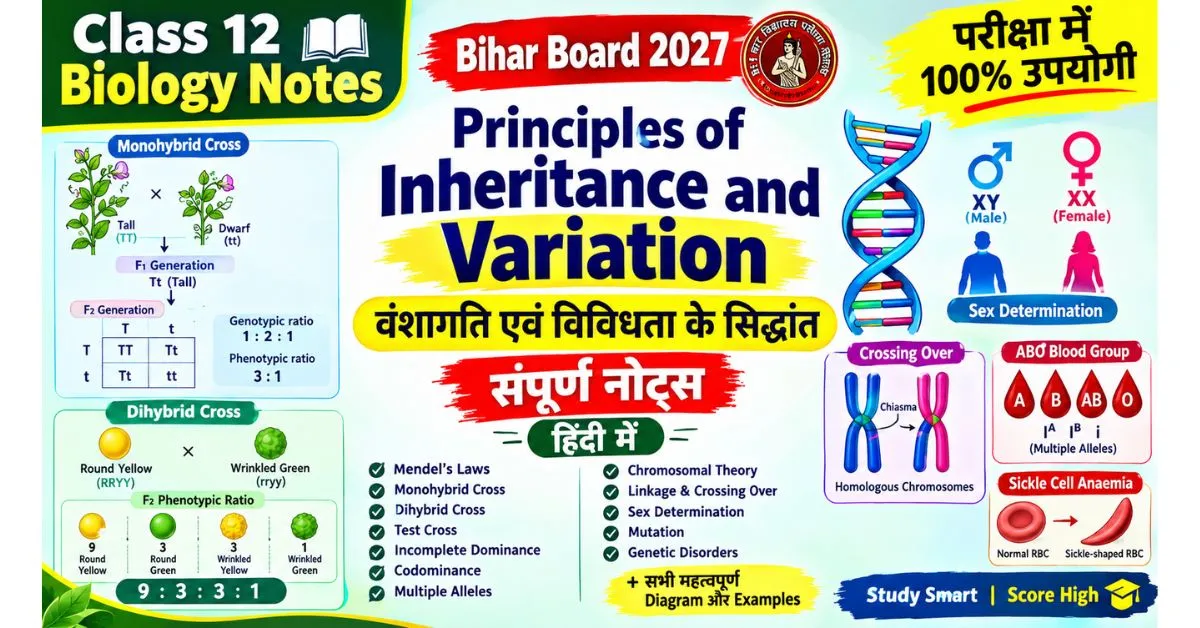
Principles of Inheritance and Variation (वंशागति एवं विविधता के सिद्धांत) Class 12 Biology का एक महत्वपूर्ण और परीक्षा की दृष्टि से उपयोगी chapter है। इस अध्याय में विद्यार्थियों को समझाया जाता है कि माता-पिता के genetic characters संतान में किस प्रकार transfer होते हैं और organisms में variation क्यों दिखाई देता है। इस chapter में Mendel’s Laws, Monohybrid Cross, Dihybrid Cross, Test Cross, Incomplete Dominance, Codominance, Multiple Alleles, Chromosomal Theory of Inheritance, Linkage, Crossing Over, Sex Determination, Mutation और Genetic Disorders जैसे महत्वपूर्ण topics शामिल हैं।
इन Class 12 Biology Notes in Hindi में concepts को सरल भाषा में examples, tables, genetic crosses और important diagrams के साथ समझाया गया है। Bihar Board 2027 की तैयारी करने वाले students के लिए ये notes quick revision और board exam preparation में उपयोगी हो सकते हैं। विशेष रूप से Mendel के laws, genetic ratios, ABO blood group, sex determination और genetic disorders को ध्यान से पढ़ें। Download NCERT BOOK IN HINDI PDF.
Principles of Inheritance and Variation Class 12: Biology Notes
Principles of Inheritance and Variation (वंशागति एवं विविधता के सिद्धांत) Class 12 Biology का एक महत्वपूर्ण chapter है। इसमें यह समझाया जाता है कि माता-पिता के genetic characters संतान में किस प्रकार transfer होते हैं और offspring में variation क्यों दिखाई देता है। इस chapter में Mendel’s Laws, Monohybrid Cross, Dihybrid Cross, Test Cross, Back Cross, Incomplete Dominance, Codominance, Multiple Alleles, Chromosomal Theory of Inheritance, Linkage, Crossing Over, Sex Determination, Mutation और Genetic Disorders जैसे महत्वपूर्ण topics शामिल हैं। Bihar Board परीक्षा की तैयारी के लिए इन concepts को definitions, examples, crosses और diagrams के साथ समझना उपयोगी है।
Heredity क्या है? — वंशागति
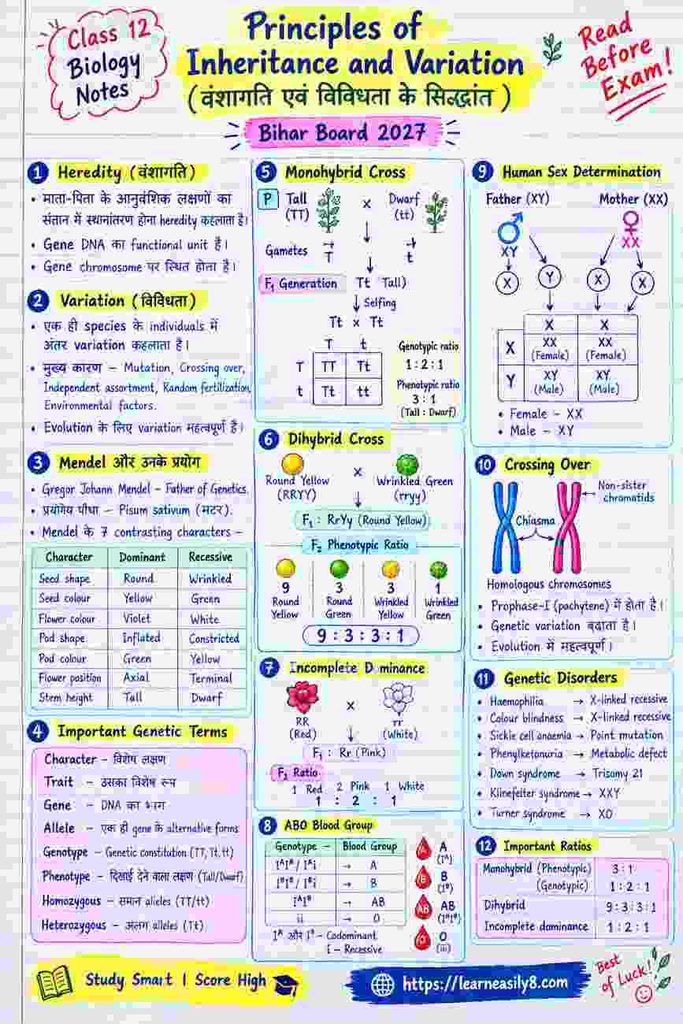
Heredity (वंशागति) वह biological process है जिसके द्वारा माता-पिता के hereditary characters उनके offspring में transfer होते हैं।
उदाहरण:
- आंखों का रंग
- बालों का प्रकार
- रक्त समूह
- कुछ genetic diseases
इन characters के transmission में genes महत्वपूर्ण भूमिका निभाते हैं।
Gene क्या है?
Gene DNA का functional unit है जो किसी विशेष character या protein की information रखता है। Gene chromosome पर स्थित होता है।
Variation क्या है? — विविधता
एक ही species के individuals में पाए जाने वाले differences को Variation (विविधता) कहते हैं।
उदाहरण के लिए, एक परिवार के सदस्यों में height, skin colour, blood group आदि में अंतर हो सकता है।
Variation के प्रमुख कारण
- Mutation
- Crossing over
- Independent assortment
- Random fertilization
- Environmental factors
Variation evolution के लिए महत्वपूर्ण है।
Mendel और Genetics
Gregor Johann Mendel को Father of Genetics (आनुवंशिकी का जनक) कहा जाता है।
उन्होंने garden pea (Pisum sativum) पर प्रयोग करके inheritance के नियमों को समझाया।
Mendel ने pea plant को क्यों चुना?
- आसानी से उगता है।
- इसका life cycle छोटा है।
- इसमें कई contrasting characters होते हैं।
- Self-pollination आसानी से होती है।
- Artificial cross-pollination संभव है।
- इसमें कई offspring प्राप्त किए जा सकते हैं।
Mendel के सात Contrasting Characters
| Character | Dominant | Recessive |
|---|---|---|
| Seed shape | Round | Wrinkled |
| Seed colour | Yellow | Green |
| Flower colour | Violet | White |
| Pod shape | Inflated | Constricted |
| Pod colour | Green | Yellow |
| Flower position | Axial | Terminal |
| Stem height | Tall | Dwarf |
Exam Tip: Mendel के सात contrasting characters से अक्सर objective questions पूछे जाते हैं।
Important Genetic Terms
Character
किसी organism की कोई विशेष hereditary feature character कहलाती है।
Trait
किसी character का specific form trait कहलाता है।
उदाहरण: Height एक character है, जबकि Tall और Dwarf उसके traits हैं।
Alleles
एक ही gene के alternative forms को alleles कहते हैं।
उदाहरण:
T = Tall
t = Dwarf
Genotype
Organism का genetic constitution genotype कहलाता है।
उदाहरण: TT, Tt, tt
Phenotype
Organism का दिखाई देने वाला character phenotype कहलाता है।
उदाहरण: Tall या Dwarf
Homozygous
जब दोनों alleles समान हों।
TT या tt
Heterozygous
जब दोनों alleles अलग हों।
Tt
Dominant और Recessive Character
जो allele heterozygous condition में अपना effect express करता है उसे Dominant allele कहते हैं।
जो allele heterozygous condition में express नहीं होता उसे Recessive allele कहते हैं।
उदाहरण:
Tt → Tall
यहाँ T dominant allele है और t recessive allele है।
Monohybrid Cross
जब एक pair of contrasting characters का inheritance study किया जाता है तो इसे Monohybrid Cross कहते हैं।
उदाहरण:
Tall plant × Dwarf plant
Parental generation
TT × tt
Gametes:
T × t
F₁ Generation
सभी offspring:
Tt = Tall
जब F₁ plants को self-cross कराया जाता है:
Tt × Tt
Punnett Square:
| T | t | |
|---|---|---|
| T | TT | Tt |
| t | Tt | tt |
Genotypic Ratio
1 TT : 2 Tt : 1 tt
Phenotypic Ratio
3 Tall : 1 Dwarf
यह Mendel के Law of Dominance और Law of Segregation को समझाने में उपयोगी है।
      P Generation

   Tall        ×        Dwarf
    TT                   tt
     ↓                    ↓
   Gamete                Gamete
     T                    t

          ↓ Fertilisation

         F₁ Generation
            Tt
         Tall plant

             ↓ Selfing

          Tt × Tt

          ┌─────┬─────┐
          │  T  │  t  │
    ┌─────┼─────┼─────┤
    │  T  │ TT  │ Tt  │
    ├─────┼─────┼─────┤
    │  t  │ Tt  │ tt  │
    └─────┴─────┴─────┘
Genotypic ratio = 1 TT : 2 Tt : 1 tt
Phenotypic ratio = 3 Tall : 1 Dwarf
Law of Dominance
Mendel के अनुसार, जब दो contrasting alleles heterozygous condition में होते हैं, तो उनमें से एक allele dominant होता है और दूसरे का expression suppress हो जाता है।
उदाहरण:
Tt → Tall
यहाँ T dominant है और t recessive है।
Law of Segregation
इस law के अनुसार किसी character के दोनों alleles gamete formation के समय एक-दूसरे से अलग हो जाते हैं और प्रत्येक gamete में केवल एक allele जाता है।
इसे Law of Purity of Gametes भी कहा जाता है।
उदाहरण:
Tt → T + t
Dihybrid Cross
जब दो pairs of contrasting characters का inheritance एक साथ study किया जाता है, तो उसे Dihybrid Cross कहते हैं।
उदाहरण:
Round Yellow × Wrinkled Green
Genotypes:
RRYY × rryy
F₁: RrYy
F₁ का self-cross: RrYy × RrYy
F₂ generation का phenotypic ratio:
9 : 3 : 3 : 1
| Phenotype | Ratio |
|---|---|
| Round Yellow | 9 |
| Round Green | 3 |
| Wrinkled Yellow | 3 |
| Wrinkled Green | 1 |
Law of Independent Assortment
Mendel के अनुसार, दो या अधिक pairs of contrasting characters के alleles gamete formation के दौरान एक-दूसरे से independently assort हो सकते हैं।
Dihybrid cross में इसका classical phenotypic ratio:
9 : 3 : 3 : 1
होता है।
Test Cross
जब किसी organism के unknown genotype को ज्ञात करने के लिए उसे homozygous recessive individual से cross कराया जाता है, तो इसे Test Cross कहते हैं।
उदाहरण:
T_ × tt
यदि सभी offspring Tall आएं, तो unknown plant के homozygous dominant होने की संभावना होती है।
यदि offspring में Tall और Dwarf दोनों मिलें, तो unknown parent heterozygous हो सकता है।
Back Cross
F₁ hybrid को उसके किसी parent के साथ cross कराने को Back Cross कहते हैं।
Back cross में F₁ individual को:
- dominant parent, या
- recessive parent
में से किसी के साथ cross कराया जा सकता है।
Test cross, back cross का एक विशेष प्रकार माना जाता है जब F₁/unknown dominant phenotype को homozygous recessive parent से cross किया जाता है।
Incomplete Dominance
जब heterozygous condition में कोई भी allele पूरी तरह dominant नहीं होता और intermediate phenotype दिखाई देता है, तो इसे Incomplete Dominance कहते हैं।
Example: Snapdragon
Red flower × White flower
RR × rr
F₁:
Rr = Pink
F₂:
RR : Rr : rr
1 Red : 2 Pink : 1 White
यहाँ phenotypic ratio भी 1 : 2 : 1 होता है।
Codominance
जब heterozygous individual में दोनों alleles simultaneously express होते हैं, तो इसे Codominance कहते हैं।
Example: ABO Blood Group
Blood group में:
Iᴬ और Iᴮ codominant alleles हैं।
यदि genotype:
IᴬIᴮ
है, तो phenotype AB blood group होता है।
Multiple Alleles
जब किसी gene के दो से अधिक alternative forms population में पाए जाते हैं, तो उन्हें Multiple Alleles कहते हैं।
ABO blood group इसका प्रसिद्ध उदाहरण है।
तीन alleles हैं:
Iᴬ, Iᴮ और i
Possible blood groups:
| Genotype | Blood Group |
|---|---|
| IᴬIᴬ / Iᴬi | A |
| IᴮIᴮ / Iᴮi | B |
| IᴬIᴮ | AB |
| ii | O |
Chromosomal Theory of Inheritance
Sutton और Boveri ने Chromosomal Theory of Inheritance प्रस्तावित की। इस theory के अनुसार:
- Genes chromosomes पर स्थित होते हैं।
- Chromosomes pairs में पाए जाते हैं।
- Homologous chromosomes meiosis के दौरान अलग होते हैं।
- Chromosome behaviour और Mendelian factors के behaviour में समानता होती है।
इससे inheritance में chromosomes की भूमिका स्पष्ट हुई।
Linkage
एक ही chromosome पर स्थित genes जो साथ-साथ inherit होने की tendency रखते हैं, उनके association को Linkage कहते हैं।
Linkage की concept को T.H. Morgan के experiments से support मिला।
Crossing Over
Meiosis के दौरान homologous chromosomes के non-sister chromatids के बीच genetic material के exchange को Crossing Over कहते हैं। यह genetic recombination उत्पन्न करता है।
Importance
- Genetic variation बढ़ाता है।
- New combinations of genes उत्पन्न करता है।
- Evolution में महत्वपूर्ण भूमिका निभाता है।
- Read More in Physics: Electronic Devices Class 12 Notes in Hindi | Semiconductor Electronics, Diode & Rectifier
- Atoms and Nuclei Class 12 Notes in Hindi | परमाणु एवं नाभिक NCERT Physics Notes, Formula & Important Questions
- Dual Nature of Radiation and Matter Class 12 Notes in Hindi | NCERT Physics Notes, Formula & Important Questions
- Wave Optics Class 12 Notes in Hindi | NCERT Physics, Derivations, Numericals & MCQs
- Ray Optics Class 12 Notes in Hindi | किरण प्रकाशिकी NCERT Physics Notes, Formula & Important Questions
- Electromagnetic Waves Class 12 Notes in Hindi | विद्युत चुंबकीय तरंगें NCERT Physics
Recombination
Parent से अलग नए combinations of genes बनने की process को Genetic Recombination कहते हैं। Crossing over इसका एक महत्वपूर्ण mechanism है।
Sex Determination
Sex determination वह mechanism है जिससे offspring का sex निर्धारित होता है।
Humans में:
Female = XX
Male = XY
Female के eggs में केवल X chromosome होता है।
Male के sperms दो प्रकार के होते हैं X-bearing sperm और Y-bearing sperm
यदि X sperm egg से fuse करता है:
XX → Female
यदि Y sperm fuse करता है:
XY → Male
इसलिए human offspring का chromosomal sex sperm के chromosome पर निर्भर करता है।
Sex-linked Inheritance
Sex chromosomes पर स्थित genes से संबंधित inheritance को Sex-linked inheritance कहते हैं।
Humans में X chromosome पर कई genes पाए जाते हैं।
Examples
- Haemophilia
- Colour blindness
ये सामान्यतः X-linked recessive disorders के examples हैं।
Haemophilia
Haemophilia एक hereditary blood disorder है जिसमें blood clotting की क्षमता प्रभावित होती है।
यह सामान्यतः X-linked recessive disorder के रूप में inherited होता है।
पुरुषों में एक ही X chromosome होने के कारण recessive allele के expression की संभावना अधिक होती है।
Colour Blindness
Colour blindness में व्यक्ति को कुछ colours को distinguish करने में difficulty होती है।
यह भी सामान्यतः X-linked recessive trait है।
इसलिए इसका inheritance sex chromosomes से जुड़ा होता है।
Mutation
DNA या genetic material में होने वाला अचानक और heritable change Mutation कहलाता है।
Mutation genetic variation का एक महत्वपूर्ण source है।
Mutation के प्रकार
- Gene mutation
- Chromosomal mutation
Example
Sickle-cell anaemia एक point mutation से संबंधित genetic disorder है।
Sickle Cell Anaemia
यह एक genetic disorder है जिसमें haemoglobin की β-chain में amino acid substitution के कारण abnormal haemoglobin बनता है।
सामान्य β-globin chain में एक amino acid की जगह दूसरा amino acid आ जाता है।
इससे RBC की shape प्रभावित हो सकती है और वे sickle-shaped दिखाई दे सकते हैं।
Genetic Disorders
Genetic disorders वे diseases हैं जो genetic material में परिवर्तन के कारण उत्पन्न होती हैं।
Important examples
| Disorder | Major Cause |
|---|---|
| Haemophilia | X-linked recessive |
| Colour blindness | X-linked recessive |
| Sickle-cell anaemia | Point mutation |
| Phenylketonuria | Metabolic/genetic defect |
| Down syndrome | Trisomy 21 |
| Klinefelter syndrome | XXY |
| Turner syndrome | XO |
Down Syndrome
Down syndrome chromosome number में abnormality के कारण होता है।
इसमें chromosome 21 की तीन copies होती हैं।
इसलिए इसे Trisomy 21 कहा जाता है।
Klinefelter Syndrome
Klinefelter syndrome में सामान्यतः 47, XXY chromosomal constitution पाया जाता है।
यह male individual में होता है।
Turner Syndrome
Turner syndrome में सामान्यतः 45, XO chromosomal constitution होता है।
यह female individual में पाया जाता है।
Pedigree Analysis
किसी family में किसी genetic character या disorder के inheritance pattern को diagram द्वारा study करने को Pedigree Analysis कहते हैं।
Common symbols
- Square → Male
- Circle → Female
- Shaded symbol → Affected individual
- Horizontal line → Mating
- Vertical line → Offspring
Pedigree analysis genetic counselling में उपयोगी है।
Mendelian Disorders और Chromosomal Disorders में अंतर
| Mendelian Disorders | Chromosomal Disorders |
|---|---|
| Gene level changes से जुड़े होते हैं | Chromosome number/structure से जुड़े होते हैं |
| Single gene inheritance हो सकता है | Chromosomal abnormality प्रमुख कारण है |
| Haemophilia example है | Down syndrome example है |
| Sickle-cell anaemia example है | Turner syndrome example है |
Important Ratios for Bihar Board
Monohybrid Cross
Phenotypic ratio = 3 : 1
Genotypic ratio = 1 : 2 : 1
Dihybrid Cross
Phenotypic ratio = 9 : 3 : 3 : 1
Incomplete Dominance
Phenotypic ratio = 1 : 2 : 1
Important Differences
Genotype vs Phenotype
| Genotype | Phenotype |
|---|---|
| Genetic constitution | Observable character |
| TT, Tt, tt | Tall/Dwarf |
| Directly दिखाई नहीं देता | दिखाई दे सकता है |
Homozygous vs Heterozygous
| Homozygous | Heterozygous |
|---|---|
| Alleles समान | Alleles अलग |
| TT / tt | Tt |
| Same alleles | Different alleles |
Dominance vs Codominance
| Dominance | Codominance |
|---|---|
| One allele expresses | Both alleles express |
| Tt → Tall | IᴬIᴮ → AB |
| Recessive effect masked | Both effects visible |
Exam-Oriented Important Questions
Very Short Answer Questions
- Genetics के Father कौन हैं?
- Gene क्या है?
- Allele क्या है?
- Genotype क्या है?
- Phenotype क्या है?
- Test cross क्या है?
- Mutation क्या है?
- Linkage क्या है?
- Crossing over क्या है?
- Codominance क्या है?
Short Answer Questions
- Mendel के Laws समझाइए।
- Monohybrid cross को समझाइए।
- Dihybrid cross का phenotypic ratio लिखिए।
- Incomplete dominance उदाहरण सहित समझाइए।
- ABO blood group inheritance समझाइए।
- Chromosomal theory of inheritance लिखिए।
- Linkage और crossing over समझाइए।
- Sex determination in humans समझाइए।
- Haemophilia और colour blindness पर टिप्पणी लिखिए।
- Down syndrome, Klinefelter syndrome और Turner syndrome समझाइए।
Long Answer Questions
- Mendel के monohybrid और dihybrid experiments को diagram के साथ समझाइए।
- Mendel के तीन laws को examples सहित समझाइए।
- ABO blood group inheritance को genotype और phenotype के साथ समझाइए।
- Sex-linked inheritance को haemophilia के उदाहरण से समझाइए।
- Chromosomal theory, linkage और crossing over को विस्तार से समझाइए।
- Human sex determination को suitable diagram के साथ समझाइए।
- Know More In CHEMISTRY: Chemical Kinetics Class 12: Notes For Chapter 4 Chemical kinetics
- Electrochemistry for 12th: Notes for chapter 3 of chemistry 12
- Notes of solution for chemistry 12th chapter two
- P- Block elements of 12th Chemistry: Notes of P-block elements
- P- Block Elements Chemistry 12th: Notes of group 16
- Notes of d-Block Elements : Complete NCERT Notes, Properties, Uses & Important Questions
- All Important Named Reactions: Organic Chemistry Free Pdf Download
- Coordination compounds notes for class 12th:Complete Chapter Notes, Important Topics & NCERT Quick Revision
Quick Revision Notes
Genetics: Study of heredity and variation.
Father of Genetics: Gregor Johann Mendel
Experimental plant: Pisum sativum
Monohybrid ratio: 3 : 1
Monohybrid genotypic ratio: 1 : 2 : 1
Dihybrid ratio: 9 : 3 : 3 : 1
Law of Segregation: Alleles separate during gamete formation.
Codominance example: AB blood group
Multiple alleles: ABO blood group
Linkage: Genes on same chromosome tend to be inherited together.
Crossing over: Exchange of genetic material between homologous chromosomes.
Human female: XX
Human male: XY
Down syndrome: Trisomy 21
Klinefelter syndrome: XXY
Turner syndrome: XO
Haemophilia: X-linked recessive disorder
Colour blindness: X-linked recessive trait
Sickle-cell anaemia: Point mutation-associated disorder
निष्कर्ष
Principles of Inheritance and Variation Class 12 Biology का एक concept-based और examination-oriented chapter है। Bihar Board की तैयारी में Mendel के laws, monohybrid और dihybrid crosses, genetic terminology, incomplete dominance, codominance, ABO blood group, chromosomal theory, linkage, crossing over, sex determination, mutation तथा genetic disorders पर विशेष ध्यान देना चाहिए। Crosses और ratios को केवल याद करने के बजाय Punnett square और genetic symbols के माध्यम से समझना अधिक उपयोगी रहेगा।