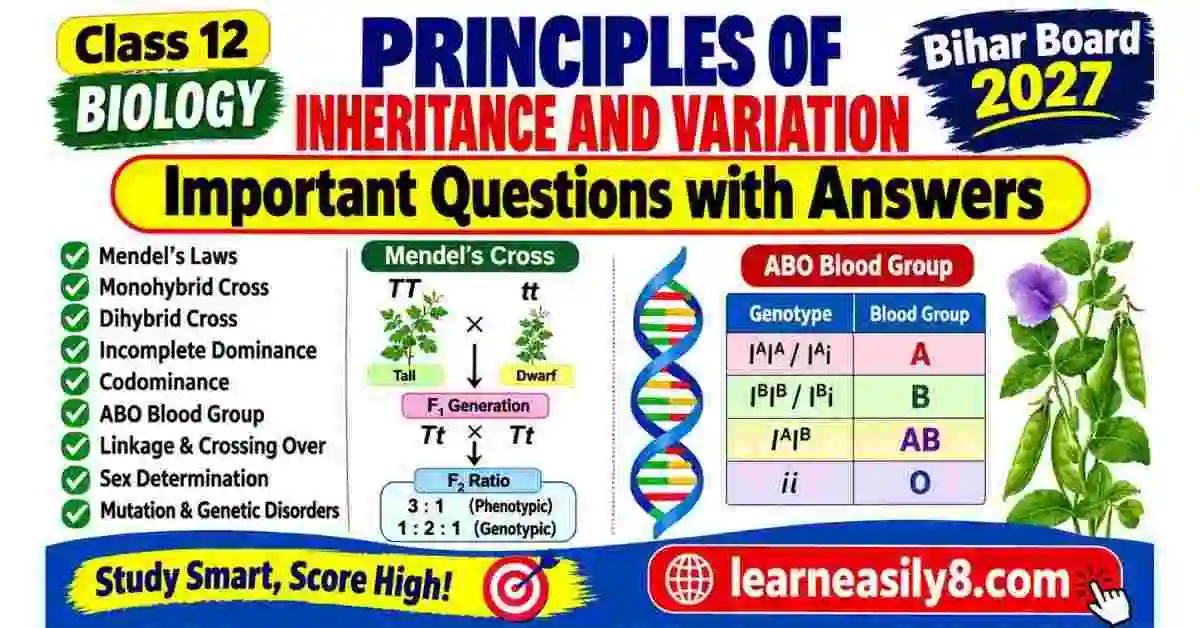
Class 12 Biology – Principles of Inheritance and Variation अध्याय Bihar Board परीक्षा के लिए बहुत महत्वपूर्ण है। इस chapter से Mendel’s Laws, monohybrid cross, dihybrid cross, incomplete dominance, codominance, multiple alleles, chromosomal theory of inheritance, linkage and recombination, sex determination, mutations तथा genetic disorders से प्रश्न पूछे जा सकते हैं।
नीचे दिए गए Principles of Inheritance and Variation Class 12 Important Questions with Answers NCERT concepts को ध्यान में रखकर तैयार किए गए हैं। विद्यार्थियों के लिए answers को सरल हिंदी में English biological terms के साथ समझाया गया है, ताकि Board Exam में उत्तर लिखना आसान हो। Download NCERT BOOK PDF.
Principles of Inheritance and Variation – Class 12 Important Questions
Q1. आनुवंशिकता (Heredity) क्या है?
उत्तर:
Heredity वह biological process है जिसके द्वारा माता-पिता के genetic characters उनके offspring में transfer होते हैं। इन characters का transfer genes द्वारा होता है। उदाहरण के लिए, पौधे की ऊँचाई, बीज का रंग और मनुष्य में blood group जैसे traits आनुवंशिकता द्वारा अगली पीढ़ी तक पहुँच सकते हैं।
Exam Point:
Heredity = Transmission of characters from parents to offspring.
Q2. Variation क्या है?
उत्तर:
एक ही species के individuals में पाए जाने वाले differences को Variation (विविधता) कहते हैं। Variation genetic recombination, mutation और environmental factors के कारण उत्पन्न हो सकता है।
उदाहरण के लिए, एक ही परिवार के बच्चों की height, eye colour या blood group में अंतर variation का उदाहरण हो सकता है।
महत्व: Variation evolution और natural selection के लिए महत्वपूर्ण है।
Q3. Gregor Johann Mendel को Genetics का Father क्यों कहा जाता है?
उत्तर:
Gregor Johann Mendel ने garden pea plant (Pisum sativum) पर systematic experiments करके inheritance के basic laws प्रस्तुत किए। उन्होंने contrasting characters का अध्ययन किया और Law of Dominance, Law of Segregation तथा Law of Independent Assortment दिए।
उनके experiments ने यह समझने में सहायता की कि characters generation से generation तक किस प्रकार transfer होते हैं।
Exam Tip:
Mendel = Father of Genetics
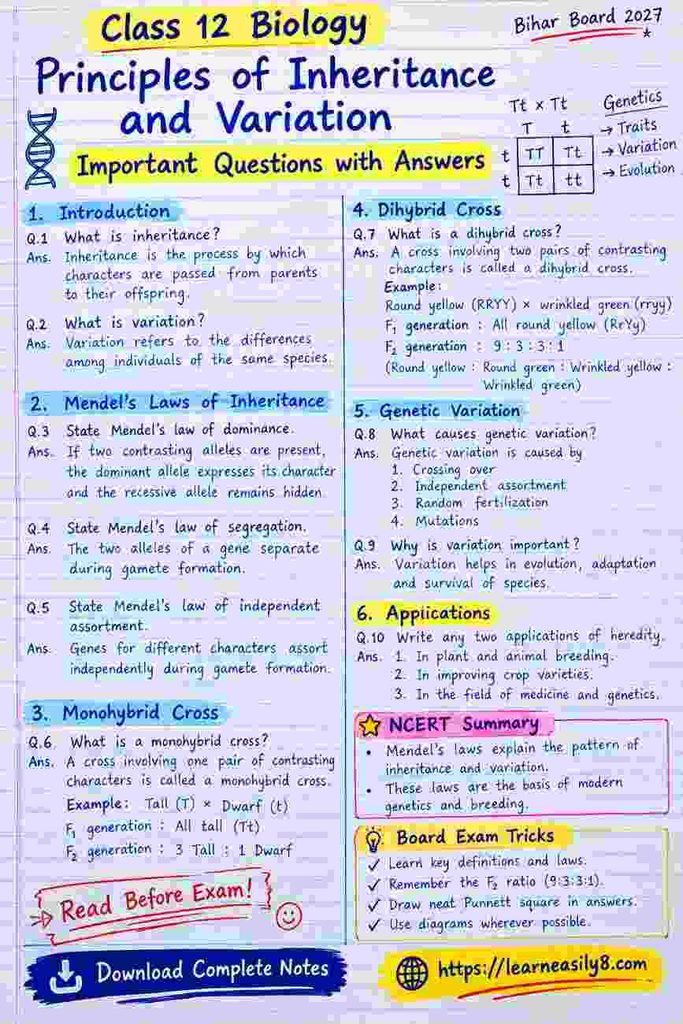
Q4. Mendel ने pea plant को अपने experiments के लिए क्यों चुना?
उत्तर:
Mendel ने pea plant को कई कारणों से चुना:
- इसमें कई स्पष्ट contrasting characters पाए जाते हैं।
- इसका life cycle छोटा होता है।
- इसमें self-pollination आसानी से होती है।
- Artificial cross-pollination भी आसानी से की जा सकती है।
- इसमें अनेक seeds प्राप्त होते हैं।
- इसके characters आसानी से observe किए जा सकते हैं।
Q5. Mendel के सात contrasting characters कौन-कौन से थे?
उत्तर:
| Character | Dominant Trait | Recessive Trait |
|---|---|---|
| Seed shape | Round | Wrinkled |
| Seed colour | Yellow | Green |
| Flower colour | Violet | White |
| Pod shape | Inflated | Constricted |
| Pod colour | Green | Yellow |
| Flower position | Axial | Terminal |
| Stem height | Tall | Dwarf |
Read More: Principles of Inheritance and Variation Class 12 Biology Notes in Hindi | Bihar Board 2027
Mendel’s Laws of Inheritance
Q6. Law of Dominance क्या है?
उत्तर:
Law of Dominance के अनुसार, जब किसी organism में किसी character के दो contrasting alleles उपस्थित होते हैं, तो F₁ generation में केवल dominant character दिखाई देता है और recessive character phenotypically दिखाई नहीं देता।
उदाहरण:
TT × tt → Tt
यहाँ T = Tall और t = Dwarf है।
F₁ generation के सभी plants Tall (Tt) होंगे।
Q7. Law of Segregation क्या है?
उत्तर:
Law of Segregation के अनुसार, किसी character के दो alleles gamete formation के समय अलग हो जाते हैं। प्रत्येक gamete में केवल एक allele जाता है।
इसे Law of Purity of Gametes भी कहा जाता है।
उदाहरण:
Tt → T + t
इसलिए heterozygous individual द्वारा बनने वाले gametes में T और t alleles अलग-अलग होते हैं।
Q8. Law of Independent Assortment क्या है?
उत्तर:
जब दो या अधिक pairs of contrasting characters का inheritance एक साथ होता है, तो एक pair के alleles दूसरे pair के alleles से स्वतंत्र रूप से assort हो सकते हैं, यदि वे independently assorting हों।
यह principle Mendel के dihybrid cross से स्पष्ट हुआ।
Monohybrid Cross
Q9. Monohybrid Cross क्या है?
उत्तर:
ऐसा genetic cross जिसमें केवल एक pair of contrasting characters का inheritance study किया जाता है, उसे Monohybrid Cross कहते हैं।
उदाहरण:
TT × tt
F₁:
सभी Tt (Tall)
F₁ self-cross:
Tt × Tt
F₂ phenotype ratio:
3 Tall : 1 Dwarf
Genotypic ratio:
1 TT : 2 Tt : 1 tt
याद रखें:
Phenotypic ratio = 3 : 1
Genotypic ratio = 1 : 2 : 1
Dihybrid Cross
Q10. Dihybrid Cross क्या है?
उत्तर:
ऐसा cross जिसमें दो pairs of contrasting characters का एक साथ अध्ययन किया जाता है, उसे Dihybrid Cross कहते हैं।
Mendel ने seed shape और seed colour को लेकर dihybrid cross किया।
F₂ generation में सामान्य phenotypic ratio:
9 : 3 : 3 : 1
यह ratio Law of Independent Assortment को support करता है।
Q11. Dihybrid cross का phenotypic ratio लिखिए।
उत्तर:
9 : 3 : 3 : 1
इसमें:
- 9 = Round Yellow
- 3 = Round Green
- 3 = Wrinkled Yellow
- 1 = Wrinkled Green
Important Genetic Terms
Q12. Gene क्या है?
उत्तर:
Gene heredity की functional unit है। यह DNA का एक specific segment होता है जो किसी particular character या functional product से संबंधित information रखता है।
उदाहरण के लिए किसी organism में किसी particular protein के निर्माण से संबंधित genetic information gene में encoded हो सकती है।
Q13. Allele क्या है?
उत्तर:
किसी gene के alternative forms को alleles कहते हैं।
उदाहरण:
T और t pea plant की height के लिए alleles का उदाहरण हैं।
Q14. Genotype और Phenotype में अंतर बताइए।
उत्तर:
| Genotype | Phenotype |
|---|---|
| Genetic constitution को genotype कहते हैं। | Observable character को phenotype कहते हैं। |
| यह genes/alleles से संबंधित है। | यह दिखाई देने वाले trait से संबंधित है। |
| उदाहरण: TT, Tt, tt | उदाहरण: Tall या Dwarf |
Q15. Homozygous और Heterozygous क्या होते हैं?
उत्तर:
Homozygous: जब किसी character के दोनों alleles समान हों।
उदाहरण: TT या tt
Heterozygous: जब दोनों alleles अलग-अलग हों।
उदाहरण: Tt
Incomplete Dominance
Q16. Incomplete Dominance क्या है?
उत्तर:
जब heterozygous condition में कोई भी allele completely dominant नहीं होता और offspring में दोनों parents के बीच का intermediate phenotype दिखाई देता है, तो इसे Incomplete Dominance कहते हैं।
उदाहरण: Snapdragon (Antirrhinum)
Red × White → Pink
यहाँ F₁ generation में pink flowers प्राप्त होते हैं।
F₂ phenotypic ratio:
1 Red : 2 Pink : 1 White
Codominance
Q17. Codominance क्या है?
उत्तर:
जब heterozygous condition में दोनों alleles independently और equally express होते हैं, तो इसे Codominance कहते हैं।
Human ABO blood group system इसका प्रमुख example है।
Iᴬ और Iᴮ alleles एक-दूसरे पर codominant होते हैं।
इसलिए:
IᴬIᴮ = Blood group AB
Q18. ABO Blood Group System समझाइए।
उत्तर:
ABO blood group system में तीन alleles होते हैं:
Iᴬ, Iᴮ और i
इनसे चार blood groups बनते हैं:
| Genotype | Blood Group |
|---|---|
| IᴬIᴬ / Iᴬi | A |
| IᴮIᴮ / Iᴮi | B |
| IᴬIᴮ | AB |
| ii | O |
यहाँ Iᴬ और Iᴮ codominant हैं, जबकि i recessive allele है।
Chromosomal Theory of Inheritance
Q19. Chromosomal Theory of Inheritance क्या है?
उत्तर:
Chromosomal Theory of Inheritance को Walter Sutton और Theodor Boveri ने independently proposed किया था।
इस theory के अनुसार chromosomes heredity के carriers हैं और genes chromosomes पर स्थित होते हैं।
Meiosis के दौरान homologous chromosomes का segregation Mendel के Law of Segregation से संबंधित है।
Q20. Linkage क्या है?
उत्तर:
एक ही chromosome पर स्थित genes के साथ-साथ inherited होने की tendency को Linkage कहते हैं।
जो genes एक ही chromosome पर स्थित होते हैं वे linked genes कहलाते हैं।
Linkage के कारण parental combinations offspring में अधिक frequency से दिखाई दे सकते हैं।
Q21. Recombination क्या है?
उत्तर:
Genes या genetic material के नए combinations बनने की प्रक्रिया को Recombination कहते हैं।
यह विशेष रूप से crossing over के कारण meiosis के दौरान हो सकता है।
Recombination genetic variation का महत्वपूर्ण source है।
Crossing Over
Q22. Crossing Over क्या है?
उत्तर:
Meiosis-I के दौरान homologous chromosomes की non-sister chromatids के बीच genetic material के exchange को Crossing Over कहते हैं।
यह process pachytene stage of prophase-I में होता है।
Crossing over के परिणामस्वरूप नए genetic combinations बन सकते हैं।
Exam Point:
Crossing over → Genetic recombination → Variation
Sex Determination
Q23. Humans में Sex Determination कैसे होता है?
उत्तर:
Humans में female का chromosome combination XX और male का XY Female केवल X-bearing eggs produce करती है।
Male दो प्रकार के sperms produce करता है:
- X-bearing sperm
- Y-bearing sperm
यदि X sperm egg से fuse करता है:
XX → Female
यदि Y sperm egg से fuse करता है:
XY → Male
इस प्रकार human offspring के sex determination में male gamete की भूमिका होती है।
Mutation
Q24. Mutation क्या है?
उत्तर:
DNA या genetic material में होने वाले अचानक और heritable changes को Mutation कहते हैं।
Mutation genetic variation का महत्वपूर्ण source है।
Mutation के examples में gene mutations और chromosomal changes शामिल हैं।
Q25. Sickle Cell Anaemia क्या है?
उत्तर:
Sickle Cell Anaemia एक genetic disorder है जो haemoglobin के β-globin chain में mutation के कारण होता है।
इसमें red blood cells सामान्य biconcave shape के बजाय sickle shape धारण कर सकते हैं।
इससे oxygen transport प्रभावित हो सकता है।
Exam Point:
Sickle Cell Anaemia → β-globin gene mutation
Genetic Disorders
Q26. Thalassemia क्या है?
उत्तर:
Thalassemia एक inherited blood disorder है जिसमें haemoglobin की globin chains का synthesis प्रभावित होता है।
यह autosomal recessive disorder हो सकता है।
इसके प्रमुख forms में α-thalassemia और β-thalassemia शामिल हैं।
Q27. Phenylketonuria क्या है?
उत्तर:
Phenylketonuria एक inherited metabolic disorder है जिसमें phenylalanine के metabolism में समस्या होती है।
यह सामान्यतः enzyme deficiency से संबंधित genetic disorder है।
यदि untreated रहे तो phenylalanine का accumulation nervous system को प्रभावित कर सकता है।
Q28. Down’s Syndrome क्या है?
उत्तर:
Down’s Syndrome एक chromosomal disorder है जो सामान्यतः chromosome 21 की trisomy के कारण होता है। इसमें chromosome 21 की तीन copies होती हैं। इसलिए इसे Trisomy 21 भी कहा जाता है।
Q29. Klinefelter’s Syndrome क्या है?
उत्तर:
Klinefelter’s Syndrome एक sex chromosome abnormality है जिसमें सामान्यतः पुरुष में XXY chromosome constitution पाया जाता है।
इसका chromosomal condition 47, XXY हो सकता है।
Q30. Turner Syndrome क्या है?
उत्तर:
Turner Syndrome में female के पास एक X chromosome की कमी होती है।
इसका सामान्य chromosomal constitution 45, XO होता है।
इसे monosomy of X chromosome कहा जाता है।
Very Important Long Answer Questions
Q31. Mendel के Monohybrid Cross को समझाइए।
उत्तर:
Mendel ने pea plant में contrasting character के रूप में tall और dwarf plants का अध्ययन किया।
उन्होंने pure tall plant TT का cross pure dwarf plant tt से कराया।
P Generation:
TT × tt
Gametes:
T और t
F₁ Generation:
सभी Tt
सभी plants phenotypically Tall होते हैं।
जब F₁ plants का self-cross कराया गया:
Tt × Tt
तो F₂ generation में TT, Tt, Tt, tt प्राप्त हुए।
इससे Genotypic ratio = 1 : 2 : 1 और Phenotypic ratio = 3 : 1 प्राप्त हुआ।
यह experiment Law of Dominance और Law of Segregation को समझाने में महत्वपूर्ण है।
Q32. Mendel के Dihybrid Cross को समझाइए।
उत्तर:
Dihybrid cross में दो characters का एक साथ inheritance study किया जाता है।
Mendel ने seed shape और seed colour को study किया।
मान लें:
- R = Round
- r = Wrinkled
- Y = Yellow
- y = Green
Parental cross:
RRYY × rryy
F₁:
RrYy
F₁ self-cross:
RrYy × RrYy
F₂ generation में phenotypic ratio 9 : 3 : 3 : 1 प्राप्त होता है।
यह Mendel के Law of Independent Assortment का classical example है।
Q33. Incomplete Dominance और Codominance में अंतर बताइए।
उत्तर:
| Incomplete Dominance | Codominance |
|---|---|
| कोई allele completely dominant नहीं होता। | दोनों alleles independently express होते हैं। |
| Intermediate phenotype दिखाई देता है। | दोनों parental traits दिखाई दे सकते हैं। |
| Snapdragon में example मिलता है। | ABO blood group में example मिलता है। |
| Red × White → Pink | IᴬIᴮ → AB |
Q34. Mendelian और Non-Mendelian Inheritance में अंतर बताइए।
उत्तर:
Mendelian inheritance में inheritance के patterns Mendel के basic laws के अनुसार समझाए जाते हैं, जैसे complete dominance और segregation।
Non-Mendelian inheritance में ऐसे patterns शामिल होते हैं जो simple Mendelian ratios से पूरी तरह explain नहीं होते, जैसे:
- Incomplete dominance
- Codominance
- Multiple alleles
- Polygenic inheritance
- Linkage
Q35. Genetic Disorders के प्रमुख प्रकार बताइए।
उत्तर:
Genetic disorders को broadly दो प्रमुख categories में समझा जा सकता है:
1. Mendelian Disorders
ये single gene mutations से संबंधित होते हैं।
Examples:
- Haemophilia
- Sickle Cell Anaemia
- Thalassemia
- Phenylketonuria
2. Chromosomal Disorders
ये chromosome number या structure में abnormalities से संबंधित होते हैं।
Examples:
- Down’s Syndrome
- Klinefelter’s Syndrome
- Turner Syndrome
Know More: Biomolecules MCQ in Hindi for Bihar Board Class 12 | जैव-अणु के 50 महत्वपूर्ण वस्तुनिष्ठ प्रश्न
Class 12 Biology Important One-Liner Questions
Q36. Genetics के Father कौन हैं?
उत्तर: Gregor Johann Mendel
Q37. Mendel ने किस plant पर experiment किया?
उत्तर: Pea plant (Pisum sativum)
Q38. Monohybrid cross का phenotypic ratio क्या है?
उत्तर: 3 : 1
Q39. Monohybrid cross का genotypic ratio क्या है?
उत्तर: 1 : 2 : 1
Q40. Dihybrid cross का phenotypic ratio क्या है?
उत्तर: 9 : 3 : 3 : 1
Q41. Law of Segregation को किस नाम से भी जाना जाता है?
उत्तर: Law of Purity of Gametes
Q42. Human female का sex chromosome combination क्या है?
उत्तर: XX
Q43. Human male का sex chromosome combination क्या है?
उत्तर: XY
Q44. AB blood group का genotype क्या है?
उत्तर: IᴬIᴮ
Q45. Blood group O का genotype क्या है?
उत्तर: ii
Q46. Down’s Syndrome किस chromosome से संबंधित है?
उत्तर: Chromosome 21
Q47. Down’s Syndrome को किस नाम से जाना जाता है?
उत्तर: Trisomy 21
Q48. Turner Syndrome का chromosome constitution क्या है?
उत्तर: 45, XO
Q49. Klinefelter’s Syndrome का chromosome constitution क्या है?
उत्तर: 47, XXY
Q50. Crossing over किस stage में होता है?
उत्तर: Pachytene stage of Prophase-I
Assertion–Reason Important Questions
Q51. Assertion: Mendel को Father of Genetics कहा जाता है।
Reason: Mendel ने pea plant पर systematic hybridisation experiments किए।
उत्तर: दोनों statements सही हैं और Reason, Assertion की सही explanation है।
Q52. Assertion: Monohybrid cross का phenotypic ratio 3:1 होता है।
Reason: F₂ generation में dominant phenotype recessive phenotype की तुलना में अधिक दिखाई देता है।
उत्तर: दोनों statements सही हैं और Reason, Assertion की सही explanation है।
Q53. Assertion: AB blood group codominance का example है।
Reason: Iᴬ और Iᴮ दोनों alleles heterozygous condition में express होते हैं।
उत्तर: दोनों statements सही हैं और Reason, Assertion की सही explanation है।
Q54. Assertion: Crossing over genetic variation उत्पन्न कर सकता है।
Reason: Crossing over homologous chromosomes की non-sister chromatids के बीच genetic material का exchange है।
उत्तर: दोनों statements सही हैं और Reason, Assertion की सही explanation है।
Q55. Assertion: Down’s Syndrome chromosome 21 से संबंधित है।
Reason: Down’s Syndrome में chromosome 21 की तीन copies होती हैं।
उत्तर: दोनों statements सही हैं और Reason, Assertion की सही explanation है।
Board Exam के लिए सबसे महत्वपूर्ण Topics
Principles of Inheritance and Variation से तैयारी करते समय इन topics को विशेष रूप से revise करें:
- Mendel’s experiments
- Seven contrasting characters
- Law of Dominance
- Law of Segregation
- Law of Independent Assortment
- Monohybrid Cross
- Dihybrid Cross
- Test Cross
- Back Cross
- Incomplete Dominance
- Codominance
- Multiple Alleles
- ABO Blood Group
- Chromosomal Theory of Inheritance
- Linkage
- Crossing Over
- Recombination
- Sex Determination
- Mutation
- Sickle Cell Anaemia
- Thalassemia
- Phenylketonuria
- Down’s Syndrome
- Klinefelter’s Syndrome
- Turner Syndrome
Quick Revision Notes
- Mendel → Father of Genetics
- Pisum sativum → Garden pea
- Monohybrid phenotype → 3:1
- Monohybrid genotype → 1:2:1
- Dihybrid phenotype → 9:3:3:1
- Segregation → Purity of gametes
- Incomplete dominance → Intermediate phenotype
- Codominance → Both alleles express
- AB blood group → IᴬIᴮ
- Female → XX
- Male → XY
- Down’s syndrome → Trisomy 21
- Turner syndrome → XO
- Klinefelter syndrome → XXY
- Crossing over → Pachytene
- Sickle cell anaemia → β-globin gene mutation
Frequently Asked Questions (FAQs)
1. Is Principles of Inheritance and Variation important for Bihar Board Class 12 Biology?
हाँ। यह Class 12 Biology का महत्वपूर्ण genetics chapter है। Mendelian inheritance, genetic disorders, blood groups, linkage और chromosomal inheritance जैसे concepts पर विशेष ध्यान देना चाहिए।
2. Monohybrid cross का ratio क्या है?
Monohybrid cross का सामान्य phenotypic ratio 3:1 और genotypic ratio 1:2:1 होता है।
3. Dihybrid cross का ratio क्या है?
Classical Mendelian dihybrid cross का F₂ phenotypic ratio 9:3:3:1 होता है।
4. AB blood group किस inheritance का example है?
AB blood group codominance का प्रमुख example है।
5. Down’s Syndrome क्या है?
Down’s Syndrome एक chromosomal disorder है जो सामान्यतः trisomy of chromosome 21 के कारण होता है।
6. Crossing over कहाँ होता है?
Crossing over meiosis-I के pachytene stage of prophase-I में homologous chromosomes की non-sister chromatids के बीच होता है।
Conclusion
Principles of Inheritance and Variation Class 12 Important Questions with Answers Bihar Board 2027 की तैयारी के लिए एक उपयोगी revision resource है। इस chapter में केवल definitions याद करने के बजाय crosses, ratios, genetic terminology, inheritance patterns और genetic disorders को conceptually समझना अधिक उपयोगी रहेगा।
Board Exam से पहले Monohybrid Cross, Dihybrid Cross, Mendel’s Laws, ABO Blood Group, Incomplete Dominance, Codominance, Linkage, Crossing Over और Genetic Disorders को दोबारा जरूर revise करें। साथ ही diagrams और genetic crosses को स्वयं बनाकर practice करें।