

Cell potential is one of the most important concepts in Class 12 Chemistry Electrochemistry. It helps us understand the electrical potential produced by an electrochemical cell and whether a redox reaction can occur spontaneously.
In this article, you will learn cell potential in electrochemistry, its definition, formula, standard cell potential, calculation method, relation with EMF, Gibbs energy and equilibrium constant, and the use of the Nernst equation. Several solved examples are also loaincluded for exam preparation. Download NCERT BOOK PDF.
What is Cell Potential in Electrochemistry?
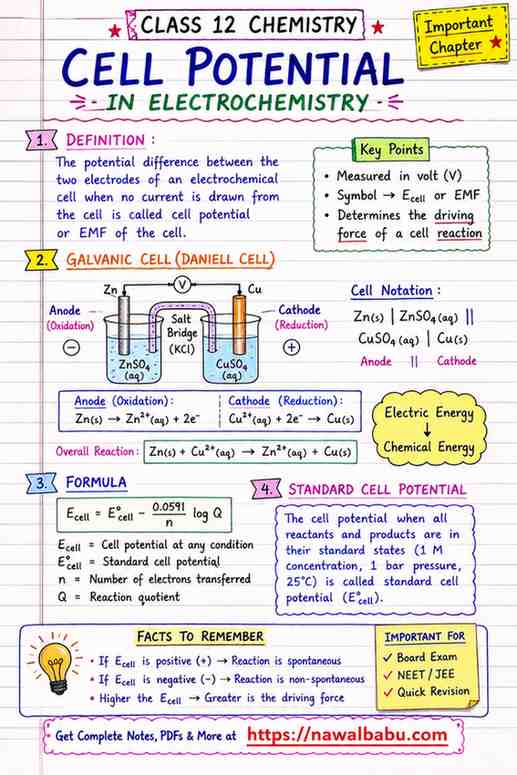
Definition of Cell Potential
Cell potential is the difference between the electrode potentials of the cathode and anode of an electrochemical cell.
In simple words, when two electrodes are connected to form an electrochemical cell, a potential difference develops between them. This potential difference is called the cell potential.
The cell potential provides information about the tendency of electrons to flow from one electrode to another.
For a galvanic or voltaic cell:
Cell potential = Cathode potential − Anode potential
Therefore,
Ecell = Ecathode − Eanode
where:
- Ecell = cell potential
- Ecathode = reduction potential of cathode
- Eanode = reduction potential of anode
The SI unit of cell potential is volt (V).
Why is Cell Potential Important?
Cell potential is important because it helps us:
- determine the direction of electron flow
- identify the anode and cathode
- calculate the EMF of an electrochemical cell
- determine whether a redox reaction is spontaneous
- calculate Gibbs energy change
- determine the equilibrium constant
- solve electrochemistry numerical problems
- understand the working of galvanic and voltaic cells
A positive standard cell potential generally indicates that the overall cell reaction is spontaneous under standard conditions.
Electrode Potential and Cell Potential
Before understanding cell potential, it is useful to distinguish it from electrode potential.
Electrode Potential
The electrode potential is the potential developed between an electrode and its electrolyte when they are in contact.
An electrode can have either a tendency to:
- lose electrons, or
- gain electrons.
Electrode potentials are usually represented as reduction potentials in standard electrode potential tables.
Cell Potential
Cell potential is the difference between the potentials of two electrodes.
Thus:
Ecell = Ecathode − Eanode
So, electrode potential refers to an individual electrode, whereas cell potential refers to the complete electrochemical cell.
Cell Potential and EMF
The terms cell potential and EMF (electromotive force) are closely related.
The EMF of a cell is the maximum potential difference between its two electrodes when no current is being drawn from the cell.
Under ideal conditions, the EMF of a galvanic cell is represented by:
Ecell
or, under standard conditions:
E°cell
Therefore, in many Class 12 Electrochemistry problems, the terms cell potential, EMF and cell voltage may be used in closely related contexts.
However, technically, EMF refers to the open-circuit potential difference of the cell.
Cell Potential Formula
The most important formula for cell potential is:
Ecell = Ecathode − Eanode
Here, the electrode potentials are taken as reduction potentials.
Under standard conditions:
E°cell = E°cathode − E°anode
where:
- E°cell = standard cell potential
- E°cathode = standard reduction potential of cathode
- E°anode = standard reduction potential of anode
Important Exam Rule
When using a table of standard reduction potentials, do not change the sign of the anode potential separately.
Simply use:
E°cell = E°cathode − E°anode
This avoids one of the most common mistakes in electrochemistry numerical problems.
Why is Cathode Potential Subtracted from Anode Potential?
In a galvanic cell:
- Oxidation occurs at the anode.
- Reduction occurs at the cathode.
- Electrons flow from the anode to the cathode through the external circuit.
The standard electrode potential table generally gives reduction potentials.
Therefore, the overall cell potential is calculated as:
E°cell = Reduction potential of cathode − Reduction potential of anode
This formula automatically takes care of the oxidation and reduction processes.
Read Also: Electrochemistry MCQs for Class 12 – 50 Most Important Questions for Board, NEET & JEE
How to Calculate Cell Potential?
Calculating cell potential becomes easy if you follow a fixed procedure.
Step 1: Identify the two electrodes
Determine which half-cell undergoes oxidation and which undergoes reduction.
Step 2: Identify the anode and cathode
Remember:
Anode → Oxidation
Cathode → Reduction
Step 3: Find the standard reduction potentials
Take the values from the standard electrode potential table.
Step 4: Apply the formula
Use:
E°cell = E°cathode − E°anode
Step 5: Write the answer with the unit
The unit of cell potential is volt (V).
Solved Example 1: Cell Potential of a Daniell Cell
Consider the following cell:
Zn | Zn²⁺ || Cu²⁺ | Cu
The standard reduction potentials are approximately:
- Zn²⁺ + 2e⁻ → Zn, E° = −0.76 V
- Cu²⁺ + 2e⁻ → Cu, E° = +0.34 V
Step 1: Identify the cathode
Copper has the higher reduction potential, so reduction occurs at copper.
Therefore:
Cathode = Cu
Step 2: Identify the anode
Zinc undergoes oxidation.
Therefore:
Anode = Zn
Step 3: Apply the formula
E°cell = E°cathode − E°anode
E°cell = (+0.34) − (−0.76)
E°cell = +1.10 V
Answer
Standard cell potential = 1.10 V
The positive value indicates that the reaction is spontaneous under standard conditions.
Standard Cell Potential (E°cell)
What is Standard Cell Potential?
The standard cell potential is the cell potential measured under standard conditions.
It is represented by:
E°cell
The standard cell potential is calculated using:
E°cell = E°cathode − E°anode
Standard electrode potentials are measured relative to the standard hydrogen electrode (SHE).
Standard Conditions for Cell Potential
The exact standard-state conventions should be kept in mind when solving Class 12 problems. Commonly, standard electrochemical conditions involve:
- solute concentrations of approximately 1 M
- gases at standard pressure
- pure solids and liquids in their standard states
- a specified temperature, commonly 298 K (25°C) when numerical values are tabulated
For calculations involving the Nernst equation, 298 K is especially important because it leads to the familiar factor 0.0591/n.
Positive and Negative Cell Potential
The sign of cell potential provides important information about the cell reaction.
Positive E°cell
If:
E°cell > 0
the reaction is thermodynamically spontaneous under standard conditions.
Negative E°cell
If:
E°cell < 0
the reaction as written is non-spontaneous under standard conditions.
The reverse reaction would have the opposite sign.
Zero E°cell
If:
E°cell = 0
the system is at equilibrium under the specified conditions.
Cell Potential and Spontaneity
Cell potential is directly related to the Gibbs energy change of a cell reaction.
The relationship is:
ΔG° = −nFE°cell
where:
- ΔG° = standard Gibbs energy change
- n = number of electrons transferred
- F = Faraday constant, approximately 96500 C mol⁻¹
- E°cell = standard cell potential
What does this equation tell us?
If E°cell is positive, then:
ΔG° is negative
Therefore, the reaction is spontaneous under standard conditions.
If E°cell is negative, then:
ΔG° is positive
Therefore, the reaction is non-spontaneous under standard conditions.
This is an important connection between electrochemistry and thermodynamics.
Know More: Ncert Solution of Electrochemistry: For Class 12th, Free Pdf Download
Cell Potential and Equilibrium Constant
Cell potential is also related to the equilibrium constant of a redox reaction.
At 298 K:
E°cell = (0.0591/n) log K
where:
- E°cell = standard cell potential
- n = number of electrons transferred
- K = equilibrium constant
This equation is useful when a question asks you to calculate the equilibrium constant from the standard cell potential.
Important Relationship
If:
E°cell > 0
then generally:
K > 1
This means products are favoured at equilibrium.
If:
E°cell < 0
then generally:
K < 1
This means reactants are favoured.
Solved Example 2: Finding Equilibrium Constant from Cell Potential
Suppose a cell reaction involves 2 electrons and its standard cell potential is 0.0591 V at 298 K.
Using:
E°cell = (0.0591/n) log K
Substitute:
0.0591 = (0.0591/2) log K
Therefore:
log K = 2
Hence:
K = 10²
K = 100
So, the equilibrium constant is 100.
Cell Potential Under Non-Standard Conditions
The standard cell potential is calculated under standard conditions. However, actual electrochemical cells often operate under different concentrations or pressures.
In such cases, the cell potential is different from the standard cell potential.
This is where the Nernst equation is used.
Nernst Equation and Cell Potential
For a general electrochemical cell, the Nernst equation is:
Ecell = E°cell − (RT/nF) ln Q
At 298 K, it becomes:
Ecell = E°cell − (0.0591/n) log Q
where:
- Ecell = cell potential under non-standard conditions
- E°cell = standard cell potential
- R = gas constant
- T = absolute temperature
- n = number of electrons transferred
- F = Faraday constant
- Q = reaction quotient
This equation shows how cell potential changes when the concentrations or pressures of the substances involved in the cell reaction change.
What is Reaction Quotient (Q)?
The reaction quotient represents the relative amounts of products and reactants at a particular moment.
For example, consider:
Zn + Cu²⁺ → Zn²⁺ + Cu
The reaction quotient can be written as:
Q = [Zn²⁺]/[Cu²⁺]
Pure solids such as Zn and Cu are not included in the expression.
Therefore, for this reaction:
Ecell = E°cell − (0.0591/2) log([Zn²⁺]/[Cu²⁺])
at 298 K.
Solved Example 3: Cell Potential Using the Nernst Equation
For the Daniell cell:
Zn | Zn²⁺ || Cu²⁺ | Cu
Suppose:
- E°cell = 1.10 V
- [Zn²⁺] = 1 M
- [Cu²⁺] = 0.01 M
- n = 2
- Temperature = 298 K
The reaction is:
Zn + Cu²⁺ → Zn²⁺ + Cu
Therefore:
Q = [Zn²⁺]/[Cu²⁺]
Q = 1/0.01 = 100
Using the Nernst equation:
Ecell = E°cell − (0.0591/2) log 100
Since:
log 100 = 2
Therefore:
Ecell = 1.10 − (0.0591/2)(2)
Ecell = 1.10 − 0.0591
Ecell ≈ 1.041 V
Answer
Cell potential ≈ 1.04 V
This example shows that changing the ion concentrations changes the cell potential.
Daniell Cell and Cell Potential
The Daniell cell is one of the most important examples used to understand cell potential.
Its cell representation is:
Zn | Zn²⁺ || Cu²⁺ | Cu
At the Anode
Zinc undergoes oxidation:
Zn → Zn²⁺ + 2e⁻
Therefore:
Anode = Zn
At the Cathode
Copper ions undergo reduction:
Cu²⁺ + 2e⁻ → Cu
Therefore:
Cathode = Cu
Overall Reaction
Zn + Cu²⁺ → Zn²⁺ + Cu
Standard Cell Potential
Using:
E°cell = E°cathode − E°anode
we get approximately:
E°cell = 0.34 − (−0.76)
E°cell = 1.10 V
Thus, the Daniell cell produces a standard cell potential of approximately 1.10 V.
Read More: Electrochemistry for 12th: Notes for chapter 3 of chemistry 12
Factors Affecting Cell Potential
Cell potential is affected by several factors.
1. Nature of Electrodes
Different metals and ions have different electrode potentials. Therefore, changing the electrode materials can change the cell potential.
2. Concentration of Ions
The concentration of ions can change the cell potential under non-standard conditions.
The Nernst equation explains this effect.
3. Temperature
Temperature can affect the cell potential because the Nernst equation contains temperature.
4. Pressure
For reactions involving gases, gas pressure can influence the reaction quotient and therefore the cell potential.
5. Reaction Quotient
The value of Q directly affects the cell potential under non-standard conditions.
Cell Potential Sign Convention
Sign conventions are very important in numerical problems.
Remember these basic rules:
Anode
Oxidation occurs at the anode.
Cathode
Reduction occurs at the cathode.
Electron Flow
Electrons flow through the external circuit:
Anode → Cathode
Formula
When reduction potentials are used:
E°cell = E°cathode − E°anode
Important Warning
Do not simply add the two standard reduction potentials.
For example, if:
E°cathode = +0.34 V
and
E°anode = −0.76 V
then:
E°cell = 0.34 − (−0.76)
not:
0.34 − 0.76
The correct answer is:
1.10 V
Cell Potential vs Electrode Potential vs EMF
| Term | Meaning |
|---|---|
| Electrode Potential | Potential developed at an individual electrode-electrolyte interface |
| Cell Potential | Difference between the potentials of cathode and anode |
| Standard Cell Potential | Cell potential under standard conditions |
| EMF | Maximum potential difference of a cell when no current is drawn |
For Class 12 numerical problems, the most important relation to remember is:
E°cell = E°cathode − E°anode
Important Formulas of Cell Potential
For quick revision, remember the following formulas.
1. Cell Potential
Ecell = Ecathode − Eanode
2. Standard Cell Potential
E°cell = E°cathode − E°anode
3. Gibbs Energy
ΔG° = −nFE°cell
4. Equilibrium Constant
At 298 K:
E°cell = (0.0591/n) log K
5. Nernst Equation
At 298 K:
Ecell = E°cell − (0.0591/n) log Q
These formulas are frequently useful in Class 12 Electrochemistry numerical questions.
More Solved Numerical Problems on Cell Potential
Numerical 1: Calculate Standard Cell Potential
Given:
E°cathode = +0.80 V
E°anode = +0.34 V
Calculate E°cell.
Solution
Formula:
E°cell = E°cathode − E°anode
Substitution:
E°cell = 0.80 − 0.34
E°cell = 0.46 V
Answer
E°cell = 0.46 V
Numerical 2: Calculate Gibbs Energy Change
Suppose:
- E°cell = 1.10 V
- n = 2
- F = 96500 C mol⁻¹
Use:
ΔG° = −nFE°cell
Therefore:
ΔG° = −(2)(96500)(1.10)
ΔG° = −212300 J mol⁻¹
or approximately:
ΔG° = −212.3 kJ mol⁻¹
Answer
ΔG° ≈ −212.3 kJ mol⁻¹
The negative value indicates that the reaction is spontaneous under standard conditions.
Numerical 3: Identify the Anode and Cathode
Suppose the standard reduction potentials are:
- Electrode A = −0.76 V
- Electrode B = +0.34 V9
The electrode with the higher reduction potential acts as the cathode in a spontaneous galvanic cell.
Therefore:
Cathode = Electrode B
Anode = Electrode A
The cell potential is:
E°cell = 0.34 − (−0.76)
E°cell = 1.10 V
Common Mistakes in Cell Potential Questions
Students often make small mistakes while calculating cell potential. Avoid the following errors:
Mistake 1: Confusing Anode and Cathode
Remember:
Anode = Oxidation
Cathode = Reduction
Mistake 2: Adding Reduction Potentials
Do not add two reduction potentials.
Use:
E°cell = E°cathode − E°anode
Mistake 3: Changing the Sign Unnecessarily
If the values are taken from a standard reduction potential table, use them directly in the formula.
Mistake 4: Forgetting the Number of Electrons
The value of n is important in the Nernst equation and Gibbs energy equation.
Mistake 5: Incorrect Reaction Quotient
Balance the overall cell reaction before writing Q.
Mistake 6: Confusing E°cell and Ecell
E°cell refers to standard conditions.
Ecell can refer to the cell potential under the specified conditions.
Mistake 7: Ignoring Temperature
The simplified 0.0591/n form of the Nernst equation is specifically for 298 K.
Important Questions on Cell Potential for Class 12
Very Short Answer Questions
- What is cell potential?
- What is the SI unit of cell potential?
- Write the formula for standard cell potential.
- Which electrode acts as the cathode in a galvanic cell?
- Where does oxidation occur in an electrochemical cell?
- What is the relationship between E°cell and ΔG°?
- What does a positive E°cell indicate?
- What is the Nernst equation?
- What is the value of Faraday constant approximately?
- What is meant by standard cell potential?
Short Answer Questions
- Define cell potential and write its formula.
- Explain the difference between electrode potential and cell potential.
- Explain the relation between cell potential and Gibbs energy.
- How does concentration affect cell potential?
- Explain the significance of a positive standard cell potential.
- Derive the expression for the standard cell potential.
- Explain how the Nernst equation is used to calculate cell potential.
Numerical Questions
- Calculate E°cell when the standard electrode potentials of the cathode and anode are given.
- Calculate the cell potential of a Daniell cell.
- Calculate ΔG° from E°cell.
- Calculate equilibrium constant from E°cell.
- Calculate cell potential under non-standard conditions using the Nernst equation.
Quick Revision of Cell Potential
Definition
Cell potential is the potential difference between the two electrodes of an electrochemical cell.
Most Important Formula
Ecell = Ecathode − Eanode
Standard Cell Potential
E°cell = E°cathode − E°anode
Anode
Oxidation occurs at the anode.
Cathode
Reduction occurs at the cathode.
Electron Flow
Anode → Cathode
Gibbs Energy Relation
ΔG° = −nFE°cell
Equilibrium Constant Relation
E°cell = (0.0591/n) log K
at 298 K.
Nernst Equation
Ecell = E°cell − (0.0591/n) log Q
at 298 K.
Key Concept
Positive E°cell → spontaneous reaction under standard conditions
Frequently Asked Questions About Cell Potential
What is cell potential in electrochemistry?
Cell potential is the difference between the electrode potentials of the cathode and anode of an electrochemical cell.
What is the formula for cell potential?
When reduction potentials are used, the formula is:
Ecell = Ecathode − Eanode
For standard conditions:
E°cell = E°cathode − E°anode
What is the unit of cell potential?
The SI unit of cell potential is volt (V).
What is the difference between cell potential and electrode potential?
Electrode potential refers to the potential of an individual electrode, whereas cell potential is the difference between the potentials of the two electrodes.
What does positive cell potential mean?
A positive standard cell potential indicates that the cell reaction is thermodynamically spontaneous under standard conditions.
How is cell potential calculated using the Nernst equation?
At 298 K, use:
Ecell = E°cell − (0.0591/n) log Q
where Q is the reaction quotient.
What is the relationship between cell potential and Gibbs energy?
The relationship is:
ΔG° = −nFE°cell
Therefore, a positive E°cell corresponds to a negative ΔG° under standard conditions.
What is standard cell potential?
Standard cell potential, represented by E°cell, is the cell potential under standard-state conditions.
Can cell potential be negative?
Yes. A negative E°cell means that the cell reaction as written is non-spontaneous under standard conditions. The reverse reaction has the opposite sign.
Conclusion
Cell potential is a fundamental concept in Class 12 Electrochemistry. It represents the potential difference between the two electrodes of an electrochemical cell and helps us understand the direction and feasibility of a redox reaction.
The most important formula to remember is:
E°cell = E°cathode − E°anode
Cell potential is also connected with Gibbs energy, equilibrium constant and the Nernst equation. Therefore, understanding cell potential makes many other Electrochemistry concepts easier.
For board examinations, students should especially practise cell potential calculations, Daniell cell problems, sign conventions, Nernst equation numericals, ΔG° calculations and equilibrium constant questions.