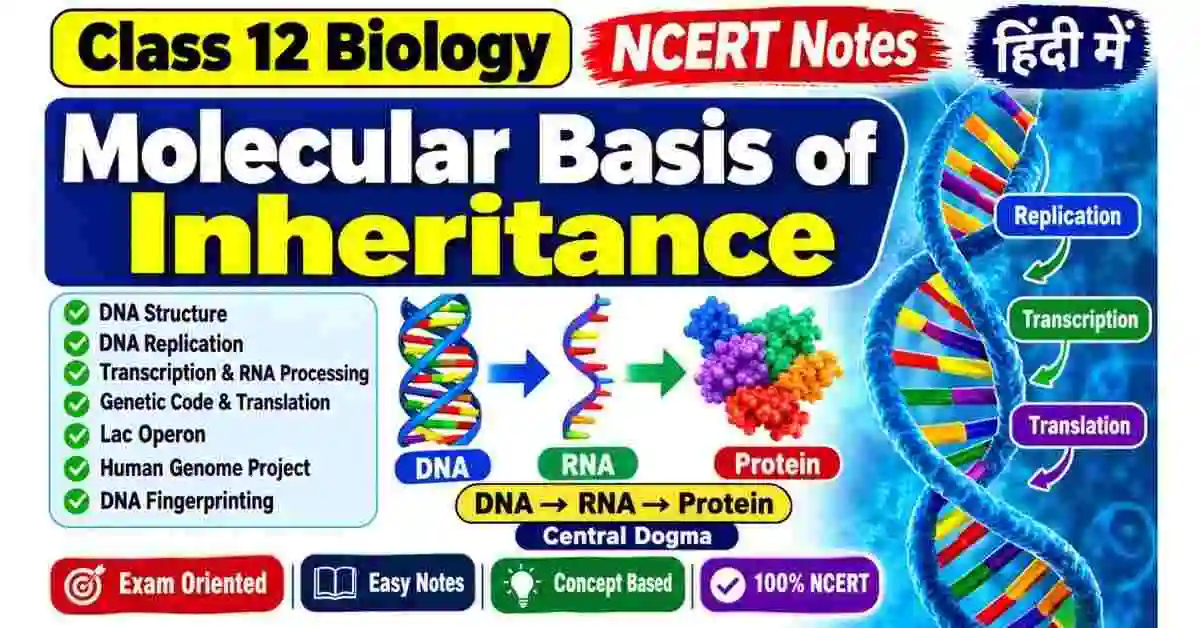
Molecular Basis of Inheritance Class 12 Biology Notes in Hindi में DNA की संरचना, DNA Replication, Transcription, Genetic Code, Translation, Lac Operon, Human Genome Project और DNA Fingerprinting जैसे महत्वपूर्ण topics को आसान भाषा में समझाया गया है। यह chapter Class 12 Biology, Bihar Board, CBSE Board और competitive examinations की तैयारी के लिए बहुत महत्वपूर्ण है।
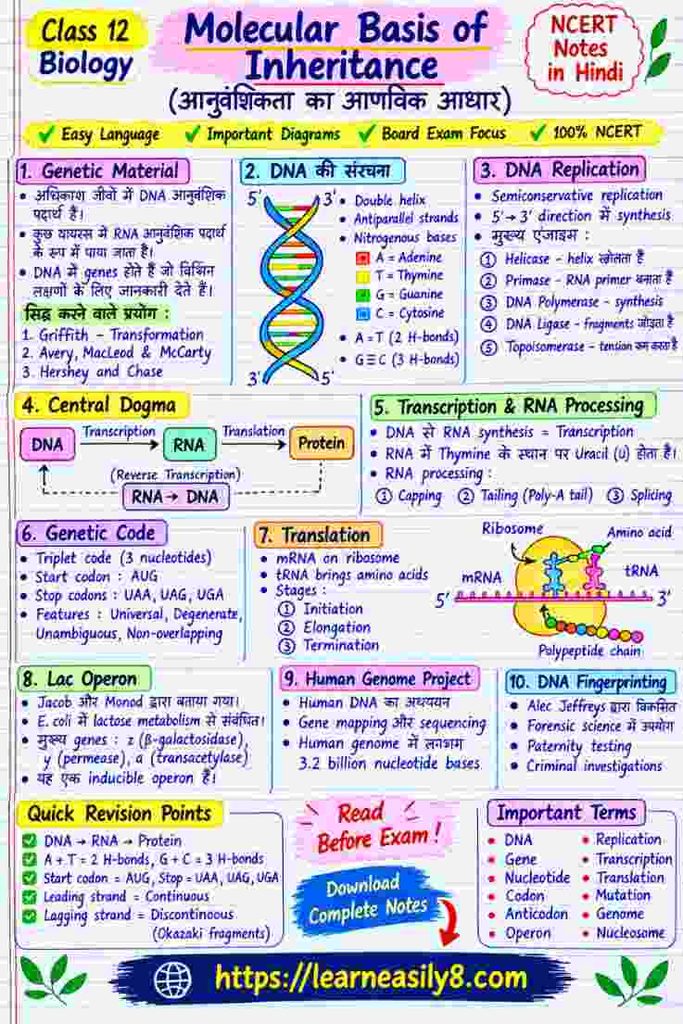
इस chapter में हम समझेंगे कि genetic information एक generation से दूसरी generation तक कैसे transfer होती है और DNA किस प्रकार protein synthesis को नियंत्रित करता है। नीचे दिए गए notes को NCERT के प्रमुख concepts को ध्यान में रखकर सरल Hindi + English में तैयार किया गया है। Download NCERT BOOK PDF.
Molecular Basis of Inheritance क्या है?
Molecular Basis of Inheritance का अर्थ है कि hereditary information molecular level पर किस प्रकार store, replicate और express होती है। मुख्य रूप से DNA (Deoxyribonucleic Acid) genetic material के रूप में कार्य करता है।
DNA में उपस्थित genes किसी organism के विभिन्न characters के लिए information रखते हैं। DNA की information पहले RNA में और फिर protein में express होती है।
इसे सामान्य रूप से इस प्रकार लिखा जाता है:
DNA → RNA → Protein
इसे Central Dogma of Molecular Biology कहा जाता है।
मुख्य घटनाएँ
- DNA Replication
- Transcription
- RNA Processing
- Translation
- Gene Regulation
- Mutation
- DNA Fingerprinting
Genetic Material – आनुवंशिक पदार्थ
Genetic material वह पदार्थ है जो hereditary information को store करता है और उसे एक generation से दूसरी generation तक transfer करता है।
अधिकांश organisms में DNA genetic material है।
कुछ viruses में RNA genetic material के रूप में पाया जाता है।
DNA को Genetic Material सिद्ध करने वाले प्रमुख प्रयोग
DNA के genetic material होने को सिद्ध करने में कई वैज्ञानिकों का योगदान रहा।
- Griffith – Transformation experiment
- Avery, MacLeod and McCarty – Transforming principle की पहचान
- Hershey and Chase – DNA को genetic material के रूप में प्रमाणित किया
Griffith का Transformation Experiment
Frederick Griffith ने Streptococcus pneumoniae bacteria पर experiment किया।
इस bacteria की दो strains थीं:
- S strain – Smooth, virulent
- R strain – Rough, non-virulent
Heat-killed S bacteria और live R bacteria को mouse में inject करने पर mouse की मृत्यु हो गई और उसके शरीर से live S bacteria प्राप्त हुए।
इससे पता चला कि कोई पदार्थ R bacteria को S bacteria में transform कर रहा था।
इसे Transformation कहा गया।
Avery, MacLeod और McCarty Experiment
Avery और उनके colleagues ने Griffith के transformation principle की chemical nature पता करने का प्रयास किया।
उन्होंने protein, RNA और DNA को अलग-अलग destroy किया।
जब DNA को destroy किया गया, तब transformation नहीं हुआ।
इससे निष्कर्ष निकला कि:
DNA is the transforming principle.
Hershey and Chase Experiment
Hershey और Chase ने bacteriophage T₂ पर experiment किया।
उन्होंने DNA को radioactive ³²P और protein को radioactive ³⁵S से label किया।
जब bacteriophage ने bacteria को infect किया, तो पाया गया कि:
- ³²P bacteria के अंदर गया।
- ³⁵S bacteria के अंदर नहीं गया।
इससे सिद्ध हुआ कि DNA genetic material है।
Exam Point
³²P → DNA
³⁵S → Protein
यह Class 12 examination के लिए बहुत महत्वपूर्ण तथ्य है।
DNA की संरचना – Structure of DNA
DNA का double helical model James Watson और Francis Crick ने 1953 में प्रस्तुत किया।
इस model के निर्माण में Rosalind Franklin और Maurice Wilkins के X-ray diffraction studies का भी महत्वपूर्ण योगदान था।
DNA एक polynucleotide molecule है।
प्रत्येक nucleotide तीन components से बना होता है:
- Nitrogenous base
- Pentose sugar
- Phosphate group
Nitrogenous Bases
DNA में चार nitrogenous bases होते हैं:
- Adenine – A
- Guanine – G
- Cytosine – C
- Thymine – T
Adenine और Guanine को Purines कहा जाता है।
Cytosine और Thymine को Pyrimidines कहा जाता है।
Base Pairing
DNA में:
A = T
G ≡ C
Adenine और Thymine के बीच 2 hydrogen bonds होते हैं।
Guanine और Cytosine के बीच 3 hydrogen bonds होते हैं।
Read More: Principles of Inheritance and Variation Class 12 Biology Notes in Hindi | Bihar Board 2027
DNA Double Helix की मुख्य विशेषताएँ
Watson-Crick model के अनुसार:
- DNA double-stranded होता है।
- दोनों strands antiparallel होते हैं।
- एक strand की direction 5′ → 3′ होती है।
- दूसरी strand की direction 3′ → 5′ होती है।
- दोनों strands hydrogen bonds द्वारा जुड़े रहते हैं।
- DNA का diameter लगभग 2 nm होता है।
- एक complete turn में लगभग 10 base pairs होते हैं।
- दो successive base pairs के बीच distance लगभग 0.34 nm होती है।
- एक complete turn की pitch लगभग 3.4 nm होती है।
Important Formula
यदि DNA में base pairs की संख्या n है, तो DNA की approximate length:
Length = n × 0.34 nm
DNA Packaging
Eukaryotic cells में DNA बहुत लंबा होता है। इसे nucleus में compact form में रखने के लिए DNA proteins के साथ packaging करता है।
DNA histone proteins के चारों ओर लिपटता है।
DNA + Histone = Nucleosome
Nucleosomes आगे compact होकर chromatin बनाते हैं।
Nucleosome
एक nucleosome में DNA लगभग 200 base pairs के आसपास histone core से associated होता है।
Histone core में आठ histone proteins होते हैं।
इसे Histone Octamer कहा जाता है।
DNA Replication – DNA का प्रतिकृतिकरण
DNA replication वह process है जिसमें एक DNA molecule से दो identical DNA molecules बनते हैं।
DNA replication को Semiconservative replication कहा जाता है।
इसका अर्थ है कि प्रत्येक newly formed DNA molecule में:
- एक parental strand
- एक newly synthesized strand
होती है।
Meselson और Stahl Experiment
Meselson and Stahl ने E. coli bacteria में DNA replication की semiconservative nature को demonstrate किया।
उन्होंने nitrogen के isotopes:
- ¹⁵N
- ¹⁴N
का प्रयोग किया।
उनके experiment से DNA replication की semiconservative nature सिद्ध हुई।
DNA Replication में Important Enzymes
DNA replication में कई enzymes काम करते हैं।
Helicase
DNA double helix को खोलता है।
DNA Polymerase
नए DNA strand का synthesis करता है।
Primase
RNA primer बनाता है।
DNA Ligase
DNA fragments को जोड़ता है।
Topoisomerase
DNA में बनने वाले tension को कम करने में सहायता करता है।
Leading और Lagging Strand
DNA polymerase केवल 5′ → 3′ direction में DNA synthesis करता है।
इस कारण दो strands पर replication अलग-अलग तरीके से होता है।
Leading Strand
इसका synthesis continuous होता है।
Lagging Strand
इसका synthesis discontinuous होता है।
Lagging strand पर बनने वाले छोटे DNA segments को:
Okazaki Fragments
कहा जाता है।
इन fragments को DNA Ligase जोड़ता है।
Central Dogma
Central Dogma genetic information के flow को बताता है।
सबसे सामान्य flow:
DNA → RNA → Protein
DNA से RNA बनने की process:
Transcription
RNA से protein बनने की process:
Translation
कुछ viruses में:
RNA → DNA
की process भी होती है, जिसे Reverse Transcription कहा जाता है।
Transcription – प्रतिलेखन
DNA से RNA synthesis की process को Transcription कहते हैं।
Transcription में DNA की एक strand template की तरह काम करती है।
RNA में Thymine के स्थान पर Uracil (U) होता है।
DNA Template
यदि DNA template strand है:
3′ – TAC GGA CTT – 5′
तो RNA होगा:
5′ – AUG CCU GAA – 3′
Types of RNA
मुख्य रूप से तीन प्रकार के RNA होते हैं:
mRNA – Messenger RNA
DNA से genetic information को ribosome तक ले जाता है।
tRNA – Transfer RNA
Amino acids को ribosome तक लाता है।
rRNA – Ribosomal RNA
Ribosome का structural और functional component है।
Transcription Unit
एक transcription unit में मुख्यतः तीन regions होते हैं:
- Promoter
- Structural gene
- Terminator
Promoter
RNA polymerase promoter region पर bind करता है।
Structural Gene
यह वह region है जिससे RNA का synthesis होता है।
Terminator
यह transcription के termination में सहायता करता है।
RNA Processing
Eukaryotic cells में primary RNA transcript को mature mRNA बनने के लिए processing से गुजरना पड़ता है।
मुख्य processes हैं:
- Capping
- Tailing
- Splicing
Capping
mRNA के 5′ end पर modified guanine nucleotide लगाया जाता है।
Tailing
3′ end पर adenine nucleotides की sequence जोड़ी जाती है।
इसे Poly-A tail कहा जाता है।
Splicing
Introns को हटाकर exons को जोड़ दिया जाता है।
Genetic Code
Genetic code वह sequence है जिसके द्वारा nucleotide sequence amino acid sequence की information निर्धारित करता है।
एक codon में 3 nucleotides होते हैं।
इसलिए genetic code को Triplet Code कहा जाता है।
Important Codons
AUG – Start codon और Methionine के लिए code करता है।
Stop codons:
- UAA
- UAG
- UGA
इनके लिए कोई amino acid code नहीं करता।
Genetic Code की विशेषताएँ
Genetic code:
- Triplet होता है।
- लगभग Universal होता है।
- Degenerate होता है।
- Unambiguous होता है।
- Non-overlapping होता है।
Degenerate Code
एक amino acid के लिए एक से अधिक codons हो सकते हैं।
उदाहरण:
Leucine के लिए कई codons होते हैं।
Translation – Protein Synthesis
mRNA की information के आधार पर protein synthesis को Translation कहते हैं।
यह process ribosome पर होती है।
Translation के मुख्य stages:
- Initiation
- Elongation
- Termination
Initiation
mRNA ribosome से जुड़ता है।
Start codon AUG की पहचान होती है और initiator tRNA methionine लेकर आता है।
Elongation
tRNA amino acids को ribosome तक लाते हैं।
Amino acids के बीच peptide bonds बनते हैं।
इससे polypeptide chain धीरे-धीरे लंबी होती जाती है।
Termination
जब ribosome stop codon पर पहुँचता है, translation समाप्त हो जाती है।
Stop codons:
UAA, UAG, UGA
Lac Operon
Lac Operon gene regulation का एक महत्वपूर्ण example है।
इसे Jacob और Monod ने E. coli में explain किया।
Lac operon lactose metabolism से संबंधित है।
इसमें प्रमुख genes हैं:
- z gene – β-galactosidase
- y gene – permease
- a gene – transacetylase
Lac Operon की Working
जब lactose उपलब्ध नहीं होता:
Repressor → Operator से bind → Structural genes OFF
जब lactose उपलब्ध होता है:
Lactose से बनने वाला inducer repressor से bind करता है।
इससे repressor inactive हो जाता है और structural genes expressed होते हैं।
इसलिए lac operon को inducible operon कहा जाता है।
Human Genome Project
Human Genome Project (HGP) का उद्देश्य human genome के DNA sequence का अध्ययन और mapping करना था।
इस project से human genome के बारे में महत्वपूर्ण जानकारी प्राप्त हुई।
HGP के प्रमुख उद्देश्य
- Human DNA की sequencing
- Genes की identification
- Genetic information का mapping
- Data storage और analysis
Human genome में लगभग 3.2 billion nucleotide bases पाए जाते हैं।
DNA Fingerprinting
DNA Fingerprinting एक technique है जिसका उपयोग किसी व्यक्ति की genetic identity की पहचान करने में किया जा सकता है।
इस technique का development Alec Jeffreys ने किया था।
DNA fingerprinting में genome के highly variable regions का अध्ययन किया जाता है।
Applications
- Forensic science
- Paternity testing
- Identification of individuals
- Criminal investigations
- Biological sample identification
Mutation – उत्परिवर्तन
DNA sequence में होने वाले heritable changes को Mutation कहा जाता है।
Mutation अचानक भी हो सकता है और कुछ mutagens के कारण भी हो सकता है।
Mutagens
- Radiation
- Certain chemicals
- UV radiation
Example
Sickle-cell anaemia एक genetic disorder है जिसमें β-globin gene में mutation के कारण haemoglobin में परिवर्तन होता है।
Know More: Wave Optics Class 12 Notes in Hindi | NCERT Physics, Derivations, Numericals & MCQs
Molecular Basis of Inheritance के Important Terms
| Term | Meaning |
|---|---|
| DNA | Genetic material |
| Gene | Functional unit of heredity |
| Nucleotide | Basic unit of nucleic acid |
| Replication | DNA duplication |
| Transcription | DNA से RNA synthesis |
| Translation | mRNA से protein synthesis |
| Codon | Three-nucleotide genetic code |
| Anticodon | tRNA पर complementary sequence |
| Operon | Functionally related genes का regulatory unit |
| Mutation | DNA sequence में परिवर्तन |
| Genome | Complete genetic material |
| Nucleosome | DNA-histone structural unit |
Molecular Basis of Inheritance – Important Differences
DNA और RNA में अंतर
| DNA | RNA |
|---|---|
| Double-stranded generally | Single-stranded generally |
| Sugar = Deoxyribose | Sugar = Ribose |
| Thymine present | Uracil present |
| More stable | Comparatively less stable |
| Genetic material in most organisms | Mainly involved in gene expression |
Replication और Transcription में अंतर
| Replication | Transcription |
|---|---|
| DNA बनता है | RNA बनता है |
| DNA से DNA | DNA से RNA |
| DNA polymerase मुख्य enzyme | RNA polymerase मुख्य enzyme |
| पूरा genome copy हो सकता है | Specific genes transcribe होते हैं |
Board Exam के लिए Important Questions
Very Short Answer Questions
- Genetic material क्या है?
- DNA का full form क्या है?
- DNA double helix model किसने दिया?
- DNA में कौन-कौन से nitrogenous bases होते हैं?
- DNA replication क्या है?
- Semiconservative replication क्या है?
- Transcription क्या है?
- Translation क्या है?
- Codon क्या है?
- Start codon कौन-सा है?
- Stop codons कौन-कौन से हैं?
- Lac operon क्या है?
- DNA fingerprinting क्या है?
- Mutation क्या है?
- Human Genome Project क्या है?
Long Answer Questions
Q1. DNA की संरचना का वर्णन कीजिए।
Answer: DNA एक double-stranded helical molecule है। इसकी दोनों strands antiparallel होती हैं और complementary base pairing करती हैं। Adenine thymine के साथ दो hydrogen bonds तथा guanine cytosine के साथ तीन hydrogen bonds बनाता है। DNA nucleotide units से बना होता है और genetic information को store करता है।
Q2. DNA replication की प्रक्रिया समझाइए।
Answer: DNA replication में parental DNA strands अलग होती हैं और प्रत्येक strand template की तरह कार्य करती है। DNA polymerase complementary nucleotides जोड़कर नई strand बनाता है। DNA replication semiconservative होता है क्योंकि प्रत्येक daughter DNA में एक parental और एक newly synthesized strand होती है।
Q3. Transcription क्या है?
Answer: DNA template strand से RNA synthesis की प्रक्रिया को transcription कहते हैं। इसमें RNA polymerase enzyme की सहायता से RNA बनता है। Eukaryotic cells में primary transcript processing के बाद mature mRNA बनता है।
Q4. Translation की प्रक्रिया समझाइए।
Answer: mRNA में उपस्थित genetic information के आधार पर ribosome पर protein synthesis को translation कहते हैं। इसमें initiation, elongation और termination मुख्य stages हैं। tRNA amino acids को ribosome तक लाता है और amino acids peptide bonds द्वारा जुड़कर polypeptide chain बनाते हैं।
Molecular Basis of Inheritance – Quick Revision Notes
DNA → Genetic information
DNA Replication → DNA → DNA
Transcription → DNA → RNA
Translation → RNA → Protein
A + T → 2 Hydrogen bonds
G + C → 3 Hydrogen bonds
Start Codon → AUG
Stop Codons → UAA, UAG, UGA
DNA synthesis → 5′ → 3′
Leading strand → Continuous
Lagging strand → Discontinuous
Okazaki fragments → Lagging strand
DNA + Histone → Nucleosome
Lac Operon → Inducible operon
DNA Fingerprinting → Alec Jeffreys
Exam में सबसे ज्यादा ध्यान देने योग्य Topics
Class 12 Biology के इस chapter की तैयारी करते समय इन topics को विशेष रूप से revise करें:
- DNA structure
- Watson-Crick model
- DNA packaging
- Griffith experiment
- Avery, MacLeod and McCarty experiment
- Hershey-Chase experiment
- Meselson-Stahl experiment
- DNA replication
- Leading और lagging strand
- Transcription
- RNA processing
- Genetic code
- Translation
- Lac operon
- Human Genome Project
- DNA fingerprinting
- Mutation
इन topics से conceptual, short-answer और long-answer questions तैयार किए जा सकते हैं।
Molecular Basis of Inheritance MCQ Practice
1. DNA में कौन-सी sugar होती है?
A. Ribose
B. Glucose
C. Deoxyribose
D. Fructose
Answer: C. Deoxyribose
2. DNA में Adenine किसके साथ pair करता है?
A. Guanine
B. Cytosine
C. Thymine
D. Uracil
Answer: C. Thymine
3. Start codon कौन-सा है?
A. UAA
B. AUG
C. UGA
D. UAG
Answer: B. AUG
4. DNA replication किस प्रकार का होता है?
A. Conservative
B. Semiconservative
C. Dispersive only
D. Random
Answer: B. Semiconservative
5. Okazaki fragments किस strand पर बनते हैं?
A. Leading strand
B. Lagging strand
C. Both equally
D. RNA strand
Answer: B. Lagging strand
6. Lac operon किस organism में प्रसिद्ध रूप से studied है?
A. E. coli
B. Human
C. Yeast
D. Amoeba
Answer: A. E. coli
7. DNA fingerprinting के development से किस वैज्ञानिक का नाम जुड़ा है?
A. Watson
B. Crick
C. Alec Jeffreys
D. Griffith
Answer: C. Alec Jeffreys
8. RNA में Thymine के स्थान पर कौन-सा base होता है?
A. Cytosine
B. Uracil
C. Guanine
D. Adenine
Answer: B. Uracil
Molecular Basis of Inheritance – निष्कर्ष
Molecular Basis of Inheritance Class 12 Biology का एक अत्यंत महत्वपूर्ण chapter है। इसमें DNA को genetic material के रूप में समझने से लेकर DNA replication, transcription, translation और gene regulation तक की पूरी प्रक्रिया का अध्ययन किया जाता है। Board examination के लिए experiments, DNA structure, replication, genetic code, translation, lac operon, Human Genome Project और DNA fingerprinting को अच्छी तरह तैयार करना चाहिए।
यदि आप इस chapter को diagrams और flowcharts के साथ revise करते हैं, तो concepts को याद रखना काफी आसान हो जाता है।
Frequently Asked Questions (FAQs)
1. Molecular Basis of Inheritance Class 12 Biology क्या है?
यह chapter बताता है कि genetic information DNA में कैसे store होती है, DNA कैसे replicate होता है और genes से RNA तथा proteins कैसे बनते हैं।
2. DNA का full form क्या है?
DNA का full form Deoxyribonucleic Acid है।
3. DNA replication क्या है?
DNA की exact copy बनने की biological process को DNA replication कहते हैं।
4. Central Dogma क्या है?
Genetic information के सामान्य flow DNA → RNA → Protein को Central Dogma कहा जाता है।
5. Start codon कौन-सा है?
AUG start codon है और यह Methionine के लिए code करता है।
6. Stop codons कौन-कौन से हैं?
UAA, UAG और UGA stop codons हैं।
7. DNA fingerprinting का क्या उपयोग है?
इसका उपयोग individual identification, forensic investigations और paternity testing जैसे कार्यों में किया जा सकता है।
8. Lac operon क्या है?
Lac operon E. coli में lactose metabolism से संबंधित gene regulation का एक प्रमुख उदाहरण है।